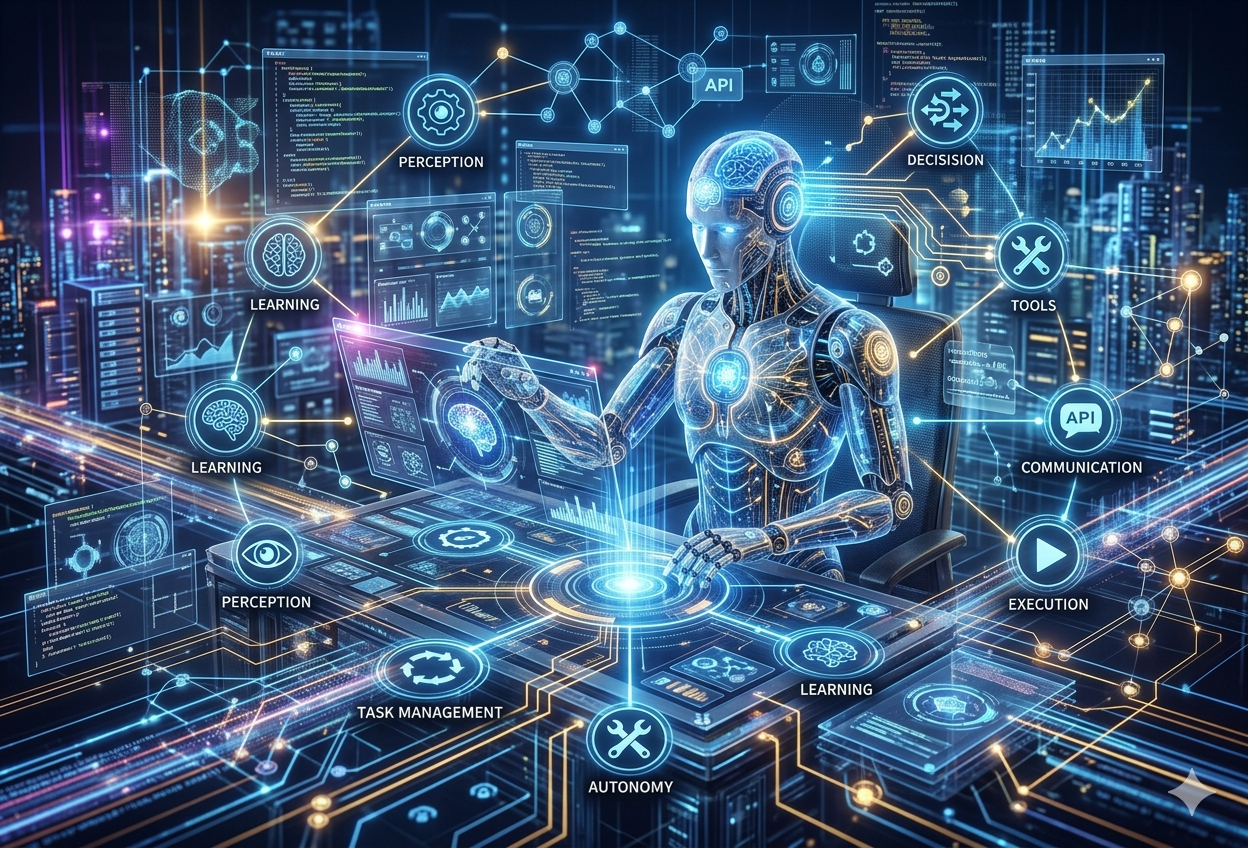
What Are AI Agents?
What Is an AI Agent?
An AI agent is an autonomous software program that perceives its environment, reasons about goals, and takes independent actions to achieve them — without requiring step-by-step human guidance.
An artificial intelligence agent is a system or program capable of autonomously performing tasks on behalf of a user or another system by designing its workflow and utilising available tools.
— IBM Think, 2024
At its most fundamental level, an AI agent differs from traditional software in one critical dimension: agency. Traditional software follows deterministic, hardcoded instructions. An AI agent observes the world, reasons about the best next action, executes that action, and evaluates the result — iteratively — until a goal is achieved. It transforms a passive oracle (like a plain language model) into an active participant that can alter the state of the world around it.
The term “agent” derives from the Latin agere — to act. In AI science, an agent is any entity that perceives its environment through sensors and acts upon that environment through actuators. In modern software systems, those sensors are APIs, databases, and data streams, and actuators are code execution, HTTP calls, file writes, and UI interactions.
Intelligence refers to a model’s capacity to understand context, solve problems, and generate language. Agency refers to the model’s authorisation and capability to take actions that change real-world state without human intervention. By granting an AI system read/write access to external environments, developers transform a passive model into an active agent.
AI Agents vs. AI Assistants vs. Bots
These three terms are often conflated but represent meaningfully different systems. Understanding the distinctions is essential for evaluating capabilities and deployment scenarios.
| Dimension | AI Agent | AI Assistant | Bot |
|---|---|---|---|
| Purpose | Autonomously and proactively perform complex tasks | Assist users with tasks on request | Automate simple, repetitive tasks or conversations |
| Autonomy | High — makes decisions independently to achieve goals | Medium — recommends actions; user decides | Low — follows pre-programmed rules |
| Complexity | Multi-step, long-horizon, cross-system workflows | Simple to moderate tasks | Simple, trigger-based interactions |
| Learning | Adapts and improves continuously from outcomes | May have limited learning | Typically static rules |
| Interaction | Proactive; goal-oriented; operates unattended | Reactive; responds to user prompts | Reactive; responds to commands/keywords |
| Example | Autonomous sales pipeline orchestrator | ChatGPT answering questions | FAQ chatbot on a website |
Evolution of AI Agents
The concept of AI agents has evolved over seven decades — from early rule-based symbolic systems to today’s LLM-powered autonomous agents capable of reasoning, planning, and executing complex real-world workflows.
Symbolic AI & Turing’s Vision
Alan Turing proposes the Turing Test (1950). Early symbolic AI systems like the Logic Theorist (1956) and General Problem Solver (1957) demonstrate goal-directed reasoning through hand-coded rules.
Expert Systems & STRIPS
The Stanford Research Institute Problem Solver (STRIPS, 1971) introduces formal action planning for agents. Expert systems like MYCIN encode domain expertise in rule bases.
Reactive Agents & BDI Model
Rodney Brooks’ subsumption architecture (1986) champions reactive, embodied agents over deliberative planners. The Belief-Desire-Intention (BDI) model formalises agent cognition.
Software Agents & MAS
The internet era spawns software agents for web search, e-commerce, and network management. Researchers formalise multi-agent systems (MAS) and agent communication languages (ACL, KQML).
Reinforcement Learning Agents
RL advances produce game-playing agents. IBM’s Deep Blue (chess) and later AlphaGo demonstrate superhuman performance. Autonomous vehicle research accelerates.
Transformer Era & LLM Emergence
The Transformer architecture (Attention Is All You Need, 2017) enables GPT, BERT, GPT-4, Claude, and Gemini. LLMs become the reasoning engine for agents.
AutoGPT, BabyAGI & the Agentic Explosion
AutoGPT and BabyAGI demonstrate LLMs autonomously breaking goals into tasks, using tools, and self-directing toward objectives — sparking widespread agentic AI research.
Enterprise Agentic AI
Salesforce Agentforce, AWS Bedrock Agents, Google Vertex AI Agents, and IBM watsonx Orchestrate bring production-grade agentic AI to enterprises.
Agent Protocols & Standardisation
Industry-standard protocols emerge: Model Context Protocol (MCP) by Anthropic, Agent2Agent (A2A) by Google, and Agent Communication Protocol (ACP) by IBM.
How AI Agents Work
AI agents operate through a continuous perception-cognition-action loop, iteratively gathering information, reasoning about goals, executing tasks, evaluating outcomes, and adapting until the objective is achieved.
Loop continues until goal is achieved or human override is triggered
Step-by-Step Breakdown
The agent receives a high-level instruction or goal from a user, system, or triggering event. Using its planning module, it decomposes this goal into a sequence of smaller, actionable sub-tasks. It does not simply execute a predefined script — it dynamically plans the order and method of task execution based on context.
The agent gathers information through digital sensors: API calls, database queries, web searches, file reads, prior conversation history, and inputs from connected systems. This perceptual data forms the agent’s understanding of “the current state of the world.” Unlike static applications, agents continuously update this world model as new information arrives.
The Large Language Model at the agent’s core processes the perceived data alongside stored memory and the defined goal. Using chain-of-thought reasoning, it evaluates possible courses of action, selects the most appropriate tool or next step, and formulates the action to take.
The agent executes its chosen action through its tool integration layer: browsing the web, writing and running code, sending emails, updating databases, calling third-party APIs, or communicating with other agents. Each action changes the state of the environment, which is then perceived anew.
After executing, the agent evaluates whether it has moved closer to its goal. It inspects output quality, seeks external feedback, and checks intermediate results. If the goal isn’t achieved, it generates new sub-tasks and continues. This self-evaluation loop is what enables agents to course-correct without human intervention.
What distinguishes an AI agent from a one-shot LLM query is the closed-loop system — the agent’s output feeds back into its input, enabling iterative refinement over multiple steps. A single LLM call produces a response; an agent loop produces a completed task.
Architecture of AI Agents
Modern AI agents are built on four fundamental architectural pillars: a foundation model (the reasoning engine), a memory system, a planning module, and a tool integration layer. Together these components enable autonomous, goal-directed behavior.
The reasoning engine at the agent’s core. Large language models like GPT, Claude, or Gemini interpret natural language instructions, generate plans, reason over context, and decide which tools to call. The LLM acts as the agent’s “brain” — processing prompts and transforming them into decisions, actions, and queries to other components.
Enables the agent to retain information across interactions, sessions, and tasks. Memory operates at multiple levels: short-term memory for the current context window; long-term memory via vector databases; episodic memory for specific past events; and consensus memory for shared knowledge in multi-agent systems.
Handles goal decomposition and task sequencing. The planning module breaks high-level goals into smaller steps and evaluates the best sequence to execute them. It may use symbolic reasoning, decision trees, or hierarchical task networks (HTNs). Often implemented as prompt-driven chain-of-thought reasoning.
Extends the agent’s capabilities beyond language by connecting it to external software, APIs, databases, and devices. Tool use enables agents to perform real-world tasks: web search, code execution, email sending, database queries, file manipulation, and hardware control. The bridge between reasoning and the real world.
Additional Architectural Elements
Each agent is given a clearly defined role, personality, communication style, and instructions describing what tools it has access to and how it should behave. A well-crafted persona ensures consistent behavior. For example, a customer service agent has a different persona configuration than an autonomous coding agent.
The action module translates decisions made by the planning and reasoning components into executable operations in the real world. It handles the mechanics of tool invocation, API calls, code execution, and physical actuation (in robotic agents). This module bridges internal cognition and external action.
At a high level: the Foundation Model reasons; Memory remembers; Planning organises; Tools act; and the Persona ensures consistent, role-appropriate behaviour. All five work in concert on every iteration of the agent’s operational loop.
Types of AI Agents
AI agents are classified along multiple dimensions: by decision-making sophistication, by the number of agents interacting, and by how they interface with users.
Classification by Decision-Making Sophistication
Widely Deployed
Acts solely on current perception using if-then rules. No memory, purely reactive. Fast and predictable.
Immediate stimulus-response. Handles fully observable, static environments. Cannot handle partially observable environments.
Traffic light controllers, thermostats, spam filters, keyword-triggered workflows, simple FAQ bots.
Common
Maintains an internal model of the world, tracking aspects not directly observable. Reactive with contextual awareness of state.
Handles partially observable environments. Tracks state over time. Decisions based on input and internal world model.
Robot vacuums that map rooms, self-driving vehicles that track hidden road segments, adaptive cruise control.
Mainstream
Plans actions with a specific objective in mind. Evaluates multiple action sequences and selects the path most likely to achieve the goal.
Search and planning capabilities. Evaluates future states. Considers multiple paths to a goal. More flexible than reflex agents.
Navigation systems finding optimal routes, customer service agents resolving tickets, coding assistants generating multi-step solutions.
Advanced
Extends goal-based thinking by assigning utility values to outcomes, selecting actions that maximise expected utility across competing objectives.
Handles trade-offs between competing goals. Selects the option offering highest overall benefit. Suitable for optimisation problems.
Flight search engines balancing price/time/comfort, logistics optimisation, algorithmic trading systems.
Rapidly Growing
Continually learns from past experiences to enhance performance. Uses sensory input and feedback to adapt its behaviour via machine learning.
Improves with experience. Adapts to changing environments. Uses reinforcement learning or supervised feedback. Gets better with each interaction.
Recommendation engines, fraud detection systems, game-playing AI, predictive maintenance agents, personalised healthcare assistants.
Enterprise Focus
Organised groups of agents in tiered structures. Higher-level agents decompose complex tasks and assign sub-tasks to lower-level specialist agents.
Handles very complex, multi-domain tasks. Parallelises work. Each agent reports to a supervising agent. Scales to enterprise complexity.
Enterprise software development pipelines, autonomous research systems, large-scale supply chain orchestration.
Classification by Interaction Mode
Google Cloud categorises agents by how they interact with users:
Engage directly with users in conversational interfaces. Includes customer service, education, healthcare, and Q&A agents. User-query triggered.
Operate behind the scenes without direct interaction. Process queued tasks, analyse data, automate routine processes. Event-driven and autonomous.
Operate independently to achieve specific goals using one foundation model and external tools. Best for well-defined tasks without collaboration.
Multiple AI agents collaborating or competing toward shared or individual goals. Each agent can use different models best suited to its role.
Classification by Role in a System
- Orchestrator Agents — Coordinate activities of other specialist agents; break down high-level goals and delegate sub-tasks.
- Specialist Agents — Expert agents with deep capability in a specific domain (e.g., a code-generation agent, a web-search agent).
- Subagents — Execute specific instructions from an orchestrator; report results back up the hierarchy.
- Proactive Agents — Anticipate future states and take initiative based on forecasts rather than waiting for explicit instructions.
- Rational Agents — Choose actions to maximise expected outcomes using both current and historical information under uncertainty.
Reasoning Paradigms
Beyond general operational loops, AI agents employ specific reasoning paradigms — architectural patterns for how thought and action are interleaved — that significantly affect their performance on complex problems.
ReAct (Reasoning + Acting)
Introduced in a landmark 2022 paper by Yao et al., the ReAct framework enables agents to interleave reasoning traces (chain-of-thought planning) with concrete actions (tool use, API calls). This synergy allows the agent to plan dynamically, observe tool outputs, and adjust its reasoning based on real-world feedback.
Thought: “The user wants today’s weather in Mumbai. I should search the web.” → Action: web_search(“Mumbai weather today”) → Observation: “32°C, humid, chance of rain” → Thought: “I have the answer.” → Final Answer: “It’s currently 32°C in Mumbai with a chance of rain.”
ReWOO (Reasoning Without Observation)
An optimisation over ReAct, ReWOO separates planning from execution. The agent generates a complete plan of all required tool calls without observing intermediate results, then executes them in a batch. This reduces token usage and latency for tasks where the plan structure is known in advance.
Chain-of-Thought (CoT) Reasoning
Chain-of-thought prompting encourages the LLM to produce intermediate reasoning steps before arriving at a final answer. In agents, CoT is the mechanism by which complex problems are decomposed into manageable sub-problems. CoT dramatically improves accuracy on multi-step mathematical, logical, and planning tasks.
Tree of Thoughts (ToT)
An extension of chain-of-thought, Tree of Thoughts allows the agent to explore multiple reasoning paths simultaneously, evaluating each branch before committing to the most promising one — analogous to a chess player considering several moves ahead. ToT significantly improves performance on tasks requiring exploration and backtracking.
Reflection & Self-Critique
Advanced agents incorporate explicit self-evaluation steps where the agent critiques its own previous outputs, identifies errors, and generates improved alternatives. This metacognitive capability is analogous to human revision and is key to producing high-quality, reliable outputs.
| Paradigm | Core Mechanism | Strengths | Best Use Cases |
|---|---|---|---|
| ReAct | Interleave thought and action in real time | Adaptive, handles dynamic environments | Web research, live data tasks, interactive problem-solving |
| ReWOO | Plan all steps first, then execute batch | Token-efficient, fast for structured tasks | Predictable workflows, pipeline automation |
| Chain-of-Thought | Explicit step-by-step reasoning | Improves accuracy, interpretable | Math, logic, multi-step analysis |
| Tree of Thoughts | Explore multiple reasoning branches | Best solution via exploration, backtracking | Creative tasks, complex planning, puzzles |
| Reflection | Self-critique and iterative improvement | Higher output quality, error correction | Code review, essay refinement, long-horizon planning |
Multi-Agent Systems
Multi-agent systems (MAS) are networks of AI agents that coordinate, collaborate, or compete to achieve goals beyond the capability of any single agent. They are the foundation of the most powerful agentic AI deployments today.
Multiple AI agents can automate complex workflows that would be intractable for a single agent. An orchestrator agent coordinates the activities of specialist agents, decomposes large tasks into sub-tasks, assigns them appropriately, and synthesises results. Individual agents can be specialised for specific sub-tasks, achieving higher accuracy and efficiency than a generalist agent attempting everything alone.
Architecture Patterns in Multi-Agent Systems
A manager/orchestrator agent decomposes tasks and delegates to specialist worker agents. Workers report results up the hierarchy. Used in enterprise process automation.
Agents communicate and negotiate directly with each other without a central coordinator. Each agent has its own goals. Useful for distributed simulations and market models.
Agents are arranged in a sequential pipeline where each processes the output of the previous one. Common in content generation, data transformation, and CI/CD.
Multiple agents independently produce solutions that are aggregated, debated, or voted on. Improves accuracy and reduces individual model errors through diverse perspectives.
Agent Communication Protocols
A key challenge in multi-agent systems is enabling agents built on different models and frameworks to communicate reliably. Several industry-standard protocols have emerged in 2024–26:
- Model Context Protocol (MCP) — Anthropic. Standard for connecting AI models to external tools, databases, and data sources in a permission-controlled way.
- Agent2Agent (A2A) Protocol — Google. Enables direct communication and task delegation between AI agents from different platforms and vendors.
- Agent Communication Protocol (ACP) — IBM’s BeeAI project. Focuses on agent interoperability across enterprise systems, enabling complex multi-agent workflows across boundaries.
- OpenAI Swarm / Agents SDK — Lightweight framework for building multi-agent orchestration with clear handoff patterns between agents.
Benefits of Multi-Agent Systems
Parallelisation
Multiple agents work simultaneously on different sub-tasks, dramatically reducing total time to completion for complex workflows.
Specialisation
Each agent can be optimised for a specific domain or task type using the most appropriate model, tools, and prompting strategy.
Scalability
Systems scale by adding more agents without redesigning the core architecture — enabling handling of arbitrarily complex workflows.
Verification
Multiple agents can independently check each other’s work, improving output quality and catching errors before final delivery.
Fault Tolerance
If one agent fails, the orchestrator can reassign the task to another agent, making the overall system more robust to individual failures.
Emergent Capability
Multi-agent collaboration can produce solutions beyond what any single agent could achieve alone — analogous to human teams.
Frameworks & Development Tools
A rich ecosystem of frameworks, libraries, and platforms has emerged to simplify building, deploying, and managing AI agents — from low-level orchestration libraries to enterprise-grade platforms with full lifecycle management.
Open-Source Frameworks
Enterprise Platforms
AWS Bedrock Agents
Amazon’s fully managed service for building AI agents on top of foundation models like Claude, Llama, and Titan. Supports knowledge bases, action groups, and multi-agent orchestration with enterprise-grade security and compliance.
Google Vertex AI Agents
Built on Gemini models, Vertex AI Agent Builder provides a no-code/low-code environment for creating agents with tool use, grounding, and integration with Google Workspace, Search, and Cloud services.
IBM watsonx Orchestrate
Enterprise AI agent platform enabling business automation through natural language. Supports multi-agent workflows, pre-built skills catalog, and integration with SAP, Salesforce, ServiceNow, and other enterprise systems.
Salesforce Agentforce
Purpose-built agentic AI platform integrated directly into Salesforce CRM. Enables creation of autonomous agents for sales, service, marketing, and commerce with an Agent Builder interface and Atlas reasoning engine.
Microsoft Azure AI Foundry
Microsoft’s unified platform for building agents using OpenAI models, Phi models, and custom foundations. Tight integration with Microsoft 365 Copilot enables agents across Office, Teams, and enterprise productivity tools.
UiPath Agentic Automation
Combines traditional robotic process automation (RPA) with AI agents, enabling hybrid workflows where agents handle reasoning-intensive tasks while RPA handles deterministic process automation.
| Framework | Best For | Key Feature | Maturity |
|---|---|---|---|
| LangChain | RAG + tool-use prototyping | Huge ecosystem of integrations | Production-ready |
| LangGraph | Stateful, cyclical agent workflows | Graph-based state machines | Production-ready |
| AutoGen | Multi-agent conversation systems | Conversational agent orchestration | Production-ready |
| crewAI | Role-based agent teams | Human-like agent roles & crews | Growing |
| BeeAI (IBM) | Enterprise multi-agent workflows | ACP protocol, open-source | Growing |
| AWS Bedrock Agents | Managed cloud deployment | Enterprise security & compliance | Production-ready |
Applications Across Industries
AI agents are transforming virtually every industry by automating complex workflows, enabling personalisation at scale, and augmenting human decision-making with real-time intelligence and proactive action.
Healthcare
Multi-agent systems coordinate patient care: diagnosis agents analyse symptoms, preventive care agents generate wellness plans, medication agents monitor adherence, and billing agents process insurance claims — orchestrated for holistic patient management. Agents also accelerate drug discovery.
Financial Services
Trading bots adapt strategies in real time during market volatility. Fraud detection agents monitor transaction streams and flag anomalies within milliseconds. Customer service agents handle account inquiries, loan applications, and financial planning.
E-Commerce & Retail
Product recommendation agents personalise suggestions based on browsing history. Inventory agents proactively reorder stock based on demand forecasts. Customer service agents handle returns end-to-end. Pricing agents dynamically adjust based on competition.
Manufacturing & Logistics
Predictive maintenance agents learn from equipment sensor data to forecast failures. Supply chain agents optimise delivery routes in real time accounting for weather, traffic, and capacity. Quality control agents identify defects automatically via computer vision.
Software Development
Coding agents (GitHub Copilot, Claude Code, Cursor) assist with code generation, test writing, code review, and debugging. Autonomous agents like ChatDev simulate entire development teams — architect, programmer, and tester agents collaborating from a single specification.
Education
Personalised tutoring agents adapt difficulty, teaching style, and content sequence to each student. Assessment agents generate customised exercises and provide detailed feedback. Administrative agents automate scheduling, enrollment, and compliance reporting.
Cybersecurity
Security agents continuously monitor network traffic for anomalies, correlating signals from threat databases to detect novel attacks. Incident response agents automatically contain breaches and initiate remediation. Vulnerability scanning agents prioritise patching by risk severity.
Marketing & Sales
Salesforce’s Agentforce agents autonomously qualify leads, send personalised outreach, schedule meetings, and update CRM records — compressing the sales cycle significantly. Marketing agents generate, A/B test, and optimise ad copy and email campaigns 24/7.
“AI agents transform the way companies operate and interact with their customers — automating complex tasks, providing personalised experiences, and freeing up human workers to tackle more demanding challenges.”
— Salesforce Agentforce, 2026
Benefits & Business Impact
AI agents deliver measurable value across organisational dimensions: productivity, cost, decision quality, customer experience, and competitive advantage.
Business teams are more productive when they delegate repetitive, time-consuming tasks to AI agents. Human workers focus on mission-critical, creative, high-judgment activities that add irreplaceable value.
Agents minimise costs from process inefficiencies, human errors, and manual labour. They tackle complex tasks with a consistent model that adapts to changing environments.
Advanced agents have predictive capabilities and process massive amounts of real-time data to surface insights. Managers receive timely, evidence-based recommendations.
AI agents provide personalised recommendations, prompt 24/7 responses, and efficient resolution of complex inquiries. Customers receive engaging, consistent experiences at every touchpoint.
Unlike human workers, AI agents operate 24/7 without fatigue or performance degradation. Global organisations can provide consistent service across all time zones.
Agents scale instantaneously to handle peak demand. A single deployment can handle thousands of simultaneous interactions without additional infrastructure.
Agents accelerate scientific and business research by autonomously searching literature, synthesising findings, generating hypotheses, and conducting experiments — compressing cycles from months to days.
Robotic AI agents can be deployed in environments dangerous for humans — disaster response, chemical plant inspection, bomb disposal, deep-sea exploration — eliminating human risk.
Challenges of AI Agents
Despite their transformative potential, AI agents introduce significant technical, operational, and ethical challenges that must be understood and proactively addressed.
| Challenge | Description | Risk Level | Mitigation Approaches |
|---|---|---|---|
| Hallucination | LLMs at the agent’s core can generate confident but factually incorrect outputs that propagate into tool calls and downstream actions. | High | Ground outputs in retrieved facts; verification steps; human review for high-stakes actions. |
| Unintended Actions | Agents with write access to real-world systems can take irreversible actions based on misunderstood instructions. | Critical | Principle of least privilege; sandboxing; human-in-the-loop approval gates. |
| Prompt Injection | Malicious content in the agent’s environment can hijack its reasoning, causing it to execute attacker-controlled instructions. | High | Input sanitisation; trust boundaries; output monitoring; adversarial testing. |
| Context Window Limits | Long-running agents may exceed LLM context limits, losing important early context and degrading performance. | Medium | Memory management; context summarisation; efficient retrieval augmentation. |
| Compounding Errors | Small errors in early reasoning steps can cascade into major failures across a multi-step workflow. | High | Checkpointing; validation between steps; conservative planning; rollback capabilities. |
| Latency & Cost | Multi-step agent workflows with many LLM calls and tool invocations can be expensive and slow. | Medium | Caching; model optimisation; batch planning (ReWOO); tiered model selection. |
| Observability | Complex multi-agent workflows are difficult to monitor, debug, and audit. | Medium | AgentOps tooling; trace logging; structured audit trails; LLM observability platforms. |
| Security & Privacy | Agents with broad tool access can inadvertently expose sensitive data or become attack vectors. | High | Permission scoping; data classification; GDPR-compliant memory policies; security audits. |
| Alignment & Control | As agents become more capable and autonomous, ensuring alignment with human values becomes critical. | Critical | RLHF; constitutional AI; human oversight; corrigibility by design. |
The very qualities that make AI agents valuable — autonomy, proactivity, and broad tool access — are also the source of their greatest risks. Every expansion of agent capability must be accompanied by a corresponding expansion of safety, oversight, and testing infrastructure.
The Future of AI Agents
AI agents are evolving faster than any other technology category. Convergence of better models, standardised protocols, deeper tool ecosystems, and enterprise adoption is accelerating the transition from proof-of-concept to production-grade agentic AI at scale.
Standardised communication protocols (MCP, A2A, ACP) will enable agent interoperability across vendors and organisational boundaries — creating a true “internet of agents.”
Agents that seamlessly process and act on text, images, video, audio, sensor data, and code simultaneously — approaching unified intelligence in any modality.
Integration of LLM reasoning with robotics enables agents that perceive and act in the physical world. Figure AI, Boston Dynamics, and Tesla are pioneering general-purpose physical agents.
Following AlphaFold’s revolution in protein structure prediction, specialised agents will drive breakthroughs in drug discovery, materials science, and climate modelling.
Organisations will deploy networks of hundreds of specialised agents working in coordination, automating entire business functions — procurement, HR, legal review, financial planning.
As agents become more capable, ensuring alignment with human values is the defining research frontier. Constitutional AI, RLHF, interpretability tools, and formal verification will become essential.
Small, efficient models running locally on devices will enable personal AI agents that protect privacy while operating without cloud dependence — always-on, context-aware, personalised.
National and international regulatory frameworks (EU AI Act, US Executive Orders, ISO AI standards) will shape how autonomous agents are deployed, audited, and held accountable.
The shift from AI assistants to AI agents is the most consequential architectural change in enterprise software since the invention of the internet. Agents don’t just answer questions — they take action in the world.
— BCG Artificial Intelligence Practice, 2025
The Road to Agentic General Intelligence
The long-term trajectory of AI agents points toward systems with increasing generality — capable of handling any task a human professional could perform, across any domain, with minimal task-specific configuration. While narrow AI agents already outperform humans in specific domains, the convergence of better reasoning, richer memory, broader tool access, and multi-agent collaboration is progressively closing the gap toward general-purpose autonomous systems. The question is no longer if this will happen, but how we govern, deploy, and benefit from it responsibly.
“An AI agent is not simply a smarter chatbot. It is a new category of software — one that doesn’t just respond, but acts.”
— Amazon Web Services, 2026
Architecture, types, evolution, and enterprise deployment of AI agents.
Principles, components, workflow, and types of AI agents with AWS context.
Key features, comparison with assistants and bots, types by interaction mode.
Comprehensive academic coverage of all major agent types with diagrams.
Business-focused overview with ReAct/ReWOO paradigms and enterprise use cases.
Technical architecture, mathematical foundations, and Python implementation.
Developer-focused perspective on agentic coding and software development agents.
Training and certification perspective on AI agent skills and deployment.
Detailed breakdown of all agent classifications with worked examples.
Practical overview of how agents work with types and real-world applications.
Original research paper introducing the ReAct reasoning and acting paradigm for LLM agents.