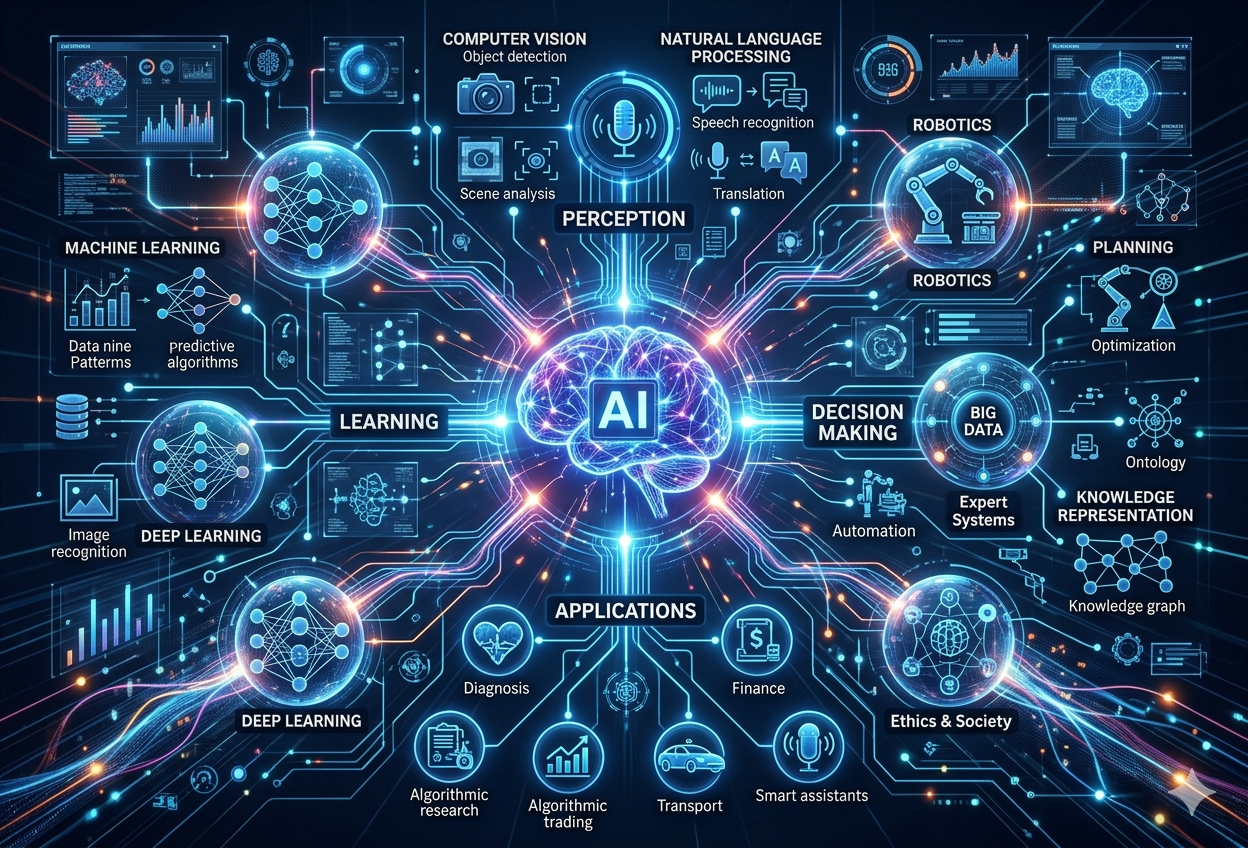
What is Artificial Intelligence?
Definition of Artificial Intelligence
Artificial Intelligence (AI) is technology that enables computers and machines to simulate human learning, comprehension, problem-solving, decision-making, creativity, and autonomy — performing tasks that traditionally required human intelligence.
AI is a machine’s ability to perform the cognitive functions we associate with human minds — such as perceiving, reasoning, learning, interacting with the environment, problem-solving, and even exercising creativity.
— McKinsey & Company
More formally, AI is the capability of computational systems to perform tasks typically associated with human intelligence, such as learning, reasoning, problem-solving, perception, and decision-making. It is a field of research in engineering, mathematics, and computer science that develops methods and software enabling machines to perceive their environment and take actions that maximise their chances of achieving defined goals.
AI is not a single technology. It is a broad, interdisciplinary field encompassing computer science, data analytics and statistics, hardware and software engineering, linguistics, neuroscience, philosophy, and psychology. Applications equipped with AI can see and identify objects, understand and respond to human language, learn from new information and experience, make detailed recommendations, and act independently.
AI vs. Human Intelligence: Key Distinction
AI systems do not possess consciousness, self-awareness, or genuine feelings. They are complex pattern-matching machines. AI is only as good as the data it’s trained on — if the data reflects human biases, the AI will learn and perpetuate them.
- Learning — Acquiring data and creating rules (algorithms) to transform it into actionable information
- Reasoning — Choosing the right algorithm to reach a desired outcome
- Self-Correction — Algorithms continuously learning and tuning themselves for accuracy
- Creativity — Using neural networks and statistical methods to generate new images, text, music, ideas
- Perception — Processing and interpreting sensory input like images, speech, and text
- Problem-Solving — Finding optimal solutions within defined constraints
AI
Generative AI ⊂ Deep Learning ⊂ Machine Learning ⊂ Artificial Intelligence
History & Timeline of AI
The groundwork for AI began in the early 1900s — not as a modern phenomenon, but as the culmination of decades of pioneering thought across mathematics, logic, neuroscience, and engineering.
First Neural Network Model
Warren McCulloch and Walter Pitts published a model of artificial neurons, laying the foundational architecture for what would become neural networks.
The Turing Test
Alan Turing published “Computing Machinery and Intelligence,” introducing the Turing Test to assess whether a machine could exhibit intelligent behavior indistinguishable from a human.
SNARC — First Neural Net Machine
Marvin Minsky and Dean Edmonds built the first neural net machine, SNARC (Stochastic Neural Analog Reinforcement Calculator).
Birth of AI as a Discipline
John McCarthy coined the term “artificial intelligence” at the Dartmouth Workshop — marking AI’s founding as a formal academic discipline. Symbolic AI (GOFAI) became the dominant paradigm.
ELIZA — First Chatbot
Joseph Weizenbaum created ELIZA at MIT, one of the first chatbots — simulating a Rogerian psychotherapist through pattern matching.
First AI Winter Approaches
Minsky and Papert mathematically demonstrated limitations of single-layer neural networks, causing reduced funding — contributing to the first “AI winter.”
Expert Systems & Revival
Expert systems like MYCIN gained prominence by simulating expert decision-making. Geoffrey Hinton and David Rumelhart revived neural networks with backpropagation.
Second AI Winter
Socio-economic factors including the dot-com boom led to a second AI winter, with fragmented research and limited commercial uptake.
Deep Blue Defeats Kasparov
IBM’s Deep Blue defeated world chess champion Garry Kasparov — a historic milestone demonstrating narrow AI’s power in domain-specific reasoning.
Deep Learning Revolution
Geoffrey Hinton’s AlexNet won ImageNet by a massive margin, sparking the modern deep learning era. GPUs began accelerating neural network training at scale.
Transformer Architecture
Google published “Attention Is All You Need,” introducing the Transformer — the foundation of virtually all modern LLMs including GPT, BERT, and Gemini.
ChatGPT & the Generative AI Boom
OpenAI released ChatGPT, triggering a global surge in AI interest. Generative AI became available to the public for text, image, code, and audio.
Agentic AI Era
AI agents capable of multi-step reasoning, autonomous tool use, and orchestrating complex workflows became commercially available. Multimodal models process text, image, video, and audio simultaneously.
How AI Works
All AI systems fundamentally rely on three pillars: data, algorithms, and computational power. AI learns and improves through exposure to vast amounts of data, identifying patterns humans might miss.
AI systems work by ingesting large amounts of labeled training data, analyzing it for correlations and patterns, and using these patterns to make predictions. A chatbot fed thousands of examples can learn to generate lifelike exchanges; an image recognition tool can learn to identify objects by reviewing millions of examples.
The Three-Phase AI Pipeline
Massive amounts of labeled or unlabeled data are fed into a model. The algorithm learns patterns and relationships, encoding them as numerical parameters.
The foundation model is adapted for specific tasks through additional supervised training or reinforcement learning with human feedback (RLHF).
The trained model is deployed in applications. It processes new inputs in real-time and generates outputs based on learned patterns.
Neural Networks: The Brain of AI
Neural networks are modeled after the human brain’s structure. They consist of interconnected layers of nodes (analogous to neurons) that work together to process and analyze complex data.
- Input Layer — Receives raw data: pixels, text tokens, audio samples
- Hidden Layers (3 to hundreds) — Extract increasingly abstract features. Early layers detect edges/shapes; later layers detect complex concepts.
- Output Layer — Produces the final prediction: a class label, a probability, a generated token
- Weights & Backpropagation — During training, errors propagate backwards and weights are adjusted via gradient descent
- Activation Functions — Non-linear functions (ReLU, Softmax) allow networks to learn complex patterns
Key Algorithmic Approaches
| Approach | Mechanism | Common Use Cases |
|---|---|---|
| Linear Regression | Fits a line to continuous data | Price prediction, sales forecasting |
| Decision Trees / Random Forest | Hierarchical if-then rules over features | Classification, fraud detection |
| Support Vector Machines (SVM) | Finds optimal hyperplane between classes | Image classification, bioinformatics |
| K-Nearest Neighbour (KNN) | Classifies based on proximity to known examples | Recommendation systems, anomaly detection |
| Convolutional Neural Networks (CNN) | Hierarchical feature extraction from grid data | Image recognition, video analysis |
| Recurrent Neural Networks (RNN/LSTM) | Sequential processing with memory | Time series, speech recognition |
| Transformers | Self-attention over sequences of tokens | LLMs, translation, code generation |
| Reinforcement Learning | Agent learns by reward/penalty signals | Game playing, robotics, autonomous systems |
Types of AI by Capability
AI can be classified by the breadth and depth of its intelligence — ranging from today’s narrow specialist systems to theoretical superintelligent entities that do not yet exist.
Designed to perform a single, specific task. Combines data with algorithms to make predictions within predefined parameters. Despite the name, does not possess reasoning or self-awareness. Examples: voice assistants, facial recognition, GPT-4, Gemini.
The only form of AI that currently exists. Powers all commercial AI products.
Would be capable of performing a broad range of tasks using human-like reasoning to learn, adapt, and improve. Unlike ANI, AGI is expected to be adaptive, autonomous, and capable of learning across any domain.
Does not yet exist. Most researchers believe we are decades away. Rodney Brooks of MIT predicts AGI won’t arrive until 2300.
The most advanced theoretical form of AI. Would be a self-aware entity operating beyond human control, significantly surpassing human intelligence in reasoning, creativity, and emotional intelligence.
Some AI researchers warn of non-negligible existential risk if ASI were to emerge without proper safety measures.
The timing of AGI’s emergence is deeply uncertain. Some researchers (notably at OpenAI and DeepMind) believe AGI may arrive within decades. Others like MIT’s Rodney Brooks don’t expect it until 2300. When it does emerge, it’s expected to represent the most transformative technological event in human history.
Types of AI by Functionality
This classification categorises AI based on how it operates and interacts in specific contexts — from purely reactive systems to theoretically empathetic machines.
Limited AI that only reacts to stimuli based on preprogrammed rules. No memory. Cannot learn from new data. Classic example: IBM’s Deep Blue.
Uses memory to improve over time by training on new data through neural networks. Most modern AI — self-driving cars, chatbots — falls here.
AI that could emulate the human mind, recognising emotions and reacting in social situations as a human would. Currently under research.
Hypothetical AI with its own consciousness, emotions, and self-awareness. The highest theoretical form — far beyond current capabilities.
Subfields of Artificial Intelligence
AI is composed of several specialised subfields, each focused on solving unique problems and advancing specific aspects of intelligent behaviour.
Machine Learning (ML)
Machine learning is a form of AI where systems learn from data to identify patterns and make predictions without direct programming. ML algorithms use statistical techniques to get progressively better at tasks by using historical data as input.
| Learning Type | Data Required | How It Learns | Examples |
|---|---|---|---|
| Supervised Learning | Labeled datasets | Learns input→output mappings from labeled examples | Spam detection, image classification |
| Unsupervised Learning | Unlabeled data | Discovers hidden patterns and structures | Customer segmentation, anomaly detection |
| Semi-Supervised Learning | Mix of labeled & unlabeled | Combines supervised and unsupervised techniques | Medical image analysis |
| Reinforcement Learning | Environment interaction | Trial-and-error with reward/penalty signals | Game playing (AlphaGo), robotics |
| Self-Supervised Learning | Unstructured data | Generates implicit labels from data structure itself | GPT pretraining, BERT |
| Transfer Learning | Pre-trained model + new data | Applies knowledge from one task to another | Fine-tuning LLMs, domain adaptation |
Deep Learning (DL)
Deep learning is a subset of ML that uses multilayered neural networks — called deep neural networks — that more closely simulate the human brain. Unlike classical ML (usually 1–2 hidden layers), deep learning models have 3 to hundreds of hidden layers.
Deep learning enables unsupervised feature extraction from large, unlabeled datasets. It powers most AI applications today: natural language processing, computer vision, speech recognition, and recommendation systems.
Natural Language Processing (NLP)
NLP enables computers to understand, interpret, and generate human language — both written and spoken. It powers voice assistants (Siri, Alexa, Google Assistant), machine translation, sentiment analysis, chatbots, and text summarisation.
- Tokenisation — Breaking text into words or subwords for processing
- Named Entity Recognition (NER) — Identifying people, places, organisations in text
- Sentiment Analysis — Determining emotional tone of text
- Machine Translation — Converting text between languages
- Question Answering — Extracting answers from documents
- Text Generation — Producing coherent, contextual text (LLMs)
Computer Vision
Computer vision allows computers to interpret and understand visual information — images, videos, and real-time camera feeds. It powers facial recognition, medical imaging, autonomous vehicles, quality control in manufacturing, and augmented reality.
Robotics & Embodied AI
The intersection of AI with physical machines enables robots to perceive, navigate, and manipulate the real world. Advances include SLAM (simultaneous localisation and mapping) for self-driving vehicles, robotic surgery, and warehouse automation.
Expert Systems & Knowledge Representation
Among the earliest AI applications, expert systems simulate human expert decision-making in specialised domains. They encode domain knowledge as rules and use logical inference — still widely used in medical diagnosis, legal reasoning, and financial analysis.
Generative AI
Generative AI refers to deep learning models that can create complex original content — long-form text, high-quality images, realistic video or audio — in response to a user’s prompt. It represents the most significant AI breakthrough of the 2020s.
At a high level, generative models encode a simplified representation of their training data, then draw from that representation to create new work that’s similar, but not identical, to the original data. The most common today are Large Language Models (LLMs) for text, but there are also models for image, video, sound, and multimodal generation.
Three Key Architectures Enabling Gen AI
Encode and compress data into a latent space, then decode it to generate multiple variations in response to a prompt.
Add noise to images until unrecognisable, then learn to remove it to generate original images. Powers DALL-E, Stable Diffusion, Midjourney.
Trained on sequenced data to generate extended sequences — words, shapes, code. Core of ChatGPT, GPT-4, Copilot, Gemini, Claude.
How Generative AI Training Works
- Foundation Model Training — A deep learning algorithm trained on terabytes of raw unstructured data. Requires thousands of GPUs and weeks of processing — costing millions of dollars.
- Fine-Tuning / Instruction Tuning — The foundation model is further trained on task-specific datasets to make it more useful and aligned with human preferences.
- RLHF (Reinforcement Learning from Human Feedback) — Human raters score outputs; a reward model is trained; the LLM is optimised to maximise reward.
- Evaluation & Iteration — Models are evaluated on benchmarks and real-world tasks; the cycle continues to improve accuracy and reduce harmful outputs.
“Generative AI tools like ChatGPT and DALL-E have the potential to change how a range of jobs are performed.”
— McKinsey & Company
Notable Generative AI Models (2022–2026)
| Model | Creator | Modality | Notable Capability |
|---|---|---|---|
| ChatGPT / GPT-4o | OpenAI | Text, Image, Audio | Conversational AI, coding, reasoning |
| Gemini | Google DeepMind | Multimodal | Integrated with Google services |
| Claude | Anthropic | Text, Document | Long context, safety-focused |
| Llama | Meta AI | Text | Open-source foundation model |
| DALL-E 3 | OpenAI | Image | Text-to-image generation |
| Midjourney | Midjourney Inc. | Image | Artistic image generation |
| Sora | OpenAI | Video | Text-to-video synthesis |
| Copilot | Microsoft | Code, Text | Developer productivity |
Applications of AI Across Industries
AI is transforming virtually every sector of the global economy. From healthcare diagnostics to financial fraud detection, AI applications deliver measurable value by automating tasks, augmenting human capabilities, and uncovering insights invisible to human analysts.
Healthcare & Life Sciences
Medical imaging analysis, drug discovery acceleration, clinical trial optimisation, personalised treatment, remote patient monitoring, AI-assisted surgery. AI can analyse medical images with accuracy matching specialist radiologists.
Finance & Banking
Real-time fraud detection, algorithmic trading, credit risk assessment, RegTech automation, personalised financial planning, customer service chatbots. AI processes millions of transactions per second to flag anomalies.
Manufacturing
Predictive maintenance, defect detection via computer vision, supply chain optimisation, robotic assembly line automation, energy optimisation, demand forecasting.
Retail & E-Commerce
Personalised recommendations (Amazon, Netflix), dynamic pricing, inventory management, visual search, chatbot customer service. Recommendation engines drive 35%+ of Amazon’s revenue.
Transportation & Automotive
Self-driving vehicles (Waymo, Tesla), route optimisation (Google Maps), traffic prediction, predictive maintenance, AI-powered logistics. Autonomous vehicles combine computer vision, LiDAR, and deep learning.
Education
Adaptive learning platforms, automated essay grading, intelligent tutoring, personalised study recommendations, accessibility tools (text-to-speech, captioning), early identification of at-risk students.
Climate & Energy
Climate modelling, smart grid optimisation, precision agriculture to optimise yields, carbon capture efficiency, renewable energy output forecasting.
Cybersecurity
Real-time threat detection, behavioural anomaly detection, phishing identification, vulnerability scanning, malware classification. AI-powered SOCs can reduce mean-time-to-detect by 60%+.
Everyday AI You Already Use
- Navigation Apps — Google Maps and Waze use AI to predict traffic and optimise routes in real time
- Email Spam Filters — ML classifies and filters billions of spam emails daily
- Streaming Recommendations — Netflix, Spotify, and YouTube use deep learning to recommend content
- Voice Assistants — Siri, Alexa, Google Assistant combine NLP, speech recognition, and knowledge retrieval
- Face Unlock — Smartphones use deep convolutional networks to recognise faces in milliseconds
- Autocomplete & Grammar — Google Search autocomplete and Grammarly use LLM-based text prediction
- Online Banking Security — Your bank uses AI to flag suspicious transactions in real time
- Social Media Feeds — Ranking algorithms use reinforcement learning to maximise engagement
Benefits of Artificial Intelligence
AI delivers transformative value across dimensions of speed, accuracy, scale, and discovery — augmenting human capabilities in ways that were previously impossible.
AI can automate repetitive, rule-based workflows — freeing humans for creative, strategic, and empathetic work. From invoice processing to support ticket routing.
AI reduces human error in high-stakes domains like medical diagnosis, financial analysis, and quality control — operating at accuracy levels that exceed human specialists for specific tasks.
AI can process and synthesise vast datasets — far beyond human cognitive capacity — to reveal hidden patterns, forecast trends, and support better decision-making.
AI services can scale instantaneously. A single model can serve millions of users simultaneously — from customer service bots to translation APIs.
AI accelerates scientific discovery — from protein structure prediction (AlphaFold) to climate modelling — compressing decades of research into months.
AI enables hyper-personalised experiences at scale — from education and healthcare to marketing and entertainment.
AI and robotics can replace humans in hazardous environments — disaster response, bomb disposal, and toxic clean-up operations.
Real-time captioning, screen readers, language translation, and image descriptions remove barriers for people with disabilities.
“AI is the new electricity.”
— Andrew Ng, Co-founder of Google Brain
Challenges & Risks of AI
Despite its transformative potential, AI introduces significant technical, social, and ethical challenges that must be understood and addressed.
| Challenge | Description | Impact |
|---|---|---|
| Data Bias | AI inherits biases from training data. Biased data produces biased models. | Loan approvals, hiring, predictive policing |
| Hallucination | LLMs can generate confident but factually incorrect information. | Risks in legal, medical, journalistic contexts |
| Black Box Problem | Deep learning decisions are often unexplainable. | Regulatory compliance and accountability |
| Compute Cost | Training frontier models requires millions of dollars and massive GPU clusters. | Power concentrated in few large companies |
| Adversarial Attacks | Small imperceptible input changes can fool AI systems. | Security risks in vehicles, facial recognition |
| Privacy Risks | Models can inadvertently memorise and reveal sensitive training data. | GDPR compliance, surveillance concerns |
| Job Displacement | Automation of repetitive tasks may eliminate certain job categories. | Labour market transition challenges |
| Deepfakes & Misinformation | Generative AI enables synthetic media threatening trust in information. | Electoral integrity, public trust |
AI Ethics & Responsible AI
As AI becomes deeply embedded in society, ethical considerations become urgent practical requirements covering fairness, accountability, transparency, privacy, and safety.
Fairness
AI systems must not perpetuate discriminatory biases based on race, gender, age, or other characteristics.
Transparency
Decisions made by AI in high-stakes contexts should be explainable and contestable by affected individuals.
Privacy
AI should respect individuals’ data rights and operate within legal frameworks like GDPR and CCPA.
Accountability
Clear responsibility must exist for AI decisions, with mechanisms for redress when harm occurs.
Human Oversight
Humans must be able to override, correct, or shut down AI systems when necessary.
Beneficence
AI should be designed to benefit humanity broadly — not only maximise profit or raw capability.
The Future of Artificial Intelligence
AI is evolving faster than at any point in its 70-year history. The convergence of better hardware, larger datasets, and algorithmic breakthroughs is accelerating progress across every frontier.
AI agents that plan, reason, and execute multi-step tasks autonomously — browsing, coding, and coordinating with other agents.
Models processing text, image, video, audio, and code simultaneously — approaching unified intelligence.
Quantum computing promises to dramatically accelerate AI training for optimisation and simulation tasks.
AlphaFold revolutionised biology. Similar breakthroughs are expected in materials science, climate modelling, and drug discovery.
Running models locally on devices — enabling real-time inference without internet connectivity while preserving privacy.
Ensuring increasingly capable AI remains aligned with human values is now one of the most critical research frontiers.
The value of AI is not in the systems themselves — it is in how we use them to assist humans in a way that builds trust and confidence.
— McKinsey & Company