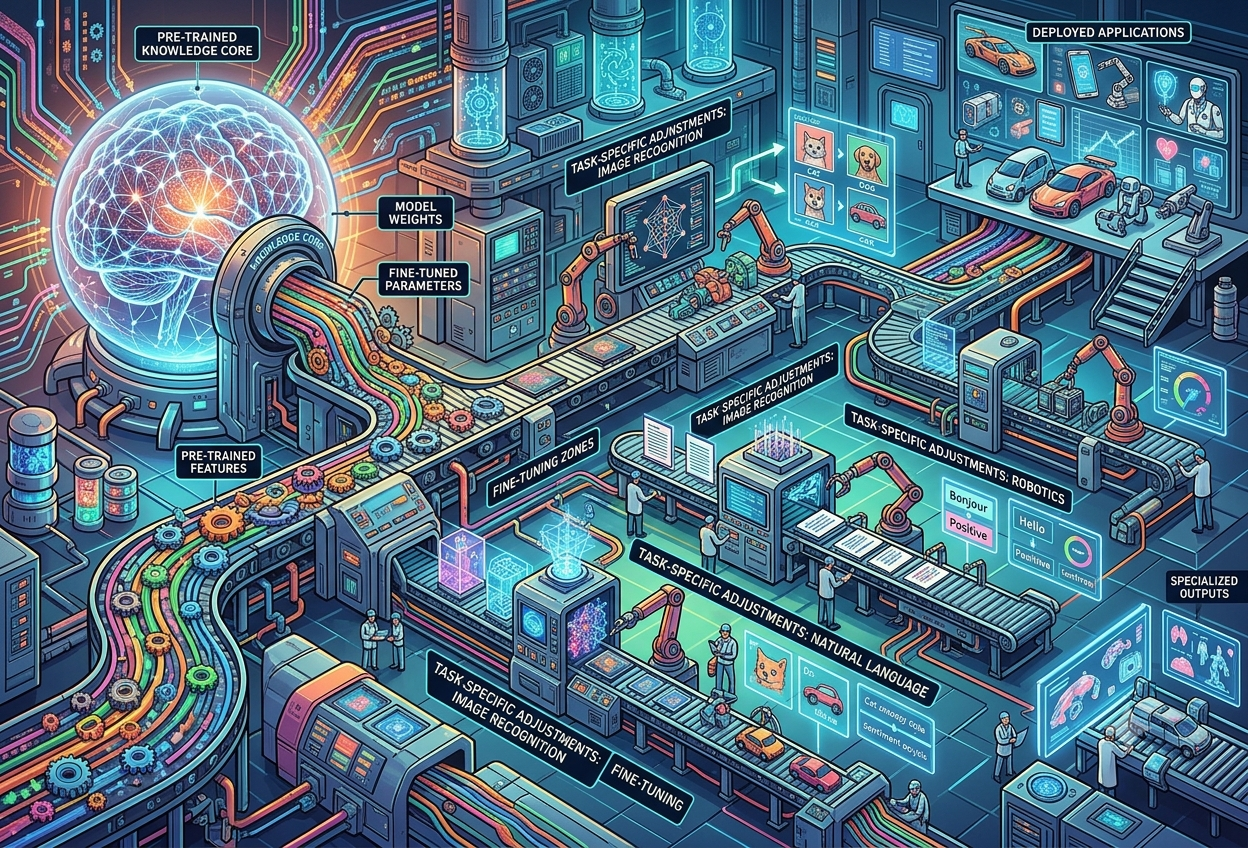
Transfer Learning & Fine-Tuning
What Is Transfer Learning?
Imagine someone who already knows how to ride a bicycle. The very first time they try a motor scooter, they are not starting from zero — they already understand balance, steering, and braking. They only need to learn the new, scooter-specific bits, like the throttle. Transfer learning is that same shortcut, applied to a neural network.
Transfer learning is a machine learning technique where the knowledge a model already gained while solving one task is reused to help it perform better on a second, related task. Instead of building and training a brand-new model from a completely blank state every single time, engineers take a model that has already been trained on a large, general dataset, and repurpose what it has learned for a new, narrower problem.
A model is never really starting from nothing. Transfer learning is the practice of letting it start from “already knows quite a lot” instead.— The Core Idea in One Sentence
Imagine you have already learned to recognise dogs in photos — you know about fur, ears, tails, and four legs. Now someone asks you to recognise wolves instead. You don’t need to learn what an animal is, what a tail is, or what fur looks like all over again — you already know all of that! You just need to learn the small differences that make a wolf different from a dog. Transfer learning lets a computer do exactly this: keep all the general knowledge it already has, and only learn the new, specific part.
The Old Way vs The Transfer Learning Way
Traditional machine learning builds one model per task, completely from scratch, every time. It assumes the training data and the real-world data the model will eventually see come from the exact same kind of distribution, so if you want to tackle even a slightly different problem, the old approach says: collect a fresh, large labelled dataset, and train a brand-new model on it, learning everything from zero. Transfer learning challenges that assumption directly — it takes an already-trained model as its starting point, and adapts the knowledge gained on an initial source task towards a new, related target task.
The model trained on the source task — say, recognising a thousand different everyday objects in photographs — has already learned a great deal of genuinely reusable knowledge along the way: how to detect edges, textures, shapes, and colours. That underlying visual vocabulary turns out to be useful for almost any other image-related task, which is exactly what transfer learning exploits.
Why Transfer Learning Works So Well
Transfer learning isn’t just a convenient shortcut — it solves three of the most painful problems in deep learning at once: not enough data, not enough computing power, and the constant risk of a model that doesn’t generalise.
Three Real Advantages
Reusing a pretrained model’s learned weights as a starting point sharply cuts down the amount of training time, processing power, and number of training passes (epochs) needed to reach a useful result.
Collecting and labelling a massive dataset is slow and expensive. Because the pretrained model already understands general patterns, the new task often only needs a comparatively small, specific dataset.
A model that has effectively learned from multiple datasets along its journey tends to generalise more broadly than one trained narrowly on a single dataset, which also helps guard against overfitting.
When Transfer Learning Can Backfire: Negative Transfer
Transfer learning is not magic, and it can occasionally make things worse rather than better — a phenomenon researchers call negative transfer. This tends to happen when the source and target tasks are too dissimilar, or when the data each was built from comes from very different distributions. Three conditions roughly predict whether transfer learning will help:
- Task similarity: The original task the model learned and the new task you want it to perform should be meaningfully related.
- Distribution similarity: The statistical patterns in the source and target datasets shouldn’t be wildly different from one another.
- Architectural fit: The same general model design needs to be reasonably applicable to both the original and the new task.
There is currently no single, agreed-upon scientific measurement for exactly how “similar” two tasks need to be before transfer learning is guaranteed to help. Researchers have proposed various tests and similarity scores, but choosing whether transfer learning is appropriate for a given pair of tasks still involves a fair amount of informed judgement and experimentation.
The Three Types of Transfer Learning
Not all transfer learning looks the same. Researchers generally split it into three settings, depending on how the source and target tasks and datasets relate to one another.
The source task and the target task are different, regardless of whether the underlying datasets (domains) are similar or not. A common example: a model pretrained to recognise general objects in images is then further trained specifically for object detection. Training a model on two related tasks at once, known as multitask learning, is a close cousin of this approach.
The task stays exactly the same, but the dataset or domain changes. The source data is typically labelled while the target data is unlabeled. A classic form of this is domain adaptation — for instance, taking a text classifier trained and tested on restaurant reviews and applying the same underlying skill to classify movie reviews instead.
Similar in spirit to inductive transfer, since the source and target tasks differ — but here, there is no manually labelled data at all on either side. A common real-world use is fraud detection, where a model learns the normal, common patterns in a large pile of unlabelled transactions, then uses that learned sense of “normal” to flag unusual, possibly fraudulent activity.
| Type | Task | Domain / Data | Labels |
|---|---|---|---|
| Inductive Transfer | Different | Same or different | Typically labelled |
| Transductive Transfer | Same | Different | Source labelled, target unlabelled |
| Unsupervised Transfer | Different | Same or different | Unlabelled throughout |
The dividing line between these three types comes down to two simple questions: is the task the same or different, and is there labelled data to learn from? Once you can answer those two questions about your own problem, you’ve effectively already classified which flavour of transfer learning you’re using.
What Is Fine-Tuning?
If transfer learning is the broad strategy of “reuse what’s already learned,” fine-tuning is one specific, hands-on technique for actually carrying that strategy out — by continuing to train some or all of a pretrained model’s own layers on the new, smaller dataset.
Fine-tuning means taking a pretrained model and further training it — adjusting its existing internal weights, not just bolting on a new final layer — using a smaller, task-specific dataset, so the model becomes more precisely suited to that particular job. Where plain transfer learning often keeps the pretrained layers frozen and only trains a new classifier on top, fine-tuning goes a step further and lets some or all of those original layers themselves keep learning and adjusting.
Think of a chef who has spent years mastering Italian cooking. That chef already understands heat, timing, seasoning, and technique extremely well. Now imagine asking them to specialise in Japanese cuisine. They don’t relearn how to use a knife or how heat works — but they do adjust and polish many of their existing techniques to suit the new style. That careful adjusting of already-skilled hands is exactly what fine-tuning does to a model’s “skills,” its internal weights.
Pretraining and Fine-Tuning Are a Pair
In modern deep learning, especially with large language models, you’ll constantly see the words pretraining and fine-tuning mentioned side by side, because they describe two back-to-back stages of the very same model’s life. Pretraining is the expensive, time-consuming first stage, where a model learns broad, general patterns from an enormous, often unlabelled dataset — for example, predicting missing words across huge amounts of internet text. Fine-tuning is the cheaper, faster second stage, where that same already-knowledgeable model is adjusted on a smaller, focused, often labelled dataset to make it genuinely good at one particular job, such as answering customer support questions or summarising legal documents.
Strictly speaking, transfer learning describes adapting a model to a new, related problem, while fine-tuning more often refers to further training a model for the very same kind of problem it was already built for — just with a narrower, more specific slice of data. For example, a general-purpose object detection model trained on a massive, varied image set can be fine-tuned specifically for detecting cars. That’s still “the same task” — object detection — just specialised. This is precisely why the two terms get used together so often, yet aren’t perfectly interchangeable.
Feature Extraction vs Fine-Tuning, Step by Step
In practice, there are two common ways to customise a pretrained model, and the difference between them comes down to one simple question: how many of the original layers are allowed to keep learning?
Step 1 — Feature Extraction (Freeze Everything Below the Head)
The pretrained base model’s existing layers are frozen, meaning their weights are locked and will not update during training. A brand-new classifier — often just one or two simple layers — is attached on top, and only that new piece is trained from scratch on the new, smaller dataset. The reasoning is straightforward: the early and middle layers of a network trained on a large, varied dataset already contain genuinely general-purpose features (edges, shapes, textures, common word patterns), and that knowledge does not need to be touched.
Step 2 — Fine-Tuning (Unfreeze the Top Layers)
Once the new classifier head has been trained for a while, an engineer can choose to unfreeze some of the upper layers of the original pretrained base — the layers nearest the output, which tend to hold more task-specific, specialised features — and continue training them together with the new head, usually at a much smaller learning rate than was used originally. This lets the higher-level feature representations bend slightly to better fit the specific new task, while the lower layers, which hold very general, broadly useful features, are often still left frozen.
Many pretrained models contain Batch Normalisation layers, which track a running average of the data’s statistics during training. When fine-tuning, it’s important to keep these layers running in their original “inference” mode rather than letting them recompute fresh statistics from the new, smaller dataset — otherwise, the carefully learned statistics from the original, much larger pretraining dataset can be overwritten and effectively destroyed, undoing some of the benefit of using a pretrained model in the first place.
Why the Learning Rate Drops So Much During Fine-Tuning
A pretrained model’s weights already encode a great deal of valuable, hard-won knowledge. Using an aggressive, large learning rate during fine-tuning risks making large, clumsy updates that wipe out that knowledge in just a few training steps — a problem closely related to what researchers call catastrophic forgetting. Using a noticeably smaller learning rate during fine-tuning than was used during the original pretraining allows the model to nudge its weights gently into place for the new task, rather than overwriting everything it already knows.
Transfer Learning vs Fine-Tuning: The Real Differences
With both concepts now defined, it’s worth laying their differences out side by side, since this comparison is one of the most frequently asked questions by anyone starting out in deep learning.
| Aspect | Transfer Learning (Feature Extraction) | Fine-Tuning |
|---|---|---|
| Training scope | Only a new final layer (or layers) is trained; the rest stays frozen | Some or all of the pretrained model’s own layers are retrained too |
| Data requirements | Works well even with a fairly small new dataset | Generally benefits from a larger dataset to avoid overfitting |
| Computational cost | Lower — far fewer parameters are being updated | Higher — more of the network is actively learning |
| Adaptability to the new task | Limited, since most learned features stay exactly as they were | Greater, since both feature extraction and decision-making layers adjust |
| Risk of overfitting | Lower, especially on small datasets | Higher, especially with small data and many trainable parameters |
| Best suited for | New task closely resembles the original one; limited time or compute | New task differs more substantially; enough data and compute available |
A Simple Decision Guide
✓ Reach for Transfer Learning When…
- The new dataset is small
- The new task closely resembles the original one
- You need a fast solution with limited compute
- You mainly want to avoid overfitting on scarce data
✗ Reach for Fine-Tuning When…
- The dataset is large enough to retrain several layers safely
- The new task differs meaningfully from the original one
- You have sufficient time, data, and compute budget
- You need the model to adapt more deeply, not just superficially
It helps to think of fine-tuning as one specific tool inside the broader transfer learning toolbox, rather than as a totally separate, competing idea. Many real projects actually use both in sequence: start with feature extraction to quickly get a working baseline, then move to fine-tuning the upper layers once you’ve confirmed the approach is promising and you have a bit more data and time to invest.
Pretrained Models: Where All of This Starts
None of this works without a good pretrained model to begin with. A pretrained model is simply a network whose weights have already been carefully trained on a large, often general-purpose dataset, ready to be reused as a starting point rather than as a finished product.
Famous Examples Worth Knowing
ResNet (Computer Vision)
A deep residual network architecture published in 2016 that became a go-to pretrained backbone for image classification and object detection, typically trained on the ImageNet dataset of roughly 1.4 million images spanning 1,000 categories.
MobileNet (Efficient Vision)
A lightweight convolutional architecture designed to run efficiently on phones and edge devices, widely used as the pretrained base in mobile-friendly transfer learning tutorials.
BERT (Language Understanding)
Published in 2018, BERT was pretrained to predict masked-out words across huge volumes of text, then could be fine-tuned with just one extra output layer to reach state-of-the-art results on tasks like question answering and sentiment analysis.
GPT-Style Models (Text Generation)
Pretrained on enormous amounts of text to predict the next word in a sequence, these models form the foundation that gets further fine-tuned (or adapted) into chat assistants, coding helpers, and countless other specialised tools.
Where Do Pretrained Models Actually Come From?
Pretraining is, by far, the most expensive and time-consuming part of the entire pipeline — it can take large research teams weeks or months, running on hundreds or thousands of specialised processors, to pretrain a large model from scratch on a massive dataset. The enormous value of transfer learning is that, once this expensive pretraining has been done once, the resulting model can be downloaded and reused by countless other people and organisations afterwards, who never need to repeat that original, costly step themselves.
Building a pretrained model is a little like a country building a giant library full of books on every subject — it takes a long time and a lot of effort. But once that library exists, anyone in that country can simply walk in and borrow exactly the books they need, instead of writing every book themselves from scratch. Pretrained models are that shared library for AI researchers and engineers.
How Big Is “Big Enough” for Pretraining Data?
Interestingly, more recent research has pushed back gently on the long-held assumption that a pretraining dataset always has to be enormous to be useful. Some studies analysing ImageNet specifically have argued that only a carefully chosen subset of such large datasets is genuinely necessary to train models that generalise well through transfer learning — suggesting that raw dataset size matters less than having the right diversity and quality of examples.
Parameter-Efficient Fine-Tuning (PEFT)
Modern large language models can contain tens or hundreds of billions of parameters, which makes traditional, full fine-tuning — adjusting every single weight in the entire model — extraordinarily expensive in compute, memory, and storage. Parameter-Efficient Fine-Tuning, or PEFT, is the family of techniques engineers built specifically to get around that problem.
The central idea behind PEFT is to freeze almost the entire pretrained model in place, and add only a small number of new, trainable parameters, often called adapters, into specific points within the network. The model keeps essentially everything it already learned during pretraining, while the small adapter pieces absorb whatever new, task-specific adjustment is required.
The Main PEFT Techniques
Small trainable modules inserted into each transformer layer, letting one base model specialise into many downstream tasks without duplicating the whole network for each one.
Introduced in 2021, Low-Rank Adaptation injects a pair of small, low-rank matrices alongside the frozen original weights, dramatically cutting the number of trainable parameters while keeping performance close to full fine-tuning.
Builds on LoRA by additionally compressing (quantising) the frozen pretrained weights down to just 4 bits per parameter, making it possible to fine-tune surprisingly large models on a single GPU.
Adds a small, learnable sequence of “virtual tokens” to every transformer layer while keeping the model itself entirely frozen, storing well over a thousandfold fewer parameters than full fine-tuning for comparable performance.
Learns a tailored prompt — either written by hand or generated by the model itself — that is fed into the input, nudging a fully frozen model towards better answers for a specific task.
A variation of prompt-tuning aimed at language-understanding tasks, where the prompts themselves are trained and refined automatically rather than written by a person.
PEFT brings several benefits at once: far lower compute and energy costs, faster turnaround from idea to working model, freedom from catastrophic forgetting since the original weights stay untouched, a lower risk of overfitting because most parameters remain fixed, and lower data requirements overall. Together, these make it realistic for small teams, not just large labs with enormous budgets, to build their own specialised language models.
Pros & Cons, Side by Side
Both transfer learning and fine-tuning bring genuine benefits, but each comes with trade-offs worth understanding before committing to one approach over the other.
Transfer Learning (Feature Extraction)
✓ Strengths
- Works well even with a small target dataset
- Fast and computationally cheap
- Low risk of overfitting
- Simple to implement on top of any pretrained model
✗ Weaknesses
- Limited ability to adapt to tasks very different from the original
- Performance ceiling is capped by how relevant the frozen features are
- Can underperform if the new task needs deeper specialisation
Fine-Tuning
✓ Strengths
- Much deeper adaptation to the specifics of the new task
- Typically achieves higher final accuracy when enough data exists
- Adjusts both feature-extraction and decision-making layers
✗ Weaknesses
- Needs more data and compute than feature extraction alone
- Higher risk of overfitting on small datasets
- Risk of catastrophic forgetting if learning rates are set too high
Parameter-Efficient Fine-Tuning
✓ Strengths
- Dramatically lower compute, storage, and energy costs
- Protects against catastrophic forgetting by keeping the base frozen
- Makes large-model customisation accessible to smaller teams
✗ Weaknesses
- May trail full fine-tuning slightly on the hardest, most demanding tasks
- Adds extra hyperparameters (rank, adapter placement) to choose carefully
- Newer ecosystem, so tooling and best practices are still maturing
Real-World Applications
Transfer learning and fine-tuning aren’t academic curiosities — they quietly power a huge share of the AI systems people use every day.
- Medical Imaging: Models pretrained on millions of everyday photographs are fine-tuned on comparatively small sets of labelled X-rays, MRIs, or pathology slides, since collecting and labelling medical images is slow, expensive, and requires expert clinicians.
- Customer Support Chatbots: A general-purpose pretrained language model is fine-tuned (often with PEFT methods like LoRA) on a company’s own support tickets and product documentation, so it learns the specific tone, facts, and edge cases of that one business.
- Object Detection for Self-Driving Cars: A vision backbone pretrained on broad image datasets is fine-tuned specifically to detect pedestrians, traffic signs, and other vehicles, since collecting enough labelled driving footage from scratch would be far slower.
- Sentiment & Text Classification: A model pretrained on a feature mismatch-prone mix of general text is adapted to specific domains — for instance, moving from movie reviews to product reviews — where the same underlying sentiment vocabulary still mostly applies.
- Speech Recognition: Acoustic models pretrained on broad speech corpora are fine-tuned on a target language, accent, or specific vocabulary (such as medical or legal terminology) where labelled audio is scarce.
- Fraud & Anomaly Detection: Patterns learned from one organisation’s or sector’s unlabelled transaction data, via unsupervised transfer, can help bootstrap fraud detection in adjacent settings with similar transactional behaviour.
“Almost no one trains a useful model entirely from zero anymore. The real skill in modern AI engineering is knowing exactly how much of someone else’s hard work to keep, and how much to carefully retrain.”
— A Practical Way to Think About Modern Model BuildingCommon Pitfalls & Best Practices
A handful of recurring mistakes account for most of the disappointing results people run into when they first try transfer learning or fine-tuning. Knowing them in advance saves a great deal of wasted training time.
Catastrophic Forgetting
Catastrophic forgetting happens when a model loses much of the broad knowledge it gained during pretraining as it is aggressively retrained for a new, narrow task. It is one of the most common reasons a fine-tuned model performs disappointingly on anything slightly outside the exact fine-tuning dataset it just saw.
Other Frequent Mistakes
- Using too high a learning rate during fine-tuning: this overwrites carefully learned pretrained weights instead of gently nudging them, accelerating catastrophic forgetting.
- Fine-tuning on too little data: a large pretrained model with many trainable parameters can overfit very quickly to a tiny dataset, memorising it rather than learning generalisable patterns.
- Ignoring task and domain similarity entirely: applying transfer learning between two genuinely unrelated tasks risks negative transfer, actively hurting performance compared to training from scratch.
- Letting Batch Normalisation layers update on tiny batches during fine-tuning: this can corrupt the stable running statistics learned during the original, much larger pretraining run.
- Treating PEFT hyperparameters as an afterthought: choices like LoRA’s rank or which layers receive adapters meaningfully affect both performance and training cost, and deserve real experimentation.
Imagine practising a brand-new dance routine so intensely, for so many hours in a row, that you accidentally forget the steps to a dance you already knew well. That’s catastrophic forgetting! The fix is the same for dancers and for AI models: practise the new thing gently and gradually, instead of all at once and at full intensity, so the old skill has a chance to stick around alongside the new one.
The Road Ahead
Transfer learning and fine-tuning have moved from a clever research trick to the default starting point for almost every serious deep learning project. The frontier now is less about whether to reuse a pretrained model, and more about exactly how cheaply and precisely that reuse can be done.
The PEFT family keeps expanding, with newer methods continuing to shrink the number of trainable parameters even further while keeping performance close to full fine-tuning.
Active research is exploring ways to automatically transfer knowledge about which fine-tuning settings — learning rate, optimiser, PEFT method, and more — tend to work well, learning from many past fine-tuning runs to make better choices on brand-new tasks.
As pretrained “foundation models” grow more capable across vision, language, and audio simultaneously, the knowledge available to transfer keeps becoming broader and more reusable.
New techniques continue to emerge for protecting a model’s original general knowledge while it specialises, reducing the catastrophic forgetting problem that fine-tuning has long struggled with.
Transfer learning is the big idea: knowledge gained on one task can genuinely help with another, related one. Fine-tuning is the specific, practical technique most often used to act on that idea, by carefully continuing to train a pretrained model’s own layers. Parameter-efficient methods like LoRA are simply the newest, leaner way of doing exactly that. Once you see all three as parts of the same underlying story — reuse what’s already known, adjust only what truly needs to change — the whole modern deep learning landscape becomes a great deal easier to make sense of.
Sources & Further Reading
Side-by-side comparison table covering training scope, data needs, cost, and overfitting risk.
Accessible overview of transfer learning concepts and common use cases.
Industry-oriented breakdown of when each technique fits real deployment scenarios.
Practical comparison aimed at teams choosing between the two approaches.
Applied earth-observation tutorial covering transfer learning hyperparameter choices.
In-depth explainer covering inductive, transductive, and unsupervised transfer, plus negative transfer.
Hands-on tutorial covering feature extraction, layer freezing, and the BatchNorm fine-tuning caveat.
Developer-focused explainer comparing the two adaptation strategies.
Research paper on meta-learning optimal fine-tuning pipelines for large language models.
Conceptual walkthrough connecting transfer learning theory to fine-tuning practice.
Research-style report comparing experimental outcomes of both approaches.
Decision-oriented guide for choosing between the two techniques.
Technical comparison of the two main customisation strategies within transfer learning.
Enterprise-oriented definition and context for fine-tuning in production AI systems.
Foundational overview of transfer learning concepts and terminology.
Community discussion sharing practical transfer learning tips and experiences.
Plain-language breakdown aimed at teams new to model adaptation.
Community Q&A clarifying how pretraining and fine-tuning relate within transfer learning.
Detailed coverage of adapters, LoRA, QLoRA, prefix-tuning, prompt-tuning, and P-tuning.
The original paper introducing BERT and modern pretrain-then-fine-tune NLP practice.