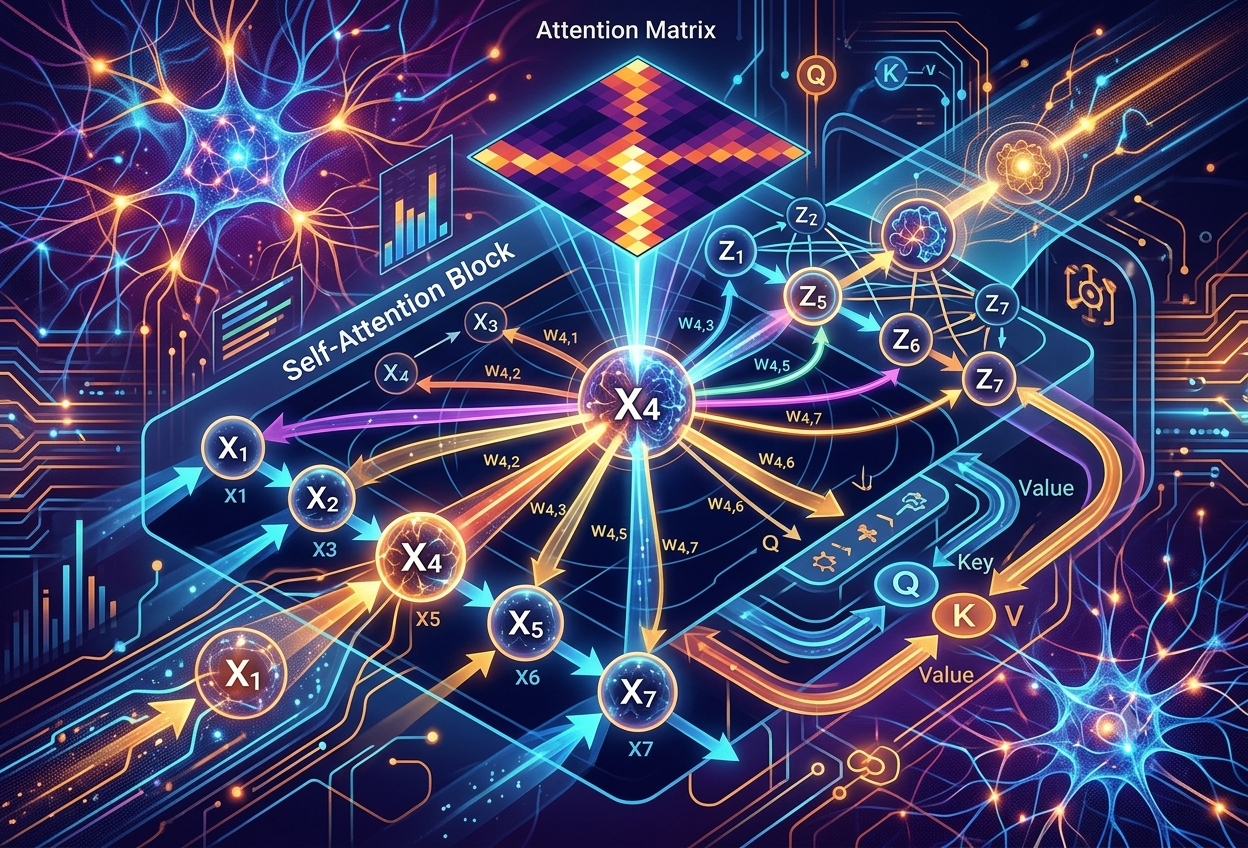
Attention Mechanism
& Self-Attention
What Is Attention?
When you read the sentence “The trophy didn’t fit in the suitcase because it was too big”, your brain instantly knows that “it” refers to the trophy, not the suitcase. You focused on the right word without consciously thinking about it. The attention mechanism teaches computers to do exactly this — focus on what matters.
In machine learning, an attention mechanism is a technique that allows a model to dynamically assign different levels of importance to different parts of its input when producing an output. Rather than treating every word or data element equally, an attention-enabled model learns which pieces of information deserve more weight in any given context.
Imagine you’re reading a mystery book and trying to answer the question: “Who took the cookie?” Your eyes don’t re-read every single word equally — they zoom in on sentences about suspects and cookies. That zooming-in, that selective focus, is exactly what attention does for an AI. Instead of looking at everything with the same importance, it figures out which words matter most for the question it’s trying to answer.
The term “attention” in the context of neural networks was inspired by the way human cognitive attention works — we naturally prioritise certain stimuli over others depending on what we’re trying to understand or accomplish. The mathematical machinery behind it, however, is rooted in the concept of weighted combinations: each element in a sequence contributes to the final output, but the weight of that contribution is learned during training and can vary at inference time based on context.
Attention is a function that maps a query and a set of key-value pairs to an output, where the output is computed as a weighted sum of the values, with the weights determined by the compatibility between the query and each key.— Vaswani et al., “Attention Is All You Need”, 2017 (paraphrased)
Why Attention Was Desperately Needed
Before attention mechanisms arrived, the dominant approach to sequence modelling — Recurrent Neural Networks (RNNs) — worked in a fundamentally limited way that broke down with long text. Understanding that limitation is the key to appreciating what attention changed.
The Bottleneck Problem in RNNs
A Recurrent Neural Network reads a sentence one word at a time, left to right. At each step it updates a hidden state — a fixed-size vector that is supposed to carry all the relevant information from words seen so far. When the network finishes reading the entire sentence, this single hidden vector is handed to a decoder that must reconstruct or translate the meaning.
The catastrophic flaw is that this hidden vector has a fixed size regardless of how long the input sentence is. Translating “The cat sat on the mat” is manageable. But translating a 200-word paragraph through a single fixed-size vector is like trying to summarise an entire novel on a sticky note — details inevitably get lost.
The Vanishing Gradient Problem
A second devastating issue with RNNs is what happens when trying to learn connections between words that are far apart in a sentence. During backpropagation, the error signal must travel backwards through every single time step. Each step multiplies the gradient by a small number, and multiplying many small numbers together produces a result so tiny it becomes effectively zero. The model literally forgets about words that appeared early in a long sentence — the gradient signal “vanishes” before it reaches those early time steps.
In the sentence “The student who passed all of the exams that the professor had designed over the previous three semesters was finally able to graduate,” a vanilla RNN would struggle to correctly connect “student” with “was” and “graduate” because so many words appear between them. Attention mechanisms solve this by allowing any word to directly interact with any other word, regardless of distance.
These two problems — the information bottleneck and the vanishing gradient — created a ceiling on the performance of sequence-to-sequence models that researchers had been struggling against for years. The introduction of the attention mechanism shattered that ceiling.
A History of Attention in AI
The story of attention in deep learning spans from a single groundbreaking paper in 2014 to the architecture that now underpins every major language model in the world.
Bahdanau Attention — The First Crack in the Bottleneck
Dzmitry Bahdanau, Kyunghyun Cho, and Yoshua Bengio published “Neural Machine Translation by Jointly Learning to Align and Translate.” Rather than compressing an entire sentence into a single vector, their model learned to look back at the encoder’s hidden states and produce a different weighted combination for each output word. This was the first practical attention mechanism, and it produced dramatic improvements in translation quality — especially for long sentences.
Luong Attention — Simplifying the Formula
Minh-Thang Luong and colleagues proposed two simplified attention formulations: the “dot-product” alignment score (just a dot product of encoder and decoder hidden states) and the “general” alignment (a learned weight matrix between them). These lighter-weight variants were faster to compute and easier to implement while preserving most of the performance gains of Bahdanau attention.
“Attention Is All You Need” — The Transformer Arrives
Ashish Vaswani and colleagues at Google Brain published the paper that changed everything. The Transformer architecture discarded RNNs entirely and relied solely on a new mechanism called self-attention to process sequences. By computing attention across all positions simultaneously, the Transformer could be trained much faster on GPUs and captured long-range dependencies far more effectively than any RNN-based system.
BERT & GPT — Attention at Scale
Google’s BERT (Bidirectional Encoder Representations from Transformers) and OpenAI’s GPT demonstrated that pre-training massive Transformer models on huge text corpora and then fine-tuning them on specific tasks produced state-of-the-art results across virtually every NLP benchmark. Self-attention was now the engine powering the best AI language systems in the world.
GPT-3, Vision Transformers & Beyond
The Transformer and self-attention spread far beyond text. Vision Transformers (ViT) applied self-attention to image patches, achieving competitive performance with convolutional neural networks. Multimodal models like CLIP combined image and text attention. Models with hundreds of billions of parameters became feasible, all built on the same scaled-dot-product self-attention mechanism from 2017.
How Attention Works — Step by Step
At its core, attention is a mechanism for computing a weighted average over a set of values, where the weights encode how relevant each value is to the current task. Let’s walk through every step from the raw idea to the mathematics.
The Query, Key, and Value Framework
Modern attention mechanisms are built around three concepts borrowed loosely from information retrieval systems: Queries, Keys, and Values. Once you understand these three roles, the entire mechanism clicks into place.
Imagine you walk into a library looking for books about “space exploration.” Your search request is the Query. The library catalogue has index cards for every book — those are the Keys. The actual books sitting on the shelves are the Values. You compare your query against every key to see which ones match, then go and retrieve the most relevant books (values). Attention does exactly this — mathematically — for every word in a sentence.
Represents “what the current position is looking for.” Each word generates its own query vector by being multiplied through a learned weight matrix W_Q. Think of it as the question each word is asking about all other words.
Represents “what each word offers for others to find.” Generated from the same input using a separate weight matrix W_K. Keys are what queries are matched against to compute relevance scores.
Represents “the actual information a word carries.” Generated using weight matrix W_V. Once the relevance scores are computed, the values of high-scoring words are aggregated to form the final output for each position.
In practice, the input sequence (each word represented as a vector) is multiplied by three different learned weight matrices to produce the Q, K, and V matrices. The same input produces all three — they are just three different projections or “views” of the same information, each optimised for a different role in the attention calculation.
Computing Attention Scores: Softmax and Weighted Sum
With the Q, K, and V matrices in hand, attention proceeds in three clean steps:
- Compute compatibility scores. For each query vector, compute a dot product with every key vector. The dot product is a mathematical measure of how “aligned” two vectors are — a high dot product means the query and key are pointing in similar directions, signalling high relevance. This produces a matrix of raw scores, one score per (query, key) pair.
- Scale and normalise. The raw dot-product scores are divided by the square root of the key dimension (√d_k). Without this scaling, large dot products can push the softmax function into regions with very small gradients, making training unstable. Then a softmax function is applied row-by-row, converting raw scores into a probability distribution that sums to 1.0. These are the attention weights.
- Compute the weighted sum of values. Each value vector is multiplied by its corresponding attention weight, and all the weighted values are summed. This produces the output for that query position — a rich blend of information from across the sequence, weighted by relevance.
When the key dimension d_k is large (e.g. 512 dimensions), the dot products between queries and keys grow proportionally large in magnitude. Large dot products cause the softmax function to produce outputs very close to 0 and 1 — sharply peaked distributions that have near-zero gradients almost everywhere, severely slowing learning. Dividing by √d_k keeps the dot products in a comfortable range where softmax produces smooth, learnable gradients.
Self-Attention — When a Sequence Talks to Itself
Self-attention is what makes Transformers magical. In regular attention, one sequence queries another (like a decoder asking questions of an encoder). In self-attention, a sequence uses itself as both the questioner and the answerer — every word simultaneously asks about every other word in the same sentence.
The mechanism is almost identical to the general attention formula, with one crucial difference: the Q, K, and V matrices are all derived from the same input sequence. Every position in the sequence attends to every other position in the same sequence, computing how much each word should “listen to” every other word when building its own representation.
Imagine every word in a sentence is a person sitting in a circle. In self-attention, every person turns to face every other person and asks: “How important are you to understanding me?” Each person then creates a new version of themselves by blending in information from everyone else, weighted by how important they judged each person to be. After this one round, every word has absorbed the context of the whole sentence — not one word at a time, but all at once.
This is the key insight: because every word directly attends to every other word in a single computation step, there is no concept of “nearby” or “distant” words. A word at position 1 and a word at position 200 interact with equal computational cost as two adjacent words. Long-range dependencies that paralysed RNNs are trivially handled by self-attention.
The resulting output for each position is a new, context-enriched vector — the same word, but now loaded with information about its meaning in this specific sentence. The word “bank” in “I went to the river bank” will have a very different output vector from “bank” in “I deposited money at the bank”, because the self-attention weights it assigns to surrounding words will be completely different.
Bahdanau Attention — The Pioneer
The original attention mechanism from Bahdanau et al. (2014) works differently from self-attention. Instead of a sequence attending to itself, the Bahdanau mechanism links an encoder (reading the source language) with a decoder (producing the target language) through a learned alignment.
In the original sequence-to-sequence machine translation setup without attention, the encoder reads the entire French sentence and produces hidden states at each position. At the end, only the last hidden state is passed to the decoder. Bahdanau’s insight was simple and powerful: why throw away all those intermediate hidden states? Why not let the decoder look at all of them and decide, at each decoding step, which encoder positions deserve the most attention?
The alignment score between each encoder hidden state hᵢ and the current decoder state sₜ is computed using a small feed-forward neural network (a learned scoring function). These raw scores are then passed through softmax to produce attention weights αᵢⱼ — a probability distribution over the encoder states. Finally, a weighted sum of encoder hidden states produces the context vector c, which is passed alongside the decoder’s own hidden state to generate the next output word.
The elegance of Bahdanau attention is that it is completely differentiable — the entire alignment score computation is learned end-to-end through backpropagation. The model learns on its own which source words to look at when generating each target word, without any human-designed alignment rules.
Multi-Head Attention — Many Perspectives at Once
The Transformer architecture introduces a powerful extension of self-attention: instead of computing attention once, it computes it multiple times in parallel, each time with different learned weight matrices. The results are concatenated and projected to produce richer, multi-faceted representations.
Imagine reading a sentence and thinking about it in multiple ways at once: one part of your brain thinks about who is doing what (subject and verb relationships), another part thinks about what things are described (adjective and noun relationships), and another part thinks about when and where things happen (prepositional relationships). Multi-head attention is a model doing exactly this — having multiple “sub-minds” each paying attention to different aspects of the text simultaneously.
In multi-head attention with h heads, the model learns h separate sets of Q, K, and V projection matrices. Each set produces a separate attention output, called a “head.” These h heads run in parallel, and their outputs (each of dimension d_model/h) are concatenated and passed through a final linear projection. The computation remains efficient because each head operates on reduced-dimensional projections.
The power of multiple heads is that each head can specialise in capturing a different type of relationship. Researchers have visualised what attention heads learn and found patterns: some heads appear to track syntactic dependencies (subject-verb relationships), others capture coreference (pronouns pointing to their antecedents), and others attend to nearby positional context. The model learns these specialisations entirely from data, without any explicit programming.
The original Transformer paper used 8 attention heads with a model dimension of 512 — each head operating in 64-dimensional space. BERT-Large uses 16 heads. GPT-3 uses 96 heads. More heads provide more representational capacity but also increase computational cost.
Types of Attention Mechanisms
The original attention idea has spawned an entire family of variants, each addressing a specific need or use case. Understanding the family tree helps clarify when to use each approach and why.
A sequence attends to itself — each position queries and is queried by every other position in the same sequence. Produces context-aware representations where the meaning of each word reflects the whole surrounding sentence. The backbone of every Transformer encoder.
Queries come from one sequence (e.g. the decoder) but keys and values come from a different sequence (e.g. the encoder output). This is how Transformers implement the encoder-decoder connection: the decoder “reads” the encoder’s representations to produce translations or summaries.
H parallel attention operations, each with different learned projections, running simultaneously. Concatenated and projected. Allows the model to jointly attend to information from different representation subspaces — e.g., one head tracks syntax, another tracks semantics.
Self-attention with a constraint: each position can only attend to earlier positions in the sequence. The upper triangle of the attention score matrix is set to −∞ (effectively zero after softmax). Used in decoder-only models like GPT to ensure that generating the next word cannot “cheat” by looking at future words.
The original 2014 attention mechanism. Alignment scores are computed using a small learned feed-forward network applied to the concatenation of encoder and decoder states. More flexible than dot-product but slightly more expensive to compute. Foundational to neural machine translation.
A simplified attention proposed in 2015 that computes alignment scores using a dot product (global) or a learned weight matrix (general) instead of a full neural network. Faster and easier to implement. The dot-product variant directly inspired the scaled dot-product attention in Transformers.
A scalability variant where each position attends to only a subset of other positions (e.g., nearby positions plus a few global tokens) rather than all N positions. This reduces quadratic O(n²) complexity. Used in models like Longformer and BigBird to handle very long documents (thousands of tokens).
A hardware-aware re-implementation of exact self-attention that achieves dramatic speed improvements by reducing memory reads/writes between GPU HBM and SRAM. Flash Attention does not change the mathematical output but changes how the computation is executed, enabling much longer context windows in practice.
Attention vs Self-Attention — Key Differences
These two terms are frequently confused, even in technical literature. The distinction is actually very clear once you understand the source of the Q, K, and V matrices.
| Dimension | General Attention (Cross-Attention) | Self-Attention (Intra-Attention) |
|---|---|---|
| Source of Q, K, V | Q from decoder; K and V from encoder | Q, K, and V all from the same sequence |
| Purpose | Bridge information between two different sequences | Capture relationships within a single sequence |
| Where used | Transformer decoder cross-attention block | Transformer encoder; Transformer decoder (masked) |
| Original paper | Bahdanau et al., 2014 | Vaswani et al., 2017 |
| Analogy | Asking a different person a question | Asking everyone in a group (including yourself) |
| Context dependency | Cross-sequence (encoder ↔ decoder) | Intra-sequence (position ↔ position) |
| Key application | Translation, text summarisation | Language understanding, representation learning |
General attention asks: “What do I need from you to understand my task?” Self-attention asks: “What do all of you mean in relation to me, within our shared context?”
— Core conceptual distinction in Transformer architectureAttention Inside the Transformer
The Transformer architecture uses three distinct deployments of attention in a carefully designed structure that simultaneously reads input, builds representations, and generates output.
Encoder Self-Attention
Each input token simultaneously attends to all other tokens. This builds deeply contextualised representations — the same word gets different vectors depending on sentence context. Used in BERT-style encoder-only models for understanding tasks.
Masked Self-Attention
In the decoder, each output position can only see previously generated tokens. A triangular mask forces the model to generate text strictly left to right, preventing “cheating” by looking at future outputs. The engine of GPT-style autoregressive generation.
Encoder-Decoder Cross-Attention
The decoder’s queries interact with the encoder’s keys and values. This is how a Transformer translator “reads” the source sentence while generating the target. Each generated word can dynamically focus on different parts of the input.
A key architectural detail that makes the Transformer work well in practice is the residual connection and layer normalisation applied after each sub-layer (attention and feed-forward). The residual connection adds the input of each sub-layer back to its output, addressing vanishing gradients and allowing very deep stacking of layers. Layer normalisation stabilises activations across the batch dimension.
Applications Across Domains
Attention mechanisms power virtually every high-performing AI system built after 2018. From the autocomplete on your phone to the AI that reads medical scans, attention is the engine underneath.
Large Language Models (ChatGPT, Claude, Gemini)
Every state-of-the-art conversational AI system is a stack of Transformer layers, each containing multi-head self-attention. When you ask a question, attention mechanisms determine which parts of your question and the conversation history are most relevant to generating each word of the response. The quality and coherence of these responses is entirely a product of well-trained attention.
Machine Translation (Google Translate)
Modern translation systems replaced older statistical phrase-based approaches with Transformer encoder-decoder architectures. Cross-attention allows the decoder to look at the most relevant source-language words when generating each target-language word — a linguistically aware alignment that dramatically improved translation quality and enabled near-human performance on many language pairs.
Medical & Clinical NLP
Clinical decision support systems use Transformer models trained on medical literature and patient records. Self-attention captures relationships between symptoms, diagnoses, and treatments spread across long clinical notes. Models like BioBERT and ClinicalBERT use the same attention architecture to understand the nuanced language of medicine that standard NLP systems miss.
Vision Transformers (Image Recognition)
Vision Transformers (ViT) divide an image into patches (like words in a sentence) and apply self-attention across those patches. Each patch attends to every other patch to understand global image structure. ViT models match or exceed CNN-based systems on image classification benchmarks, demonstrating that attention is a general-purpose mechanism beyond language.
Music & Audio Generation
Models like MusicLM and AudioCraft use attention over audio tokens to generate coherent, long-form music and speech. The self-attention mechanism captures long-range musical structure — themes that resolve dozens of bars later — that sequential models could never handle reliably.
Drug Discovery & Protein Folding
AlphaFold2, which predicted the 3D structure of nearly every known protein, uses self-attention to model the relationships between amino acid residues across the full protein sequence. The mechanism captures how distant residues influence each other’s folding — a spatial relationship problem that maps perfectly onto attention’s ability to handle long-range dependencies.
Strengths & Limitations of Attention
Strengths
- Handles long-range dependencies directly — no distance penalty
- Fully parallelisable — all positions computed simultaneously
- Context-dependent representations — same word, different meanings
- Interpretable — attention weights can be visualised
- Generalisable across modalities (text, image, audio, protein)
- No hand-engineered alignment rules — learned end-to-end
- Multi-head design captures diverse linguistic patterns
- Scales with data and compute — performance keeps improving
Limitations
- O(n²) complexity — quadratic scaling with sequence length
- Very high memory consumption for long sequences
- No built-in positional information — requires positional encoding
- Attention ≠ explanation — high weights ≠ causal importance
- Computationally expensive to train from scratch
- Prone to attention collapse in very deep models
- Difficult to apply to streaming / real-time tasks
- May encode spurious correlations from training data biases
The Quadratic Complexity Problem
The most significant practical limitation of standard self-attention is its computational cost. For a sequence of n tokens, computing all pairwise attention scores requires O(n²) operations and O(n²) memory. For typical short sentences (n ≤ 512 tokens), this is manageable. But for tasks requiring long context — entire books, genome sequences, high-resolution images — the quadratic cost becomes prohibitive.
This limitation has inspired an entire subfield of efficient attention research. Approaches include sparse attention (attending only to a subset of positions), linear attention (approximating full attention in O(n) time), sliding window attention (attending only to a local neighbourhood), and Flash Attention (hardware-aware exact attention with dramatically lower memory reads). Context window lengths have grown from 512 tokens in BERT (2018) to over 1 million tokens in models like Gemini 1.5 Pro (2024), largely through these engineering advances.
Early researchers hoped that attention weights would serve as a direct window into model reasoning — if the model attends strongly to word X when generating Y, then X must be the “reason” for Y. Subsequent research has systematically challenged this interpretation. Models can produce the same outputs with very different attention patterns. High attention weights are a useful diagnostic signal, but they should not be naively read as explanations of causal reasoning. Proper interpretability of attention-based models remains an active and open research problem.
Future Directions
Reformulations like Performer and Linformer approximate the softmax attention kernel using random feature maps or low-rank projections, reducing complexity from O(n²) to O(n) while preserving most of the expressiveness.
Combining sparse attention with mixture-of-experts routing (different sub-networks for different inputs) creates models that are far larger in parameter count but only activate a fraction of parameters per token, controlling compute cost.
Models like Mamba challenge Transformer attention with linear recurrent architectures that achieve O(n) time and space complexity. These “sub-quadratic” approaches are being actively researched as potential successors or complements to attention for very long sequences.
Comprehensive enterprise-level explainer on attention mechanisms, their role in Transformers, and their relationship to LLMs and generative AI.
Detailed technical treatment of self-attention, scaled dot-product attention, and multi-head attention in the context of the Transformer architecture.
Accessible intuition-first walkthrough of why attention was needed, what problem it solves, and how it works inside large language models.
In-depth technical guide to self-attention including mathematical framework, Query-Key-Value mechanics, and applications from GPT to Vision Transformers.
Survey of all major attention variants — self-attention, cross-attention, multi-head, causal/masked attention — with explanations of their applications and design rationale.
Historical and technical survey covering early RNN attention (Bahdanau, Luong) through Transformer self-attention, with mathematical derivations.
Visual, code-accompanied guide to implementing attention mechanisms from scratch, with clear diagrams of the Transformer encoder-decoder architecture.
Accessible tutorial on Transformer architecture, self-attention computation, and how positional encoding interacts with attention to preserve sequence order information.
Clear technical comparison of cross-attention and self-attention mechanisms, explaining the source of Q, K, V in each case with code examples.
Academic seminar paper providing a rigorous mathematical treatment of attention mechanisms from Bahdanau through multi-head self-attention, with worked examples.
Precise technical breakdown of the architectural and mathematical differences between the three major attention formulations, targeted at software engineers.
Practitioner-focused explanation of why the distinction between attention types matters for model design, with intuitive examples and implementation considerations.