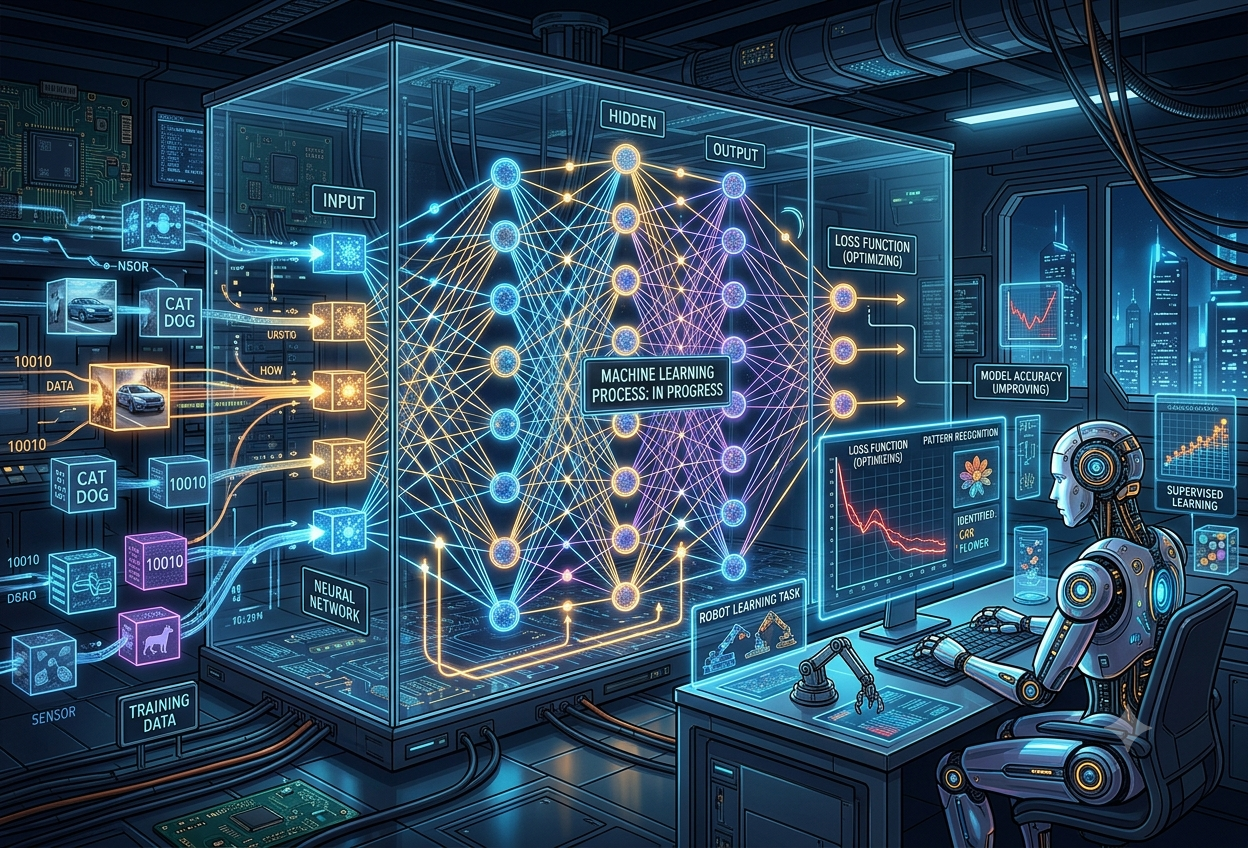
How Machines Learn
What Is Machine Learning?
Machine Learning is not magic — it is mathematics. But at its core, it answers one profound question: how do we make computers learn from experience rather than explicit instructions?
“Machine Learning is a subset of Artificial Intelligence focused on the ability of machines to receive data and learn for themselves — recognising patterns and adjusting to unique situations, without specific programming.”— Google Crowdsource / Dr. Pradeep Kumar S, 2022
For most of computing history, a programmer had to write explicit rules for every situation a program might encounter. If you wanted a program to detect spam emails, you wrote rules: “If the subject line contains ‘FREE MONEY’, flag as spam.” This approach worked — but only for problems simple enough to enumerate. The real world is far messier.
Machine Learning inverts this paradigm. Instead of a human writing the rules, the machine finds the rules itself by analysing thousands — or millions — of examples. You show it 100,000 spam emails and 100,000 legitimate ones, and it figures out the distinguishing patterns on its own. The resulting “rules” are often too complex for any human to have written.
Traditional programming: Data + Rules → Output
Machine Learning: Data + Output → Rules
We feed examples of both inputs and desired outputs, and the machine reverse-engineers the rules. Those rules — encoded as a trained model — can then be applied to new, unseen data.
Why Now? The Convergence of Three Forces
The key algorithms powering machine learning were created decades ago — drawing from statistics, linear algebra, biology, and physics. So why has ML exploded in the 21st century? Three forces converged simultaneously:
The internet, smartphones, and IoT sensors generate trillions of data points daily. More diverse training data means better, more robust models.
GPUs — originally designed for video games — turned out to be perfect for the parallel matrix math that ML demands. Cloud platforms democratised access overnight.
Breakthroughs in deep learning (backpropagation, attention, transformers) unlocked performance on tasks once considered uniquely human.
Human vs Machine Learning
The parallels between biological and artificial learning are more than metaphorical — they are the founding inspiration for the entire field.
Consider how a child learns to recognise a tree. They are never given a formal botanical definition. Instead, they encounter thousands of trees across their lifetime — tall ones, short ones, oak and pine and willow — and their brain gradually extracts the common patterns. Ask that same child to define a tree and they will struggle. Yet show them a photo and they identify it instantly.
“Give a three-year-old a photo and ask whether it shows a tree. The answer will probably be correct. Ask a 30-year-old for the definition of a tree, and you get a vague answer. We learn from data perceived through our senses — not from definitions.”
— Felix Pappe, Medium (2026)This is precisely how machine learning works. The computer does not memorise examples; it extracts patterns from them. And just as humans can recognise a tree they have never seen before, a trained ML model can correctly classify data it has never encountered — provided the pattern was present in training.
Key Parallels & Differences
| Dimension | Human Learning | Machine Learning |
|---|---|---|
| Input | Sensory experience (sight, sound, touch) | Numerical data (pixels, audio samples, text tokens) |
| Mechanism | Synaptic connections strengthened/weakened | Weights in a model adjusted via gradient descent |
| Speed | Years to develop deep expertise | Hours to days on GPU clusters |
| Volume | Thousands of examples over a lifetime | Millions to billions of examples per training run |
| Transfer | Excellent — knowledge generalises intuitively | Limited — models can struggle outside their training domain |
| Forgetting | Gradual, selective, context-dependent | Catastrophic forgetting — new tasks can erase old ones |
| Introspection | Humans can explain (some) reasoning | Deep models are often “black boxes” |
Artificial neural networks are directly inspired by the structure of the human brain: nodes mimic biological neurons; weighted connections mimic synapses; activation functions mimic the threshold at which a neuron “fires.” The field even borrowed terminology — layers, backpropagation, dropout — from neuroscience.
Data — The Fuel of AI
If algorithms are the engine, data is the fuel. Every machine learning system is only as good as the data it trains on. Understanding data — its structure, quality, biases, and limitations — is the single most important skill in applied ML.
What Is Data in the ML Context?
In machine learning, data refers to any recorded observation of the world that can be represented numerically. This includes:
- Structured data — tabular rows and columns: customer age, transaction amount, product category.
- Unstructured data — images (arrays of pixel values), audio (waveform samples), text (tokenised word sequences), video (frames over time).
- Semi-structured data — JSON, XML, logs, sensor readings with partial schema.
- Time-series data — sequences of measurements over time: stock prices, IoT sensor readings, EEG signals.
- Graph data — nodes and edges: social networks, molecular structures, knowledge graphs.
Labels — The Supervision Signal
Most foundational ML algorithms are trained with labelled data — examples where both the input and the correct output (the “label”) are known. The Lamarr Institute illustrates this with a cat-vs-dog classifier:
Each row is a training example. The “Species” column is the label — what the model must learn to predict from the other features.
| # | Length | Weight | Fur Colour | Fur Type | Label (Species) |
|---|---|---|---|---|---|
| 1 | 45 cm | 7 kg | Dark | Short | Cat |
| 2 | 40 cm | 6.7 kg | Dark | Long | Dog |
| 3 | 52 cm | 11.2 kg | Spotted | Rough | Dog |
| 4 | 43 cm | 6.3 kg | Light | Short | Cat |
| 5 | 55 cm | 12.4 kg | Spotted | Long | Dog |
The model must generalise from these 5 examples to correctly classify new animals it has never seen before — the essence of machine learning.
The Data Collection Challenge
Practitioners consistently report that data collection, cleaning, and labelling consume 60–80% of total project time — far more than algorithm selection or model tuning. Real-world data is:
Missing values, duplicate records, measurement errors, inconsistent formatting, and corrupted entries are ubiquitous in any real dataset.
Fraud represents 0.1% of transactions. Rare diseases affect 1 in 100,000. Models trained on imbalanced data tend to ignore rare-but-critical cases.
Medical records, financial transactions, and personal communications — the most valuable training data — are the most legally and ethically restricted.
Human annotators must manually review thousands of examples. A radiology AI may require a board-certified radiologist to label every training image.
Google’s Crowdsource platform crowdsources data labelling to improve diversity and reduce bias in ML training data. ML products are only as good as the data they train on. A diverse set of inputs leads to better products for more people — representation in training data is not just an ethical concern but a technical one.
The Machine Learning Pipeline
Machine learning is not a single step — it is a rigorous, iterative pipeline from raw data to deployed prediction system. Understanding each stage is essential for building systems that actually work.
Focus on the User & Define the Problem
Not every problem needs ML — and ML cannot solve every problem. Begin by identifying a user need that is too complex for rule-based programming but addressable by pattern recognition. Clearly frame the problem statement and define quantifiable success metrics.
Collect, Explore & Prepare Data
Identify the input data your model needs. Gather it, clean it, and explore it thoroughly. Remove duplicates, handle missing values, normalise scales, encode categorical variables. Experts say this phase — often called EDA — is the longest and most critical.
Choose an Algorithm & Train the Model
Select an appropriate algorithm for your problem type (classification, regression, clustering) and data characteristics. Split your labelled dataset into training data and test data. Train the model by iteratively adjusting parameters to minimise prediction error.
Evaluate & Validate
Apply the trained model to the held-out test data to measure real-world performance. Key metrics include accuracy, precision, recall, F1 (classification) or RMSE, MAE (regression). Use a validation set during training to tune hyperparameters without leaking test data.
Deploy, Monitor & Iterate
Once validated, the model is deployed into production. Crucially, the process does not end here. Real-world data drifts over time (data drift), and model performance degrades. Continuous monitoring, retraining pipelines, and A/B testing are essential for maintaining production ML systems.
The pipeline is never linear in practice. Evaluation in step 4 frequently reveals that training data in step 2 was insufficient. Deployment in step 5 may surface edge cases that send you back to step 1. Expect 3–10 full iterations before a production-ready model.
Models, Parameters & Training
A machine learning model is a mathematical function — a set of equations with adjustable knobs (parameters) that map inputs to outputs. Training is the process of finding the right values for those knobs.
What Is a Model?
In ML, a “model” refers to both the architecture (the mathematical structure and relationships between parameters) and the learned parameters themselves after training. The Lamarr Institute’s framing is precise: “The set of parameters and their interrelationships is often referred to as a model because, in a sense, it models the training data.”
Different model families make different assumptions about the structure of the data. Choosing the right model is more art than science:
| Model Type | Core Assumption | Best For | Interpretability |
|---|---|---|---|
| Linear / Logistic Regression | Linear relationship between features and output | Tabular data, baseline, regulatory contexts | Very High |
| Decision Tree | Data can be split by threshold rules recursively | Mixed data types, explainable decisions | High |
| Random Forest | Ensemble of trees reduces variance | Structured/tabular data, robustness | Medium |
| Gradient Boosting (XGBoost) | Sequentially correct errors of weak learners | Tabular data competitions, regression | Medium |
| Support Vector Machine | Find maximum-margin hyperplane between classes | High-dimensional text, small datasets | Low |
| Neural Network / Deep Learning | Hierarchical feature extraction via layers | Images, text, audio, video | Very Low |
| k-Nearest Neighbours | Similar inputs have similar outputs | Prototyping, recommendation | High |
| Probabilistic / Naive Bayes | Features are conditionally independent | Text classification, spam filtering | High |
Parameters vs Hyperparameters
A critical distinction that confuses beginners:
The internal values of the model that are adjusted during training. In a neural network: the weights and biases of every connection. In linear regression: the slope and intercept. The model learns these automatically from data via the optimisation algorithm.
Configuration choices made before training that govern the learning process itself. Examples: learning rate, number of layers, tree depth, regularisation strength. These are set by the practitioner, not learned — and tuning them is “hyperparameter optimisation.”
Optimisation & Loss Functions
How does a model actually “learn”? It iteratively measures its mistakes and adjusts its parameters to make smaller mistakes next time. This process — called optimisation — is the mathematical engine of all machine learning.
The Loss Function — Measuring Mistakes
Before a model can improve, it needs a way to measure how wrong it is. This is the job of the loss function (also called the objective or cost function). It takes the model’s predictions and the true labels, and returns a single number — the “loss” — that represents total error across all training examples.
- Mean Squared Error (MSE) — for regression tasks; penalises large errors heavily due to squaring.
- Cross-Entropy Loss — for classification tasks; measures divergence between predicted probability distribution and true labels.
- Hinge Loss — used in Support Vector Machines; penalises predictions within a margin of the decision boundary.
- Binary Cross-Entropy — for binary classification (spam/not-spam, fraud/not-fraud).
Gradient Descent — Finding the Minimum
With a loss function defined, the model’s goal is to find parameter values that minimise that loss. This is an optimisation problem — and for almost all real ML models, the solution is gradient descent. Imagine the loss function as a hilly landscape. Every combination of parameter values corresponds to a point in that landscape, with height representing loss. The model starts at a random point and wants to roll downhill. The gradient — the derivative of loss with respect to each parameter — tells the model which direction is “downhill.”
Set all weights to small random values.
Random start prevents symmetry; the optimiser does the rest.
Run training data through the network to produce predictions.
Generates the outputs that will be compared against true labels.
Measure error between predictions and labels.
A single scalar number — the thing the optimiser is trying to shrink.
Compute gradients of loss with respect to every weight.
Tells each weight which way to move to reduce error.
Adjust each weight a small step in the descending direction.
The size of the step is the learning rate — the central hyperparameter.
Loop for all batches across many epochs.
Training continues until loss plateaus or validation accuracy peaks.
Key Optimisation Variants
Computes gradients over the entire training dataset before updating. Accurate but slow and memory-intensive on large datasets.
Updates after every single example. Fast but noisy — the loss bounces around rather than smoothly decreasing.
Updates after each small batch (typically 32–512 examples). Best of both worlds — the practical standard for deep learning.
Adaptive learning rates per parameter. Combines momentum and RMSProp. The default choice for most deep learning tasks since 2014.
The learning rate controls how large each parameter update step is. Too high: the model overshoots minima and diverges. Too low: training takes forever or gets stuck. Learning rate schedulers (warmup, cosine decay, cyclic LR) dynamically adjust the rate during training — a crucial trick for training large models reliably.
Types of Machine Learning
Not all learning is the same. The availability of labelled data — and the nature of the feedback signal — defines which learning paradigm applies. Each has distinct strengths, limitations, and use cases.
Supervised Learning
The most common paradigm. Training data includes both inputs and correct outputs (labels). The model learns to map inputs to outputs by minimising prediction error across thousands of labelled examples.
Output is a discrete category. Examples: spam/not-spam, cat/dog/bird, disease/healthy, fraud/legitimate.
Output is a continuous number. Examples: house price prediction, stock forecasting, patient age estimation from scan.
Unsupervised Learning
No labels — the model discovers hidden structure, patterns, or groupings on its own. Essential when labelling is expensive, impossible, or when you don’t know what you’re looking for.
- Clustering (k-Means, DBSCAN) — Group similar data points together. Used for customer segmentation, document topic modelling, anomaly detection.
- Dimensionality Reduction (PCA, UMAP, t-SNE) — Compress high-dimensional data into fewer dimensions while preserving structure. Used for visualisation, feature engineering, noise removal.
- Generative Models (GANs, VAEs, Diffusion) — Learn the underlying data distribution to generate new, realistic synthetic examples.
- Association Rules (Apriori) — Find co-occurrence patterns in transaction data. Classic: “customers who buy X also buy Y.”
Reinforcement Learning
An agent takes actions in an environment, receives reward or penalty signals, and learns a policy to maximise cumulative reward over time. No labelled dataset — the learning signal comes from doing.
RL has produced AI’s most dramatic results: AlphaGo (2016) beat world Go champion Lee Sedol. AlphaZero (2017) mastered Chess, Shogi, and Go from scratch in 24 hours. OpenAI Five (2019) defeated professional Dota 2 teams. Modern LLMs use RL via RLHF (Reinforcement Learning from Human Feedback) to align with human values.
Semi-Supervised & Self-Supervised Learning
Semi-supervised learning combines a small amount of labelled data with a large unlabelled pool — ideal when labelling is expensive. Self-supervised learning (used in GPT, BERT, CLIP) creates its own supervision signal from the structure of the data itself — predict the next word, reconstruct a masked region, match image-text pairs — enabling learning from internet-scale unlabelled data.
Neural Networks Explained
Neural networks are the architecture that unlocked modern AI. Inspired by the brain, they learn rich, hierarchical representations from raw data — enabling machines to see, hear, and understand language.
The Biological Metaphor
The human brain contains approximately 86 billion neurons, each connected to up to 10,000 others via synapses. A signal travels from neuron to neuron; a neuron “fires” when incoming signals exceed a threshold, passing the signal forward. Artificial neural networks abstract this into mathematics:
Receives numeric inputs, computes a weighted sum, adds a bias term, and passes the result through an activation function.
A number on each connection controlling signal strength. Weights are the primary learned parameters — adjusting them is training.
Non-linear function (ReLU, Sigmoid, Tanh) that determines whether a neuron “fires.” Without non-linearity, deep networks collapse to one linear layer.
Input layer receives raw data; hidden layers extract features; output layer produces final prediction. “Deep” = 3+ hidden layers.
The chain-rule algorithm that computes how much each weight contributed to error, enabling simultaneous update of all weights.
One complete pass through the entire training dataset. Models typically train for dozens to thousands of epochs.
The Forward Pass — What Happens in One Prediction
When data enters the network: (1) each input feature is multiplied by its corresponding weight; (2) weighted inputs are summed at each neuron and a bias is added; (3) the sum passes through an activation function; (4) the output becomes input to the next layer; (5) this propagates forward until the output layer produces a prediction. The entire computation is a series of matrix multiplications — highly parallelisable on GPU hardware.
CNN (Convolutional Neural Network) — for images and spatial data; uses sliding filter kernels to detect local patterns.
RNN / LSTM — for sequences (text, time series); maintains hidden state across time steps.
Transformer — self-attention over sequences; backbone of GPT, BERT, Claude. Parallelisable and highly scalable.
GAN — generator vs discriminator adversarial training; produces photorealistic images, video, and audio.
Overfitting & Underfitting
The central tension in machine learning is between memorising training data and generalising to new data. Get this balance wrong in either direction and your model fails in the real world.
The model is too simple to capture the true pattern. High error on both training and test data. Occurs when: model has too few parameters, training is too short, or regularisation is too strong. Fix: more expressive model, train longer, reduce regularisation.
The model memorises training data — including noise — instead of learning the true underlying pattern. Excellent training accuracy, poor test accuracy. Fix: more data, dropout, regularisation (L1/L2), early stopping, data augmentation.
Techniques to Combat Overfitting
- Regularisation (L1 / L2 / Elastic Net) — adds a penalty to the loss function for large parameter values, discouraging over-reliance on any single feature.
- Dropout — randomly deactivates a proportion of neurons during each training step, forcing the network to learn redundant representations.
- Early Stopping — monitor validation loss during training; stop when it starts increasing even as training loss decreases.
- Cross-Validation — evaluate the model across multiple train/test splits to get a more reliable performance estimate.
- Data Augmentation — artificially expand training data by applying transformations (flipping, rotating, cropping for images; synonym replacement for text).
- Ensemble Methods — average predictions from many independently trained models; errors tend to cancel out.
Every ML model navigates the fundamental bias-variance trade-off. Bias is error from overly simplistic assumptions (underfitting). Variance is sensitivity to small fluctuations in training data (overfitting). Total error = Bias² + Variance + Irreducible Noise. The art of model selection is finding the sweet spot.
Bias, Fairness & Data Quality
Machine learning systems inherit — and can amplify — the biases present in their training data. This is not a theoretical concern: real-world ML systems have caused documented harm in hiring, lending, healthcare, and criminal justice.
“Machine learning models are not inherently objective. Human involvement in the provision and curation of training data makes model predictions susceptible to bias. A biased data sample teaches the algorithm to look for similar patterns and hold them ‘true’.”— Google Crowdsource, 2022
Types of Bias in ML Systems
Training data is not representative of the population the model will encounter in deployment. A facial recognition system trained mostly on light-skinned faces will perform poorly on darker skin tones.
Human annotators bring their own biases to labelling decisions. If annotators consistently rate identical CVs differently based on names, the model learns those biases.
Data reflects past human decisions that were themselves biased. An AI recruiter trained on 10 years of historically male-dominated hires will perpetuate that pattern.
Model predictions influence future data collection, amplifying biases over time. Predictive policing algorithms send more police to policed areas, creating more arrests, “confirming” the original prediction.
Amazon built an AI recruitment tool trained on 10 years of résumé data — mostly from men, reflecting tech industry demographics. The model learned to penalise CVs containing the word “women’s” and downgraded graduates from all-women colleges. Amazon scrapped the tool in 2018. The lesson: models do not discriminate between representative patterns and historically biased patterns — both look like signal.
Mitigating Bias — A Multi-Layer Approach
- Diverse data collection — actively seek out underrepresented groups; measure demographic representation before training.
- Fairness metrics — measure model performance across demographic subgroups separately; equalised odds, demographic parity, calibration.
- Adversarial debiasing — train an auxiliary model to predict demographic attributes from model representations and penalise the main model for enabling this prediction.
- Human-in-the-loop review — for high-stakes decisions (hiring, lending, medical diagnosis), maintain human oversight of model outputs.
- Crowdsourced diversity — platforms like Google Crowdsource involve global contributors to diversify labelling, reducing cultural and geographic bias.
Real-World Applications
Machine learning is no longer a research topic — it runs in billions of devices and systems every day, making decisions that affect healthcare, finance, transport, education, and entertainment.
Applications You Use Without Knowing
Email Spam Filtering
Gmail’s ML filters process over 100 million spam emails per day with 99.9% accuracy. Naive Bayes, logistic regression, and transformer-based classifiers analyse content, sender reputation, and behavioural signals to block unwanted mail before it reaches your inbox.
Maps & Navigation
Google Maps uses ML to predict real-time traffic, estimate arrival times, and optimise routes for millions of journeys simultaneously. Deep learning models ingest live GPS traces to infer traffic speed without explicit sensors.
Content Recommendation
Netflix attributes 80%+ of views to its recommendation engine. YouTube’s system drives over 70% of watch time. Collaborative filtering and deep learning analyse billions of interaction signals to surface content each user is likely to enjoy.
Medical Diagnosis
CNNs detect diabetic retinopathy, skin cancer, and chest X-ray abnormalities with radiologist-level accuracy. Google’s LYNA identifies breast cancer metastases in lymph node slides with 99% AUC — catching subtle cases human pathologists missed.
Self-Driving Vehicles
Autonomous vehicles combine computer vision (CNNs for object detection), sensor fusion (LIDAR + radar + camera), and reinforcement learning for driving policy. Tesla’s Autopilot trains on billions of miles of real-world driving data.
Fraud Detection
Visa’s AI evaluates 65,000 transactions per second, flagging fraud in under 300ms. Gradient boosting and deep learning models analyse hundreds of features — merchant category, transaction velocity, device fingerprint, geographic anomaly — in real time.
Voice Assistants
Siri, Alexa, and Google Assistant combine deep learning ASR (automatic speech recognition, <5% word error rate), NLU (intent classification), and dialogue management models to understand and respond to natural language commands.
Precision Agriculture
From sorting cucumbers in Japan to diagnosing eye disease in India: ML-powered drones and sensors analyse satellite imagery and soil data to optimise irrigation, detect crop disease early, and reduce pesticide use — improving yields while cutting costs.
A Japanese farmer built a cucumber sorting machine using TensorFlow and a Raspberry Pi — trained on photos of his own cucumbers. Google’s AI detects eye diseases in India that would go undiagnosed for lack of ophthalmologists. This range — from a $35 computer to a hospital AI system — illustrates that ML is now a tool accessible to everyone.
The Future of Machine Learning
Machine learning is progressing faster than any technology in history. Understanding the trends shaping the next decade is critical for anyone building, using, or governing intelligent systems.
Foundation Models & Transfer Learning
Pre-training massive models on internet-scale data, then fine-tuning for specific tasks, has become the dominant paradigm. GPT-4, Claude, Gemini, and Llama 3 serve as bases for thousands of downstream applications — enabling ML without large labelled datasets.
Agentic & Autonomous AI Systems
Models are evolving from answering questions to taking actions — browsing the web, writing and executing code, booking appointments, managing workflows. Multi-agent systems where AI models collaborate on complex tasks are moving from research to production.
AI in Scientific Discovery
AlphaFold solved protein folding; GNoME discovered 2.2 million new crystal structures; AI is accelerating drug discovery from decades to months. The next frontier: AI as a genuine research collaborator in climate science, materials design, and medicine.
Towards General Intelligence
The long-term goal of AGI — systems with general problem-solving capability across all domains — remains contentious and distant. But the trajectory of capability improvement, especially in reasoning, multi-step planning, and tool use, suggests the boundary between narrow and general AI is blurring faster than anticipated.
Six Trends Reshaping ML
Model distillation, quantisation, and pruning are making capable models run on smartphones and edge devices — eliminating cloud dependency and enabling private, real-time AI.
Regulatory and safety requirements are driving demand for explainable models. SHAP, LIME, attention visualisation, and mechanistic interpretability are moving from academic tools to production requirements.
Federated learning (train on device, never share raw data), differential privacy, and secure multi-party computation enable ML on sensitive data without centralising it.
Training GPT-3 consumed ~1,287 MWh of electricity. Energy-efficient architectures, green data centres, and carbon-aware training scheduling are becoming engineering priorities.
The EU AI Act, US Executive Orders, and voluntary safety commitments from frontier labs signal a new era. Model documentation, capability evaluations, and audit trails are becoming baseline requirements.
Models that seamlessly process text, images, audio, and video are dissolving the boundaries between modalities — enabling applications like real-time voice conversation with visual context.
“Any sufficiently advanced technology is indistinguishable from magic.”
— Arthur C. Clarke, cited by Google Crowdsource in the context of Machine LearningMachines learn by finding patterns in data through mathematical optimisation. The fuel is data. The engine is algorithms. The result is a model — a compressed representation of patterns too complex for humans to write explicitly. Every ML system, from the spam filter in your inbox to the model that designed this year’s most promising cancer drug, operates on the same fundamental principles: data in, patterns learned, predictions out.
Infographic overview of ML algorithms and applications.
Foundational ML concepts: parameters, training, validation — Sascha Mücke, 2021.
Beginner-friendly introduction to ML concepts.
Summary and analysis of ML learning principles.
Enterprise perspective on ML adoption and mechanics.
ML overview, bias, data diversity — Dr. Pradeep Kumar S, 2022.
Beginner-friendly ML explanation with human-learning parallels, 2026.