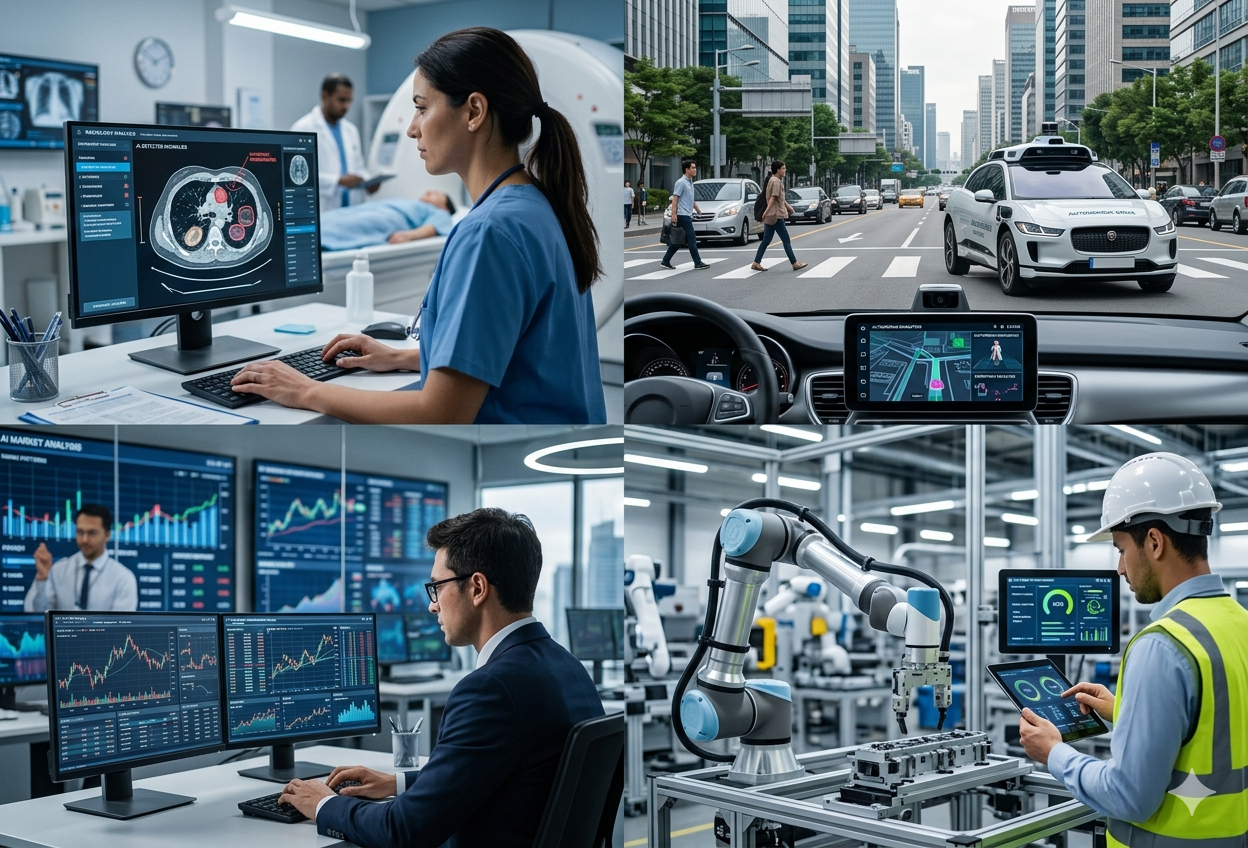
Real-World Applications of AI Today
The AI Revolution Is Already Here
While only 33% of people believe they use AI, over 77% already interact with AI-powered services or devices every single day. The revolution is not coming — it arrived quietly, embedded in the services we take for granted.
“AI is a dynamic tool used across industries for better decision-making, increasing efficiency, and eliminating repetitive work. I definitely fall into the camp of thinking of AI as augmenting human capability and capacity.”— Satya Nadella, CEO of Microsoft
Artificial Intelligence is the branch of computer science concerned with replicating the thought processes and decision-making abilities of humans through algorithms. But today’s AI is far more than a theoretical pursuit — it is operational infrastructure, embedded in search engines, hospital diagnostics, financial trading floors, factory assembly lines, and the content feeds of three billion social media users.
The pace of adoption is staggering. The number of companies that have implemented AI has grown by 270% over the past five years. Seventy-five of 176 countries are now using AI tools for public safety and surveillance. By 2025, research indicates that up to 95% of all customer interactions will include an AI component. Understanding where AI is deployed, how it functions in each sector, and what results it produces is essential literacy for the 21st century.
The Five Core AI Technologies Powering These Applications
Systems that learn from data and improve over time without explicit reprogramming. Powers fraud detection, recommendations, predictive analytics, and demand forecasting.
Enables machines to interpret and understand visual input — images and video. Powers medical imaging, autonomous vehicles, quality control, facial recognition, and cashier-less retail.
Allows computers to understand and generate human language. Powers chatbots, virtual assistants, translation, sentiment analysis, and document processing.
Combines AI with physical systems to perform tasks in the real world. Powers surgical robots, warehouse automation, self-driving vehicles, and industrial cobots.
Uses ML models trained on historical data to forecast future outcomes. Powers maintenance scheduling, demand planning, risk assessment, and clinical intervention timing.
How AI Applications Actually Work
Every AI application — from a spam filter to a surgical robot — operates on the same fundamental cycle: data in, patterns learned, decisions or predictions out. Understanding this cycle demystifies even the most sophisticated deployments.
Google Cloud defines AI applications as “software programs that use AI techniques to perform specific tasks — ranging from simple, repetitive tasks to complex, cognitive tasks requiring human-like intelligence.” What distinguishes AI applications from traditional software is their ability to improve over time as they process more data, and to handle inputs they were not explicitly programmed for.
Traditional software follows hand-coded rules: IF condition A → THEN action B. Brittle — breaks on edge cases. Cannot improve. Every new scenario requires a programmer update. Works only in narrow, predictable domains.
Learn rules from examples. Improve with more data. Handle novel inputs with graceful degradation. Scale to millions of variables simultaneously. Continuously retrain as the world changes. Applicable to almost any domain with data.
AI in Business Intelligence — The Cross-Cutting Layer
Before diving into sectors, it’s important to understand AI’s role as a horizontal layer in business intelligence. According to Google Cloud, AI-powered BI enables organisations to:
- Collect data from structured sources (databases) and unstructured sources (text, images, video, sensor feeds) simultaneously.
- Analyse that data at machine speed to identify patterns, trends, and anomalies invisible to human analysts.
- Visualise findings in intuitive dashboards that update in real time.
- Decide using AI-generated insights and recommendations — shifting organisations from reactive to proactive strategy.
Healthcare & Medicine
Healthcare is the sector where AI’s potential impact is most profound — and most personal. From diagnosing diseases to designing new drugs, AI is augmenting human clinicians in ways that are saving lives today.
Machine learning algorithms analyse X-rays, MRIs, and CT scans to detect abnormalities with accuracy that matches or exceeds trained radiologists. AI-powered systems can identify early signs of cancer, heart conditions, and neurological disorders — enabling timely interventions that dramatically improve outcomes. Google’s LYNA system identifies breast cancer metastases in lymph node slides with 99% AUC, detecting subtle cases that human pathologists missed.
AI diagnoses diabetic retinopathy from retinal photos with ophthalmologist-level performance. In India, this is deployed to screen populations in regions with no ophthalmologists — a patient who would otherwise go undiagnosed for years receives a result in seconds.
AlphaFold solved the 50-year protein folding problem and has since predicted structures for over 200 million proteins — essentially the entire known proteome. This has unlocked drug discovery at a scale previously inconceivable: researchers can now identify binding sites and design candidate molecules computationally before ever entering a lab. AI is compressing drug development timelines from the traditional 10–15 years to potentially 3–5 years.
AI models analyse vast patient datasets including medical records, genetic information, and treatment histories to identify patterns for new therapies. These models also predict patient response to drugs based on genomic profiles — enabling truly personalised medicine.
AI models predict ICU transfers, hospital-acquired infection risk, and patient deterioration hours before clinical signs appear — enabling proactive intervention. Wearables like Apple Watch and Fitbit collect continuous biometrics and flag anomalies in real time.
AI-assisted surgical robots (e.g. Da Vinci) provide sub-millimetre precision, reducing blood loss and recovery time. In hospitals, robots transport supplies, sterilise equipment, and assist in complex procedures — interpreting real-time data to adjust actions dynamically.
AI can identify early signs of Alzheimer’s 6 years before clinical diagnosis. Deep learning detects diabetic retinopathy with 90%+ sensitivity. AI reduces radiologist reading time for mammograms by 30% while reducing false positives. Virtual health assistants handle 24/7 patient support, reducing burden on overloaded healthcare systems globally.
Finance & Banking
Finance was one of the earliest and most aggressive adopters of AI — and for good reason. The combination of vast structured data, clear success metrics (profit/loss), and high stakes for errors makes it an ideal domain for machine learning.
Fraud Detection & Prevention
Visa’s AI system evaluates 65,000 transactions per second, flagging fraud in under 300ms. ML models analyse transaction velocity, geographic anomalies, device fingerprints, and spending patterns simultaneously. AI-powered fraud prevention has reduced financial crime losses by billions annually across global banking.
Algorithmic Trading
AI-driven trading systems (including robo-traders by Aidya and Nomura Securities) process market data and execute trades at millisecond speed — far beyond human reaction time. These systems identify arbitrage opportunities, manage portfolio risk, and respond to market events autonomously at scale.
Credit Scoring & Risk Assessment
ML models augment traditional credit scoring with hundreds of behavioural and alternative data signals, enabling more accurate risk assessment and expanding credit access to underserved populations who lack conventional credit histories.
Document Processing & Compliance
JPMorgan’s CoiN contract intelligence system analysed 12,000 commercial credit agreements in seconds — work that previously required 360,000 hours of lawyer time annually. NLP monitors communications for regulatory compliance and auto-generates audit reports.
Banks like SBI (SIA chatbot) deploy AI-powered conversational assistants that handle account queries, transaction alerts, financial product recommendations, and loan applications at scale. Natural language processing enables human-quality dialogue in multiple languages, dramatically reducing call centre volumes while improving 24/7 customer access.
Transport & Autonomous Vehicles
Transport is undergoing perhaps the most dramatic AI-driven transformation of any sector — from the navigation app on your phone to the fully autonomous vehicles beginning to operate on public roads today.
The Self-Driving Car Stack
Autonomous vehicles represent the most complex real-world AI deployment in existence — simultaneously solving perception, prediction, planning, and control problems in real time. Tesla’s Autopilot collects data from every Tesla on the road and feeds it into centralised ML training pipelines, improving with every mile driven by the fleet. The AI stack involves:
- Perception — Computer vision (CNNs) + LIDAR/radar sensor fusion to build a real-time 3D model of the environment: lanes, vehicles, pedestrians, traffic signals.
- Prediction — ML models predict the future trajectories of surrounding vehicles and pedestrians over a 3–5 second horizon.
- Planning — Reinforcement learning and optimisation algorithms select the safest, most efficient path through the predicted environment.
- Control — Low-level controllers translate the planned path into steering, throttle, and braking commands at 100Hz.
- V2X Communication — AI helps cars anticipate hazards from connected infrastructure: traffic lights, construction zones, other vehicles.
Google Maps ingests live GPS traces from hundreds of millions of Android users, inferring real-time traffic speeds without physical sensors. AI predicts journey time with accuracy within minutes — and proactively reroutes around incidents. Uber and FedEx use AI route optimisation to reduce fuel consumption and delivery times.
AI analyses sensor data from trains, aircraft, and ships to predict component failure before it occurs — scheduling maintenance proactively rather than reactively. Airlines have reduced unscheduled maintenance events by 30%+ using predictive AI, preventing costly delays and safety incidents.
AI-powered traffic systems analyse flow data from cameras and sensors city-wide, dynamically adjusting signal timing to optimise throughput. Pittsburgh’s Surtrac system reduced travel time by 25% and idle time by 40% in a pilot deployment. Chinese cities deploying AI traffic management report 15–20% reductions in average journey times across entire metropolitan areas.
Retail & E-Commerce
AI has transformed retail from a product-centric industry to a data-driven, personalised experience engine — turning every customer interaction into a learning opportunity.
Amazon generates approximately 35% of its total revenue from AI-powered recommendations. Netflix attributes 80%+ of content viewed to its recommendation system. These engines use collaborative filtering (what similar users enjoyed), content-based filtering (attributes of items the user liked), and deep learning over session behaviour to surface maximally relevant items in real time.
Personalisation extends beyond “you might also like” — it encompasses personalised pricing, personalised search ranking, personalised email campaigns, and personalised landing pages. Every touchpoint in the customer journey is now individually calibrated by AI models running at millisecond speed.
Dynamic Pricing
AI adjusts prices across millions of SKUs in real time based on demand signals, competitor pricing, inventory levels, and customer segment. Amazon reportedly updates prices 2.5 million times per day — far beyond human management. Airlines have used ML-based dynamic pricing for decades; retail has now adopted the same technology at scale.
Cashier-Less Retail
Amazon Go stores use computer vision (ceiling-mounted cameras + weight sensors + deep learning) to track customers and items automatically. Shoppers grab products and walk out — the AI bills them via app. This technology is now licensed to other retailers and is expanding globally.
Demand Forecasting & Inventory
AI models analyse historical sales, seasonal patterns, external events (weather, social trends), and market data to predict product demand at store and SKU level weeks in advance. This reduces stockouts, minimises overstock write-offs, and optimises supply chain efficiency.
E-Commerce Fraud Prevention
AI monitors transaction patterns and user behaviour to detect fake reviews, account takeovers, and payment fraud in real time. ML models continuously update their understanding of fraud patterns as attackers evolve — a cat-and-mouse game where AI gives defenders a decisive speed advantage.
Manufacturing & Industry
Manufacturing was an early adopter of automation, but AI takes it to a new level — shifting from pre-programmed machines to systems that learn, adapt, and optimise continuously.
Four Pillars of AI in Manufacturing
LSTM and temporal CNN models trained on vibration, temperature, current, and pressure sensor data predict equipment failure hours to days in advance — scheduling maintenance before breakdowns occur. Reduces unplanned downtime by 20–50% in production facilities.
CNNs inspect products at superhuman speed (thousands of units per minute), detecting surface defects, dimensional deviations, and assembly errors invisible to human inspectors. Dramatically reduces defect escape rates and customer returns.
AI-powered cobots work safely alongside human workers — detecting proximity and adjusting force accordingly. Handle repetitive, ergonomically damaging tasks while humans focus on dexterity and judgement. Used in assembly, welding, material handling, and packaging.
AI explores millions of design variants meeting specified constraints (weight, strength, cost, manufacturability) — surfacing geometries no human engineer would have conceived. Used in aerospace, automotive, and medical device design to produce lighter, stronger parts.
Google’s DeepMind AI reduced data centre cooling energy by 40% through reinforcement learning — an AI agent that controls cooling systems autonomously, outperforming human engineers who had already spent years optimising the same systems. This breakthrough has been extended to other energy-intensive manufacturing and facility management contexts globally.
Education
AI is beginning to fulfil the long-promised vision of truly personalised education — a one-to-one tutoring experience, at scale, available to every student regardless of geography or resources.
Personalised Adaptive Learning
ML algorithms track each student’s mastery of every concept, identifying gaps and misconceptions in real time. Systems like Khan Academy’s Khanmigo and Duolingo’s AI tutor adapt content sequencing, pacing, and instructional strategy to each individual — providing the equivalent of private tutoring to every student at near-zero marginal cost.
Intelligent Tutoring & Chatbots
AI tutoring systems engage students in Socratic dialogue, explain concepts in multiple ways, generate practice problems on demand, and provide detailed feedback on written work — all in natural language. Available 24/7 without scheduling, these systems dramatically expand access to quality academic support.
Automated Assessment & Grading
NLP models grade essays, short answers, and code with reliability comparable to human markers — handling routine assessment at scale, freeing educators to focus on discussion, mentoring, and creativity. Automated marking software provides instant feedback rather than waiting days for results.
Early Intervention & Wellbeing
Predictive models identify at-risk students from engagement and performance patterns weeks before they would self-identify — enabling proactive support. AI also monitors psychological, mental, and physical wellbeing indicators, flagging students who may need counselling intervention.
86% of students worldwide admit to using AI in their schoolwork. AI reduces administrative burden (scheduling, grading, reporting) by up to 30%, giving educators more time for teaching. Students using AI tutoring systems have shown 2-sigma improvement in learning outcomes in controlled studies — matching the legendary results of one-to-one human tutoring.
Agriculture & Precision Farming
Agriculture feeds 8 billion people on a finite planet facing climate change. AI is the technology that will enable farmers to produce more food with less water, less pesticide, less land, and far greater resilience.
AI on the Farm — Five Applications
- Crop Disease Detection — Computer vision systems analyse drone and satellite imagery to detect early signs of disease, pest infestation, or nutrient deficiency at field scale. A farmer can survey thousands of hectares in minutes using a drone equipped with an AI model that previously required a trained agronomist walking every row.
- Precision Irrigation & Soil Analysis — IoT sensors measure soil moisture, temperature, and nutrient levels continuously. AI models determine the precise amount of water and fertiliser each section of a field needs — reducing water usage by 30–50% while maintaining or improving yields.
- Weather Forecasting & Yield Prediction — AI analyses satellite data, historical weather patterns, and real-time sensor feeds to forecast crop yields months in advance and recommend optimal planting and harvest timing.
- Weed & Pest Management — AI-guided precision sprayers identify individual weeds using computer vision and apply herbicide only to weed locations — reducing chemical usage by 90% versus broadcast spraying. This protects soil health and reduces cost significantly.
- Supply Chain & Market Intelligence — AI helps farmers make production and pricing decisions based on real-time market data, predicting supply/demand dynamics to maximise profit margins.
“From helping farmers in Japan sort cucumbers to assisting doctors in India diagnose eye disease, machine learning is changing the way people use code to solve problems and improve lives.”
— Google Crowdsource, 2022A Japanese farmer built a deep learning cucumber sorting machine using TensorFlow on a Raspberry Pi — trained on thousands of photos of his own cucumbers classified by his mother. The AI matched the quality of her expert sorting at machine speed and cost less than $1,000. This story became iconic: AI is no longer just for tech giants. A single farmer with a camera and an internet connection can build production AI systems today.
Cybersecurity
Cybersecurity is a domain of perpetual adversarial escalation. AI has given defenders the speed, scale, and pattern-recognition capacity to detect and respond to threats that would be invisible to human analysts — while attackers simultaneously weaponise AI to launch more sophisticated attacks.
ML models establish baseline behaviour profiles for users, devices, and network traffic. Deviations — unusual login times, abnormal data volumes, unexpected API calls — trigger alerts. Catches zero-day attacks that signature-based antivirus misses entirely.
AI platforms aggregate and correlate data from threat feeds, security logs, dark web forums, and partner networks to identify emerging threats before they reach enterprise perimeters. Converts raw IOC data into actionable intelligence within minutes.
Security orchestration platforms use AI to automatically isolate compromised endpoints, block malicious IPs, and revoke suspicious credentials — reducing mean time to respond (MTTR) from hours to seconds without requiring human intervention.
Deep learning models analyse code behaviour (not just signatures) to detect novel malware variants. Sandbox environments run suspicious files in AI-monitored containers, classifying intent from runtime behaviour patterns without requiring prior exposure to the threat.
AI is both the strongest shield and the sharpest sword in cybersecurity. Attackers use LLMs to write more convincing phishing emails, generate polymorphic malware that evades signature detection, and automate reconnaissance at scale. The arms race between AI-powered attackers and AI-powered defenders is the defining security dynamic of the current decade. Defenders generally hold the advantage — but only if they deploy AI proactively rather than reactively.
Natural Language Processing & Digital Assistants
NLP is the AI technology that makes machines readable and speakable — transforming the human-computer interface from code and clicks to conversation. It is the most universally deployed AI technology in consumer products today.
The Digital Assistant Ecosystem
The five major digital assistants — Siri (Apple), Alexa (Amazon), Cortana (Microsoft), Google Assistant, and Bixby (Samsung) — collectively handle hundreds of millions of voice and text queries daily. Each combines:
NLP Applications Beyond Assistants
Search Engine Intelligence
Google’s BERT and MUM models understand search queries contextually — not just as keyword matches but as natural language expressions of information needs. Google’s “People also ask” feature and autocomplete are real-time NLP inference running at planetary scale for every search.
Machine Translation
Google Translate uses Transformer-based Neural MT to translate over 100 billion words per day across 133 languages. The 2016 switch from statistical to neural translation produced accuracy improvements equivalent to a decade of prior progress in a single year.
Sentiment Analysis
NLP models analyse customer reviews, social media posts, and news articles to measure brand sentiment in near real time. Financial institutions use sentiment analysis of news and earnings calls to inform trading decisions. Brands use it to monitor reputation and detect emerging crises before they escalate.
Content Generation & Summarisation
Large language models (GPT-4, Claude, Gemini) generate human-quality text for marketing copy, code, reports, emails, and creative writing. They summarise lengthy documents in seconds. GitHub Copilot now writes an estimated 46% of new code in supported files for its 1 million+ paid users.
Media, Entertainment & Social Media
Entertainment and media were early testbeds for AI at consumer scale. Today, AI determines what three billion people read, watch, and listen to — making it perhaps the most culturally influential AI deployment in existence.
Content Recommendation
Netflix’s recommendation engine generates 80%+ of viewing hours. YouTube’s system drives 70%+ of watch time. Deep learning models process viewing history, time of day, device, and peer group behaviour to surface maximally engaging content. Netflix’s recommendation saves an estimated $1B annually in customer churn alone.
Social Media Algorithms
Facebook, Instagram, TikTok, and YouTube run AI algorithms that determine what content each of their billions of users sees. TikTok’s For You algorithm is widely considered the most powerful content recommendation system ever built — capable of accurately predicting user interests within 1–2 hours of a new account.
Gaming AI
AI in gaming has evolved from rule-based NPCs to deep reinforcement learning agents that adapt to each player’s style. OpenAI Five defeated world-champion Dota 2 teams. Procedural generation powered by AI creates infinite unique game worlds. AI companions now provide emotionally nuanced, contextually appropriate dialogue in real time.
AI-Generated Content
Diffusion models (Sora, DALL·E 3, Stable Diffusion) generate photorealistic images and video from text. AI music tools (Suno, Udio) generate complete songs in specified styles in seconds. AI is both automating content creation and generating entirely new creative possibilities — fundamentally reshaping how media is produced.
AI enables hyper-granular audience targeting: ads are served based on thousands of behavioural and demographic signals, not just age and gender. Programmatic advertising platforms run real-time auctions for ad placements in milliseconds, with AI bidding systems optimising for specific conversion outcomes. AI also writes and A/B tests ad creative — generating hundreds of variants and automatically promoting top performers.
Human Resources & the Workplace
AI is reshaping how organisations find, develop, and retain their most critical asset: people. From resume screening to workforce planning, AI is making HR data-driven at every touchpoint.
AI-Powered Recruitment & Candidate Screening
ML algorithms scan thousands of resumes, analyse candidate profiles, and rank applicants based on skills, experience, and predicted job performance. This reduces time-to-hire by 70% and allows recruiters to focus on the most promising candidates. Voice and video AI analyses interview responses for communication clarity and competency indicators.
Personalised Onboarding
AI systems personalise onboarding journeys based on role, location, and background — delivering the right training content at the right time. Chatbots answer common new-joiner questions 24/7 without HR staff involvement, handling paperwork, system access, and cultural onboarding efficiently.
Workforce Planning & Skill Development
Predictive analytics forecast future workforce needs, skill gaps, and attrition risks based on engagement signals, performance data, and career trajectory patterns. AI recommends targeted learning paths for each employee — enabling organisations to continuously upskill their workforce aligned with strategic direction.
Engagement & Retention AI
AI analyses communication patterns, performance trends, and survey data to identify employees at risk of leaving — enabling proactive retention interventions weeks before a resignation. Sentiment analysis on internal communications (with appropriate privacy safeguards) provides early warning of disengagement and morale issues.
Amazon’s AI recruitment tool (2018) had to be scrapped after it was found to systematically downgrade female candidates — because it trained on 10 years of male-dominated hiring history. This case established a critical principle: HR AI must be continuously audited for demographic bias. AI can equally reduce bias through consistent, criteria-based assessment — but only if built and governed thoughtfully with representative training data.
Challenges, Ethics & Societal Impact
The transformative power of AI comes with proportional responsibility. Understanding the genuine challenges — not as abstract concerns but as concrete, documented problems — is essential for anyone deploying or depending on AI systems.
AI systems trained on historical data inherit historical biases. Facial recognition systems perform 30% worse on dark-skinned faces. Lending algorithms disadvantage minority borrowers. These are not hypothetical concerns — they are documented, measured, and ongoing.
AI’s insatiable appetite for data creates fundamental tensions with privacy. Medical AI requires patient data. Recommendation systems require behavioural surveillance. The systems that help us most are often those that know us most — raising consent, ownership, and security questions.
AI automates cognitive tasks previously thought immune to automation. Radiologists, lawyers, journalists, programmers, and accountants all face significant AI disruption. Proactive reskilling and social safety net reforms are critical policy priorities for this transition.
When an AI denies a loan, misdiagnoses a condition, or upholds a wrongful criminal conviction, who is responsible? Establishing clear accountability chains for AI decisions — especially in high-stakes domains — is a critical unsolved governance challenge.
The compute, data, and talent required to train frontier AI models is concentrated in a handful of organisations. This creates power asymmetries that could undermine market competition, democratic governance, and equitable access to AI’s benefits.
Training GPT-3 consumed ~1,287 MWh — equivalent to powering 120 US homes for a year. Inference at scale across billions of queries is rapidly becoming a major component of data centre energy demand. Sustainable AI architecture is a growing engineering priority.
| Challenge | Current Status | Key Mitigations | Regulatory Response |
|---|---|---|---|
| Algorithmic Bias | Documented across hiring, lending, criminal justice, healthcare | Diverse training data, fairness metrics, regular audits | EU AI Act (High-Risk systems), US EEOC guidance |
| Data Privacy | Growing tension between utility and privacy | Federated learning, differential privacy, data minimisation | GDPR, CCPA, India DPDP Act |
| Misinformation | AI-generated deepfakes and synthetic media at scale | Watermarking, provenance tracking, detection models | EU AI Act, platform content policies |
| Safety & Alignment | Active research area; frontier models exhibit emergent behaviours | RLHF, Constitutional AI, red-teaming, evaluations | Voluntary commitments, emerging legislation |
| Explainability | Deep models remain “black boxes” for critical decisions | SHAP, LIME, mechanistic interpretability research | EU AI Act requires explanations for high-risk AI |
Future Directions in AI Applications
The trajectory of AI applications is accelerating, not plateauing. The next wave of deployments will be more autonomous, more multimodal, more deeply integrated into physical infrastructure — and governed by frameworks we are only now beginning to design.
Agentic AI — From Answering to Acting
AI systems are evolving from question-answering to autonomous action: browsing the web, writing and executing code, booking appointments, managing workflows. Multi-agent systems where AI models collaborate are moving from research to production deployment.
Quantum + AI Convergence
Quantum computing’s ability to perform complex calculations at unprecedented speeds could revolutionise AI algorithms — unlocking breakthroughs in drug discovery, materials science, cryptography, and optimisation that classical hardware cannot achieve within any reasonable timeframe.
Federated Learning & Privacy-Preserving AI
Training AI models across decentralised data sources without centralising sensitive data unlocks collaborative AI in healthcare, finance, and other privacy-critical domains — where the data needed to build powerful models cannot be pooled due to legal or ethical constraints.
Explainable AI as Default
Regulatory pressure (EU AI Act) and safety imperatives are driving a shift from black-box to interpretable AI — especially in healthcare, criminal justice, and finance. Mechanistic interpretability research at labs like Anthropic is making progress on understanding exactly what computations are running inside large neural networks.
“AI is not a product — it is a new way for intelligence to exist in the world. The practical question is not whether it will transform everything, but how fast, and who shapes the transformation.”
— Synthesised from industry analysis, 2026AI applications are no longer in the future — they are the present infrastructure of global commerce, healthcare, security, education, and governance. The 13 sectors covered in this document collectively represent the majority of global GDP. In every one of them, AI is not a pilot project or an experiment: it is operational, at scale, handling consequential decisions every second of every day. The imperative now is not to ask whether to engage with AI — but to ensure that engagement is thoughtful, evidence-based, and governed by the values of those it serves.
Consumer AI applications, digital assistants, search, social media, robotics.
NLP, computer vision, ML, robotics, BI, healthcare, finance, manufacturing, education.
AI applications in business contexts, chatbots, personalisation, smart products.
Data platforms and AI applications at scale.
Consumer and enterprise AI applications overview.
Academic analysis; AI market size, education statistics, industry transformation.
Comprehensive enterprise AI use case library.
E-commerce, education, navigation, robotics, NLP, computer vision taxonomy.
Technical deep-dives on AI applications by domain.
E-commerce, navigation, robotics, HR, healthcare — detailed analysis; market statistics.
Healthcare, automobile, banking, gaming, robotics, agriculture, entertainment.
Academic overview of AI applications and societal implications.
Healthcare, finance, transportation, retail, manufacturing, education, cybersecurity; challenges and ethics.
Technical breakdown of 20 AI application domains with specific examples.