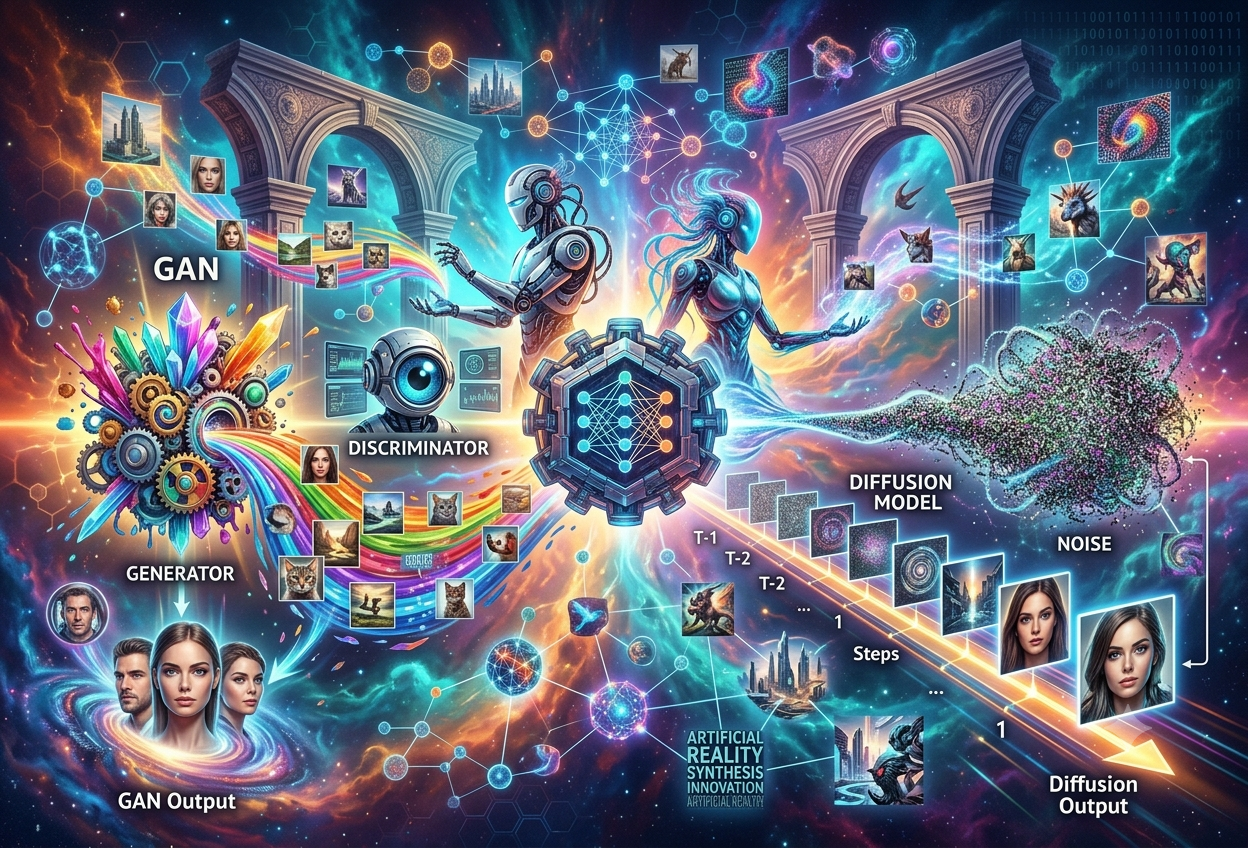
Generative Models — GANs & Diffusion
What Are Generative Models?
Most of the AI you have used so far is good at telling things apart — is this a cat or a dog, is this email spam or not. Generative models flip that idea on its head: instead of judging what already exists, they make brand-new things that never existed before.
“A generative model is a system that has studied so many examples of something that it can now produce convincing new examples of its own — pictures, sentences, sounds, or even strings of DNA — that follow the same patterns as the real thing.”A working definition for this guide
Think about the difference between a movie critic and a movie director. A critic (a discriminative AI model) looks at a film and judges it — good or bad, comedy or drama, suitable for kids or not. A director (a generative AI model) starts from nothing and creates an entirely new film. Generative models are the directors of the AI world: given enough examples of paintings, songs, or photographs, they learn the underlying “rules” of that kind of content well enough to produce fresh examples that follow those same rules.
This guide focuses on two of the most influential families of generative models for images: Generative Adversarial Networks (GANs), introduced in 2014, and Diffusion Models, which exploded in popularity from around 2020 onward and now power tools like Stable Diffusion, Midjourney, and DALL-E. We will also tour their cousins — variational autoencoders, recurrent neural networks, and transformer-based autoregressive models — so you leave with a complete map of the generative AI landscape.
Imagine you have looked at thousands of drawings of cats — so many that you start to notice patterns: cats usually have pointy ears, whiskers, and a tail. Now imagine you could draw a brand-new cat that nobody has ever drawn before, just by remembering all those patterns. That is exactly what a generative model does, except it does it with math instead of crayons, and it can do it for almost anything: faces, voices, music, or even made-up places that look like real photographs.
Two Big Categories of AI Models
Learns to separate or label things. Given an image, it answers “what is this?” — useful for spam filters, medical diagnosis, and recommendation engines.
Learns to create new things that resemble its training data. Given nothing but noise or a short text prompt, it answers “what could this look like?”
Many modern products mix both — a generative model creates content, while a discriminative model checks and filters the output for quality or safety.
How Generative Models Actually “Learn”
Every generative model is trained on a large collection of real examples — millions of photographs, paintings, or audio clips. During training, the model is not memorising those exact files. Instead, it is slowly adjusting millions of internal numerical “knobs” (called parameters) so that its own outputs become statistically similar to the training examples. Once trained well, the model has captured a compressed, mathematical sense of “what this kind of data tends to look like” — and it can sample fresh examples from that learned sense of normality, the same way you could imagine a believable new face without having ever seen that exact face before.
A well-trained generative model is not simply copying and pasting pieces of its training images together like a collage. It has learned underlying statistical patterns — the curve of an eyebrow, the texture of fur, the way light falls on glass — and it recombines those learned patterns in new configurations. This is also why responsible generative-AI products take care with training data and add safeguards, since a model is only as fair and safe as the patterns it absorbed.
Why It Matters
Generative models are not just a clever party trick. In under a decade, they have moved from research-lab curiosities to tools used by hundreds of millions of people every month — reshaping art, design, medicine, science, and software development along the way.
What Problems Do Generative Models Solve?
Before generative models matured, creating realistic synthetic images, voices, or text required either an actual human artist or extremely rigid, hand-coded graphics rules. Generative models solve several real, practical problems at once:
- Scarcity of data: Medical researchers studying a rare disease may have only a handful of real scans. A generative model trained carefully on the available examples can produce additional realistic, synthetic scans to help train other diagnostic AI systems.
- Cost and time of creative work: Designers, game studios, and marketers can produce draft visuals, concept art, or product mockups in seconds rather than days.
- Imagining what does not yet exist: Architects can generate visualisations of unbuilt buildings; fashion designers can preview garments before a single thread is sewn.
- Filling in missing or damaged information: Generative techniques can restore damaged old photographs, remove scratches from film, or fill in missing regions of an image convincingly (a task called inpainting).
- Personalisation at scale: From custom avatars to AI-generated background music for a video, generative tools let ordinary people create things that once required professional skills.
Imagine you wanted a picture of a dragon riding a bicycle through outer space — something nobody has ever drawn before. You could spend hours trying to draw it yourself, or you could ask a generative AI model, describe what you want, and have a brand-new picture appear in seconds. That is the superpower these models give people: turning an idea in your head into something you can actually see, hear, or read, almost instantly.
Why GANs and Diffusion Specifically?
Among the many generative approaches, GANs and diffusion models deserve special attention because they currently dominate high-quality image, video, and audio generation. GANs were the breakthrough that first made AI-generated faces and objects look startlingly convincing. Diffusion models then took over as the new state of the art for image quality and are the technology behind most of today’s leading text-to-image tools. Understanding both — how they work, where each shines, and where each struggles — gives you a genuinely useful mental model for almost any “AI generated this image” headline you will read in the news.
How GANs Work
A Generative Adversarial Network, or GAN, is built from two neural networks locked in a contest with each other. One tries to create convincing fakes; the other tries to catch them. The word “adversarial” simply means “opposing” — the two halves of a GAN are rivals, and that rivalry is precisely what makes the system improve.
The Forger and the Detective
The classic way to understand a GAN is to picture an art forger and an art detective locked in the same room, repeating a game over and over again:
The Generator starts out knowing absolutely nothing. It takes in a burst of pure random numbers (often called random noise or a sample from latent space) and tries to turn that noise into something that looks like a real photograph — say, a human face. At first, its attempts are laughably bad: blurry, distorted blobs of colour.
The Discriminator is shown a mix of real photographs from the training dataset and fake images freshly produced by the Generator. Its only job is to look at an image and output a single score between 0 and 1 — closer to 1 means “I believe this is real,” closer to 0 means “I believe this is fake.”
The Tug-of-War: Minimax Training
Mathematically, this contest is described by what researchers call a minimax game: the Generator is trying to minimise the Discriminator’s ability to detect fakes, while the Discriminator is trying to maximise its own accuracy at telling real from fake. Each network is judged by its own loss function — a number that measures how badly it is doing. A technique called backpropagation then calculates exactly how each internal “knob” in the network should be nudged to reduce that loss, and the nudging happens automatically, thousands of times, across the training process.
Early in training, the Generator’s fakes are easy to spot, so the Discriminator’s job is simple and its loss is low. But every time the Discriminator correctly flags a fake, that information flows back to the Generator as a learning signal — essentially “here’s what gave you away” — and the Generator nudges its own settings to fix that giveaway. Over thousands of rounds, both networks improve in lockstep. Ideally, training approaches a kind of balance point, sometimes called Nash equilibrium, where the Generator’s images have become so convincing that the Discriminator can do no better than random guessing — a 50/50 coin flip between real and fake.
Picture two kids playing a drawing game. One kid (the Generator) draws fake $20 bills and tries to sneak them past the other kid. The second kid (the Discriminator) tries to spot the fakes among real $20 bills. Every time the detective catches a fake, the forger learns from the mistake and draws a slightly better fake next time. Every time a fake slips through, the detective studies harder. After thousands of rounds, the forger’s drawings get so good that even a very careful detective struggles to tell them apart from the real thing!
Where Does the Random Noise Come From?
The starting point for every image a GAN generates is a vector — a list of numbers — drawn randomly from what is called latent space. You can think of latent space as an enormous, invisible control panel with hundreds of sliders, where each slider subtly influences some visual trait of the final image — perhaps one slider nudges hair colour, another nudges the angle of the head, another nudges the lighting. The Generator’s entire job is to learn a reliable mapping from “settings on this control panel” to “a believable image,” so that different starting noise vectors produce different — but always plausible — outputs.
Training Stability: Why GANs Can Be Tricky
A healthy GAN training run requires both networks to improve at roughly matched speeds. If the Discriminator becomes too good too quickly, it stops giving the Generator useful feedback — every image looks equally “obviously fake” to it, so the Generator does not know which direction to improve in. If the Generator gets ahead instead, the Discriminator’s feedback can become unreliable in the opposite direction. Researchers have introduced variants such as the Wasserstein GAN, which changes the underlying loss function to a more stable mathematical measure of distance between the real and generated data distributions, specifically to reduce these instability problems.
Types of GANs
Since the original GAN paper in 2014, researchers have built dozens of specialised variants, each tweaking the basic forger-versus-detective idea to solve a particular kind of problem. Here are the variants you are most likely to encounter.
Vanilla GAN
The “Vanilla” GAN is the original, plain recipe: a Generator and Discriminator built from simple, fully-connected layers of artificial neurons (sometimes called multilayer perceptrons). It is the easiest version to understand and implement, but also the least stable to train and the least capable of producing large, detailed images.
Conditional GAN (cGAN)
A plain GAN has no control over what it produces beyond what random noise happens to generate. A Conditional GAN fixes this by feeding extra information — a “label” or “condition” — into both the Generator and Discriminator. That label might be a category (“generate a cat” rather than “generate something”), a sketch, or even a short sentence describing the desired output. This is the foundational idea that lets a model take a text description and turn it into a corresponding image, or convert a black-and-white photo into a colour one by conditioning the Generator on the original grayscale image.
Deep Convolutional GAN (DCGAN)
DCGANs replace the simple layers of a Vanilla GAN with convolutional neural network layers — the same building blocks used throughout computer vision — which are far better suited to processing the grid-like structure of pixels in an image. The Generator uses a technique called transposed convolution to gradually “zoom in” on random noise, expanding it step by step into a larger, more detailed image, while the Discriminator uses ordinary convolutions to “zoom out” and judge the overall structure of an image. DCGAN was one of the first architectures to reliably produce sharp, recognisable images at scale.
StyleGAN
StyleGAN, developed by NVIDIA researchers, introduced a clever idea: instead of feeding a single noise vector straight into the network, it injects “style” information at every layer of the Generator, with early layers controlling coarse features (pose, face shape) and later layers controlling fine details (skin texture, individual strands of hair). This lets StyleGAN generate photorealistic faces at high resolutions and gives users surprisingly precise control — for example, smoothly changing a person’s hair colour or age in an image — without retraining anything.
CycleGAN
Most GANs need carefully matched pairs of training examples (a sketch and its matching photograph, for instance). CycleGAN was designed to work without paired data at all. It uses two Generators and two Discriminators: one Generator translates an image from style A to style B (say, photo to painting), and a second Generator translates it back from B to A. The model is trained so that translating an image there-and-back should reproduce something very close to the original — a constraint called cycle consistency. This makes CycleGAN extremely useful for style transfer tasks where paired examples simply do not exist, such as turning horse photographs into zebra photographs.
Laplacian Pyramid GAN (LAPGAN)
LAPGAN tackles high-resolution image generation by building the image gradually across multiple scales, much like stacking increasingly detailed transparencies on top of each other. It first generates a small, low-resolution image, then uses a chain of additional GANs to progressively add finer and finer detail at each larger scale — an approach known as a Laplacian pyramid.
DiscoGAN
Similar in spirit to CycleGAN, DiscoGAN learns relationships between two different domains — for instance, matching clothing items to their corresponding handbag style — without needing explicitly paired training examples, using two Generators and two Discriminators with the same cycle-consistency idea to keep translations faithful.
| GAN Variant | Core Idea | Best Suited For |
|---|---|---|
| Vanilla GAN | Simple generator/discriminator pair | Learning the basic concept; small experiments |
| Conditional GAN | Adds labels/conditions to control output | Text-to-image, class-controlled generation |
| DCGAN | Convolutional layers replace simple layers | General-purpose realistic image generation |
| StyleGAN | Layer-wise style injection | High-resolution faces with fine-grained control |
| CycleGAN | Cycle consistency with unpaired data | Style transfer, domain translation |
| LAPGAN | Multi-scale pyramid refinement | Progressive high-resolution generation |
| DiscoGAN | Cross-domain learning without pairs | Cross-domain style and attribute mapping |
Think of these like different “modes” of the same forger-and-detective game. A Conditional GAN is the game played with a rule: “today’s fakes must be cats, not dogs.” A CycleGAN is like a forger who can turn a photo into a painting and then turn that painting back into something that looks like the original photo, just to prove the trick works both ways. A StyleGAN is a forger who has separate control knobs for big things (the overall shape of a face) and tiny things (a single eyelash) — letting you mix and match.
How Diffusion Models Work
Diffusion models take a completely different approach from GANs. Instead of two networks competing, a diffusion model trains a single network to do one very specific job extremely well: looking at a noisy image and guessing what noise was added to it, so that noise can be subtracted away again.
Borrowed From Physics
The name “diffusion” comes from physics, where it describes how a drop of ink slowly spreads and disperses through still water until the colour is evenly, randomly distributed — you can no longer tell exactly where the drop first landed. Diffusion models apply the same idea mathematically to images: a clear picture is gradually and deliberately “dissolved” into random noise, step by tiny step, and the model’s entire purpose is to learn how to run that dissolving process backwards.
The Forward Process: Destroying the Image
During training, the model is shown a real image and a recipe for slowly ruining it. At each of many timesteps, a small, carefully measured amount of random (Gaussian) noise is added to the image. After enough steps — often somewhere around 1,000 — the original image has been completely overwhelmed by static, indistinguishable from pure random noise. This is called the forward process or forward diffusion, and it requires no learning at all — it is simply a fixed, mathematical recipe for adding noise a little at a time.
The Reverse Process: Learning to Undo the Damage
The actual learning happens in the reverse process. The neural network — typically built using an architecture called a U-Net — is trained to look at a noisy image at some timestep and predict exactly what noise was added to get it there. Once the model has gotten good at predicting and removing a small amount of noise at any given step, it can be run in a chain: start from pure random noise, predict and subtract a little bit of “noise” (even though there is no real underlying image yet), and repeat that denoising step hundreds or thousands of times. Remarkably, this gradual cleanup process converges into a coherent, often strikingly realistic, brand-new image — one that was never in the training set, but that “fits” the patterns the model absorbed.
Why So Many Steps?
You might wonder why the model bothers with hundreds or thousands of small denoising steps instead of just removing all the noise in one go. The answer is that predicting the entire original image from pure static in a single leap is an enormously harder problem than predicting “what tiny bit of noise was just added” at each of many small steps. By breaking an extremely difficult task into many easy ones, diffusion models sidestep a lot of the instability that plagues GAN training, at the cost of needing more computation to generate each image.
Guiding the Generation: Text Prompts and Conditioning
Modern diffusion tools like Stable Diffusion or DALL-E do not just generate a random image — they generate an image that matches a text prompt you typed. This is achieved through conditioning: the text prompt is converted into a numerical representation (an embedding) using a language-understanding model, and that representation is injected into the denoising network at every step, nudging each denoising decision toward outputs that match the description. This is also how techniques like inpainting (filling in a missing part of an image) and outpainting (extending an image beyond its original borders) work — the surrounding pixels act as an additional condition guiding what the missing region should look like.
Imagine you have a photograph, and you slowly sprinkle TV static over it, a little bit at a time, until the photo completely disappears into snow. A diffusion model is like someone who watched that happen so many times that they can now do the reverse trick: starting with nothing but TV static, they carefully brush away a tiny bit of “fuzz” over and over, and a brand-new picture slowly appears out of the noise — like a Polaroid photo developing in slow motion, except the picture was never really there to begin with. It was built out of pure static, one careful brushstroke at a time.
Score-Based Models and DDPMs: The Theory Behind the Magic
Researchers describe diffusion models using a few specific technical names you may encounter. Denoising Diffusion Probabilistic Models (DDPMs) are the specific mathematical formulation that made modern diffusion practical, learning to estimate the noise at each timestep using a simplified, stable training objective. A closely related framing called score-based generative modelling describes the same underlying process in terms of “scores” — mathematical directions that point from a noisy sample back toward more realistic data. These two perspectives turned out to describe essentially the same phenomenon, discovered somewhat independently, and together they form the theoretical backbone behind essentially every modern diffusion-based image generator.
GANs vs. Diffusion: Head to Head
Both GANs and diffusion models can generate impressively realistic images, but they get there through very different routes, and those routes produce different strengths, weaknesses, and ideal use cases.
| Aspect | GANs | Diffusion Models |
|---|---|---|
| Core mechanism | Two networks compete (generator vs. discriminator) | One network learns to reverse a noising process |
| Generation speed | Fast — a single forward pass | Slower — many sequential denoising steps |
| Training stability | Can be unstable; prone to mode collapse | Generally more stable to train |
| Image quality / detail | Sharp, realistic, occasionally less diverse | Excellent detail and diversity at the cost of speed |
| Adversarial training needed? | Yes, by definition | No — purely supervised denoising objective |
| Computational cost at inference | Lower — well suited to edge devices | Higher, unless accelerated (see Section 09) |
| Typical strengths | Real-time applications, style transfer, lightweight deployment | State-of-the-art text-to-image, fine detail, complex scenes |
In short: GANs trade some quality and diversity for speed, since generating an image requires only one pass through the Generator network. Diffusion models trade speed for quality and training stability, since they must run the denoising network many times to produce a single image, but the resulting images are generally considered the current state of the art for fidelity and variety.
“Speed versus quality is the real trade-off — a GAN can paint in one brushstroke, while a diffusion model takes a thousand careful ones.”
A working summary for this guideMode Collapse: The GAN-Specific Problem Worth Knowing
One particular failure mode is common enough in GANs that it deserves special attention: mode collapse. This happens when the Generator discovers one particular kind of output that reliably fools the Discriminator and then, having found a “winning move,” keeps producing variations on basically the same output rather than the rich diversity present in the real training data. Imagine asking for portraits of “a person” and getting back the same face over and over with only minor changes — that is mode collapse in action. Diffusion models are considerably less prone to this specific problem, thanks to their gradual, step-by-step generation process and non-adversarial training objective.
Which One Should You Choose?
The right choice depends entirely on what you are optimising for:
- Need results instantly, on a phone or in a live video feed? A GAN’s single-pass generation is usually the better fit.
- Need the absolute best possible image quality and are willing to wait a few seconds? A diffusion model is usually the better fit, which is why most modern text-to-image products are diffusion-based.
- Working with limited or unstable training data and want a smoother training experience? Diffusion models tend to be more forgiving and predictable to train.
- Need fine-grained, intuitive control over a small number of visual attributes (like StyleGAN’s facial controls)? Certain specialised GAN variants remain excellent at this.
Think of a GAN as a fast caricature artist at a fair — they can dash off a recognisable, fun sketch of you in under a minute. A diffusion model is more like a portrait painter who works slowly and carefully, building up layer after layer of detail, taking much longer but producing a much richer, more lifelike painting. Neither is “better” in every situation — it depends on whether you need it fast or you need it perfect.
Other Generative Model Families
GANs and diffusion models get most of the spotlight, especially for images, but they are far from the only generative approaches in active use. Several other families power the text, video, and structured-data generation tools many people use every day.
Variational Autoencoders (VAEs)
A VAE also uses two cooperating parts, but unlike a GAN’s adversarial pair, they work together rather than against each other. The encoder compresses a complicated input — an image, say — down into a compact, simplified mathematical summary called the latent space. The decoder then expands that summary back out into a full image again.
The “variational” part of the name refers to a clever trick: instead of mapping each input to one exact point in latent space, a VAE maps it to a small probability distribution of nearby points. This deliberate fuzziness is what makes a VAE genuinely generative rather than just a compression tool — by sampling slightly different points from that distribution and feeding them through the decoder, the model produces new, varied outputs that still belong to the same general family as the training data, rather than reproducing exact training examples.
VAEs train smoothly without the push-and-pull instability of adversarial setups, making them a dependable starting point for many research projects.
VAEs tend to produce softer, less sharp images than GANs or diffusion models, since their training objective favours safe, averaged-out predictions.
VAEs remain widely used for tasks where stability and a well-structured latent space matter more than razor-sharp detail — drug discovery (generating candidate molecular structures), anomaly detection (flagging data that does not fit the learned distribution), and as a building block inside larger systems, including the encoder/decoder stage used by some diffusion models to work efficiently in a compressed latent space rather than on raw pixels.
Recurrent Neural Networks (RNNs)
An RNN is built to handle sequential data — information where order matters, like words in a sentence or prices in a stock chart over time. Unlike a standard feed-forward network, an RNN has a feedback loop: as it processes each item in a sequence, it carries forward a “memory” of everything it has seen so far, which influences how it interprets the next item. This makes RNNs a natural early choice for generating text one word at a time or producing music note by note, since each new output can depend on everything that came before it.
Variants such as Long Short-Term Memory (LSTM) networks were developed specifically to help RNNs remember useful information over longer sequences without that memory fading out, a problem known as the vanishing gradient. While RNNs and LSTMs were once the standard approach for sequence generation, they have largely been overtaken by transformer-based models for most large-scale text generation tasks today, though they remain relevant for time-series forecasting and certain specialised sequential problems.
Autoregressive Models and Transformers
An autoregressive model generates output one piece at a time, with each new piece predicted based on everything generated so far — much like predicting the next word in a sentence given all the previous words. The most influential autoregressive architecture today is the transformer, which uses a mechanism called self-attention to weigh the importance of every other piece of input when generating the next piece, rather than only looking at the immediately preceding item the way a simple RNN does. This lets transformers capture long-range relationships in data far more effectively.
Transformer-based autoregressive models are the technology underneath large language models such as the GPT family (“GPT” stands for Generative Pre-trained Transformer) — generating text one word (or sub-word “token”) at a time, each new token chosen based on the entire conversation so far. The same autoregressive, transformer-based idea has also been adapted for image generation, where an image is generated patch by patch or pixel-group by pixel-group, although diffusion models currently dominate that particular niche.
Smooth, structured latent space; stable training; somewhat blurrier outputs; useful for science and anomaly detection.
Built for sequences with memory of the past; historically strong at text and time-series generation.
Self-attention captures long-range context; the backbone of today’s large language models.
A VAE is like a friend who squishes a big LEGO castle down into a tiny instruction booklet, then rebuilds a slightly different castle from a slightly changed booklet — same general style, new result. An RNN is like reading a story one word at a time while trying to remember everything you have read so far, so the next word makes sense. A transformer is an even better version of that, where instead of only remembering recently, it can instantly glance back at any earlier word in the whole story to decide what should come next.
Popular Tools & Real Examples
The theory behind GANs and diffusion models eventually turned into real products that millions of people use directly. Here is a tour of the tools that brought generative AI into the mainstream.
Diffusion-Based Image Generators
OpenAI’s text-to-image diffusion models. DALL-E 3 is integrated directly into ChatGPT and is known for closely following detailed instructions, including legible text within images.
OpenAIAn openly available diffusion model from Stability AI. Because its underlying code can be run on personal hardware, it spawned a huge ecosystem of fine-tuned community models and plug-ins.
Stability AIA diffusion-based image generator known for strong artistic, painterly aesthetics. Distinctively, it is accessed primarily through the Discord chat platform rather than a standalone app.
Midjourney Inc.Google’s text-to-image diffusion model, noted for photorealism and strong language understanding thanks to large transformer-based text encoders feeding the diffusion process.
GoogleGAN-Based Tools and Techniques
While diffusion models dominate headline-grabbing text-to-image products today, GAN-based tools remain heavily used behind the scenes — for face restoration and de-aging effects in film and photo apps, real-time video filters, super-resolution upscaling of old or low-quality footage, and as a lightweight option for on-device generation where a diffusion model’s many steps would be too slow.
Video and Beyond
Generative techniques have moved beyond still images into video. Text-to-video diffusion models can now generate short clips — typically a minute or less — directly from a written description, modelling motion and physical consistency across frames in addition to the visual content of each individual frame. This remains one of the most computationally demanding generative tasks, since the model must keep objects, lighting, and physics consistent across many frames rather than just within one image.
Generative AI Beyond Images
Music & Audio
Diffusion and autoregressive models compose original instrumental tracks and generate realistic synthetic speech.
Text
Transformer-based large language models generate essays, code, and conversation using the autoregressive approach.
Molecules
VAEs and diffusion models propose new candidate drug molecules and protein structures for scientific research.
3D & Game Assets
Generative models increasingly produce 3D meshes, textures, and game environments from text or 2D reference images.
You may have already seen the results of these tools without knowing it — a strange, dreamlike picture posted online, a song that sounds almost like a real artist but is not quite, or a video filter that makes someone look like a painting. Behind almost all of these is one of the models described in this guide, quietly doing its forger-and-detective dance or its noise-and-denoise dance, just with a finished, polished product on the other end.
Speeding Up Diffusion Models
The biggest practical drawback of diffusion models is speed: a naive implementation can require a thousand sequential denoising passes to generate one image, while a GAN needs only one. Researchers have spent years closing that gap, and modern tools generate images in a fraction of the time early diffusion models needed.
Denoising Diffusion Implicit Models (DDIM)
DDIM is an alternative sampling method that reformulates the reverse process so that it no longer needs to strictly follow every single one of the original training timesteps. By skipping ahead intelligently, DDIM can produce comparable image quality using dramatically fewer steps than the original DDPM approach. It also has a useful side benefit: because its process is closer to deterministic, starting from the same random seed reliably reproduces very similar images, which matters for workflows that need predictable, repeatable results.
Progressive Distillation
Distillation is a general machine learning technique where a smaller or faster “student” model is trained to mimic the behaviour of a larger, slower “teacher” model. In progressive distillation, a student model is trained to achieve in one denoising step what its teacher achieved in two, and this halving process can be repeated across several generations of students, each one roughly twice as fast as its teacher while preserving most of the image quality.
Consistency Models
Introduced more recently, consistency models are trained so that any point along the noising-to-image trajectory can be mapped directly back to the same final clean image in a single step, rather than requiring a long sequential chain of small corrections. This is conceptually similar to having a reliable shortcut map that always leads back to the same destination regardless of where on the path you start, which allows for extremely fast — sometimes single-step — image generation while retaining much of the quality diffusion models are known for.
Latent Diffusion: Working in a Smaller Space
Another major speed-up trick, used by Stable Diffusion among others, is to run the entire diffusion process not on full-resolution pixel images directly, but on a much smaller, compressed representation produced by a VAE-style encoder. Denoising a small latent representation requires far less computation than denoising a full-size image, and a decoder expands the final result back up to a full, detailed picture only at the very end. This single architectural choice is a major reason Stable Diffusion can run on consumer graphics cards rather than requiring industrial-scale computing clusters.
Imagine cleaning a really messy room. Doing it the slow way means picking up one item at a time, a thousand times. A faster way is to sort things into big piles first — clothes here, toys there — and only then tidy each pile, which takes far fewer total “moves.” That is roughly what these speed-up tricks do for diffusion models: they find clever shortcuts so the model can get from messy noise to a clean picture using a fraction of the steps it used to need.
Real-World Applications
Generative models have moved far beyond research papers and art experiments. They are now embedded in healthcare, manufacturing, entertainment, and scientific research workflows around the world.
Healthcare & Medicine
Generating synthetic but realistic MRI, CT, and X-ray images helps train diagnostic AI when real patient data is scarce or privacy-restricted. GANs and diffusion models are also explored for designing novel candidate drug molecules.
Gaming & Entertainment
Studios use generative models to rapidly prototype textures, environments, and character concepts, and to create realistic visual effects and de-aging or face-swapping for film.
Design & Marketing
Marketing teams generate ad creatives, product mock-ups, and social media imagery in moments rather than commissioning original photography for every campaign.
Data Augmentation
When real training examples are limited, generative models synthesise extra, realistic training images to make other machine learning models more accurate and robust.
Photo Restoration
Old, damaged, or low-resolution photographs can be repaired and upscaled, recovering plausible detail in scratched or missing regions.
Architecture & Fashion
Designers visualise unbuilt structures or unmade garments before committing physical materials, speeding up early-stage creative iteration.
Scientific Research
Diffusion and VAE-based models simulate complex physical and chemical systems that would be costly or impractical to study experimentally at scale.
Autonomous Vehicles
Generative models create synthetic driving scenarios — rare weather, unusual obstacles — to test self-driving systems against situations too dangerous or rare to capture on real roads.
A Closer Look: Edge Devices and Real-Time Use
Because GANs need only a single forward pass to generate an output, they remain genuinely useful in settings where computing power is limited and speed matters — mobile phone camera filters, embedded systems, IoT devices, and other “edge” environments where a multi-step diffusion process would simply be too slow or too power-hungry. This is one reason GANs have not been entirely replaced by diffusion models, despite diffusion’s edge in raw image quality.
The same realism that makes generative models useful for art and science also makes them capable of producing convincing “deepfakes” — fabricated images or videos of real people doing or saying things that never happened. Most major AI labs and platforms now build in safeguards such as content filters, watermarking of AI-generated media, and usage policies, and responsible use of these tools includes being transparent about when content has been AI-generated, especially when it depicts real, identifiable people.
Pros, Cons & Limitations
No generative model is perfect for every job. Understanding the honest trade-offs of each approach helps you set realistic expectations and pick the right tool for a given task.
Generative Adversarial Networks
Strengths
- Very fast generation — a single forward pass
- Lightweight, suitable for edge and mobile devices
- Fine-grained, controllable attribute editing (e.g. StyleGAN)
- Strong track record in style transfer and super-resolution
Weaknesses
- Training can be unstable; requires careful hyperparameter tuning
- Vulnerable to mode collapse — limited output diversity
- Generally needs large amounts of training data and compute
- Quality can be harder to evaluate with standard metrics
Diffusion Models
Strengths
- State-of-the-art image quality and fine detail
- More stable, predictable training process
- Handles diverse conditioning inputs (text, sketches, masks)
- Less prone to mode collapse than GANs
Weaknesses
- Slower generation — many sequential denoising steps
- More computationally intensive, even with speed-ups
- Complex underlying mathematics, harder to interpret
- Can still inherit and reproduce biases from training data
Challenges Shared Across All Generative Models
- Evaluation is hard: There is no perfect, universally agreed numerical score for “how good” a generated image, song, or paragraph really is — human judgement still matters enormously.
- Bias inheritance: A model trained on data that under-represents certain groups, styles, or perspectives will reproduce those same gaps and skews in its generated output.
- Computational and environmental cost: Training large generative models from scratch consumes significant energy and specialised hardware, an ongoing concern as model sizes grow.
- Interpretability: It is often difficult to explain exactly why a generative model produced a particular output, which complicates debugging and trust.
- Misuse potential: The same realism that makes these tools valuable for creativity and science also enables deepfakes, misinformation, and copyright concerns around training data.
No tool is good at absolutely everything — a bicycle is faster than walking but cannot cross an ocean, and a ship is great for oceans but terrible for a quick trip to the corner shop. GANs and diffusion models are similar: GANs are the quick bicycle, great for speed and small, light jobs; diffusion models are more like a careful, detailed ship, slower but capable of an incredible amount of detail and quality.
Choosing the Right Model
If you are building or selecting a generative system for a real project, the “best” model is the one that matches your specific constraints — not necessarily the one with the flashiest demo. Here is a practical framework for deciding.
Key Questions to Ask
Real-time or on-device needs usually point toward GANs or a heavily distilled/consistency-based diffusion model.
If the absolute best fidelity and detail matter more than speed, standard diffusion models are usually the stronger choice today.
Diffusion models, even accelerated ones, generally demand more GPU resources per generated item than a trained GAN.
Specialised GAN variants like StyleGAN remain excellent for precise, continuous control over specific visual attributes.
CycleGAN-style architectures are purpose-built for learning from unpaired training examples.
VAEs offer a smoother, more interpretable latent space, useful for scientific applications like molecule generation.
Practical Best Practices
- Start with a pretrained model when possible. Training a GAN or diffusion model from scratch requires enormous datasets and compute; fine-tuning an existing open model on your specific data is usually far more practical.
- Curate training data carefully. Generative models faithfully reflect whatever biases and gaps exist in their training data, so diverse, well-labelled, and rights-cleared datasets matter enormously.
- Monitor training closely for GANs. Watch for early signs of mode collapse (suddenly low output diversity) or runaway discriminator dominance, and be ready to adjust learning rates or apply stabilising techniques like the Wasserstein loss.
- Benchmark with both automated metrics and human review. Automated scores capture some useful signal, but human evaluation remains essential for judging realism, aesthetics, and appropriateness.
- Plan for safety and provenance from day one. Build in content filters, usage policies, and, where relevant, watermarking or metadata that signals AI-generated origin.
There is rarely a single “correct” generative model for a domain — only a best fit for your particular constraints around speed, quality, controllability, and available data. Many production systems today even combine approaches, such as using a VAE-style encoder to compress images before running diffusion in that smaller latent space, getting benefits from more than one family at once.
The Road Ahead
Generative modelling is one of the fastest-moving corners of AI research. The gap between “research paper” and “everyday product” has shrunk from years to months, and several clear trends are shaping what comes next.
Where the Field Is Heading
Text-to-video generation is rapidly improving in length, resolution, and physical consistency, narrowing the gap with still-image generation.
TrendConsistency models and further distillation techniques continue pushing diffusion generation speeds closer to GAN-like instant response.
TrendNewer frameworks aim to handle many generation tasks (text-to-image, editing, style transfer) within a single unified model rather than separate specialised ones.
TrendIndustry-wide efforts are growing to embed detectable signals in AI-generated media, helping people tell synthetic content apart from real recordings.
PolicyOpen Challenges
- Compute and energy demands: As models scale up for higher resolution and longer video, training and running them sustainably remains an unsolved engineering and environmental challenge.
- Copyright and consent: Ongoing legal and ethical debate continues over how training data is sourced, and what rights original creators retain when their work shapes a model’s learned patterns.
- Deepfakes and trust: As generated media becomes harder to distinguish from real recordings, society-wide tools for verification and media literacy become increasingly important.
- Bias and representation: Continued work is needed to ensure generative models represent the full diversity of people, cultures, and contexts fairly, rather than over-representing whatever dominated their training data.
GANs and diffusion models represent two different, equally clever solutions to the same fundamental challenge: teaching a computer to imagine something new that never existed, yet feels real. GANs achieve this through competition between two networks; diffusion models achieve it through the patient, step-by-step reversal of decay. Both are still evolving quickly, and the underlying ideas — adversarial training, gradual denoising, latent spaces, and self-attention — will likely keep resurfacing in whatever generative technology comes next.
Side-by-side architectural and performance comparison of both model families.
Survey of generative model families including VAEs, GANs, diffusion, transformers, and NeRFs.
Accessible breakdown of GANs, VAEs, RNNs, diffusion, and autoregressive model applications.
Foundational explainer on generative AI modelling concepts and approaches.
Detailed walkthrough of forward/reverse diffusion, DDIM, distillation, and popular diffusion tools.
Comparative analysis of the three major deep generative model families.
Business-oriented overview of generative AI model types and use cases.
Accessible narrative comparison of GAN and diffusion approaches.
Practitioner-focused introduction to GAN architecture and training.
Applied perspective comparing GAN and diffusion model performance.
In-depth theoretical and mathematical introduction to diffusion model training and sampling.
Reference glossary covering core deep generative modelling terminology.
Technical deep dive into the underlying engines of modern generative AI.
Comparative breakdown of generative technique trade-offs.
Comprehensive explainer covering GAN architecture, variants, applications, and benefits/challenges.
Historical narrative tracing GANs, VAEs, and diffusion models across time.
Peer-reviewed academic treatment of generative modelling techniques.