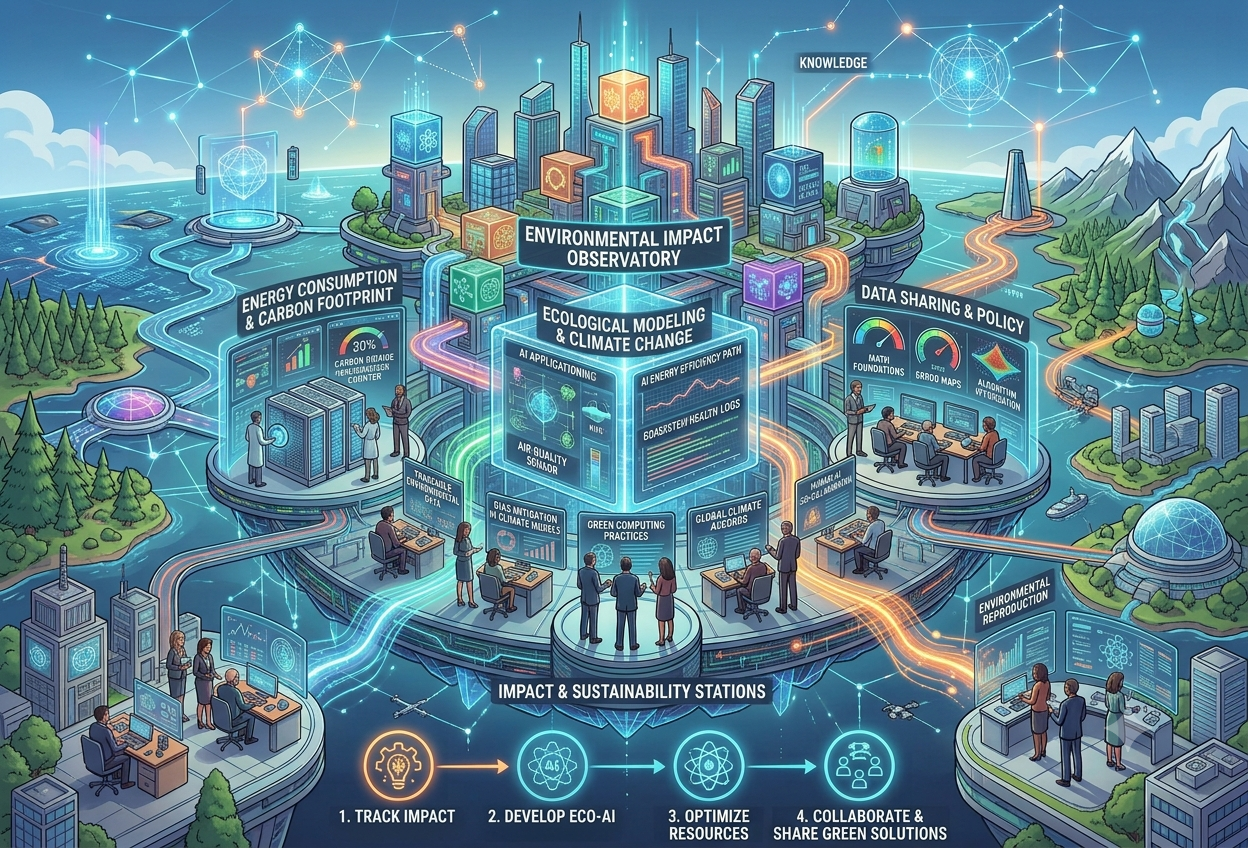
Environmental Impact of AI
AI’s Environmental Footprint, Defined
When you ask an AI chatbot a question, it can feel like magic happening somewhere far away in “the cloud.” But that cloud is not made of mist — it is made of enormous warehouses packed with humming machines, drawing real electricity from real power plants, cooled by real water pulled from real rivers and reservoirs.
“A lot of people think that the environmental footprint of AI shrinks as technology improves. But more efficient, cheaper AI tends to drive far more total use of AI — and that bigger usage can outweigh the efficiency gains entirely.”— Paraphrased summary of UN University research findings, 2026
The environmental footprint of AI describes the full set of resources — electricity, water, raw materials, and land — that get consumed to build, train, and run artificial intelligence systems, along with the waste and emissions that result. This footprint has three main parts that researchers track separately: a carbon footprint (the greenhouse gases released, mostly from generating electricity), a water footprint (the water used, mostly for cooling), and a land footprint (the physical space taken up by data centers, power infrastructure, and mining operations).
Imagine a giant, super-smart library where every single book is being read out loud by a robot librarian, all day and all night, to millions of people asking questions at once. That library needs lights, fans to stay cool, and a huge building to hold all the shelves. AI is a bit like that library — except instead of one building, there are thousands of them around the world, called data centers, and they need electricity and water just like any other building full of busy machines.
Where the Footprint Actually Comes From
AI’s environmental impact does not come from one single source — it builds up across the entire life of an AI system. Mining and manufacturing the computer chips that power AI uses energy and raw materials before a single line of code is even written. Training a large AI model on huge datasets can run for weeks on thousands of powerful machines at once. And once a model is finished training, every single time someone actually uses it — asking a question, generating an image — that use draws additional electricity, repeated billions of times a day across the world.
Greenhouse gases released, mostly from burning fossil fuels to generate the electricity AI systems consume.
Fresh water used to cool the hardware and to generate the electricity that powers it in the first place.
Physical space consumed by data centers, power lines, and the mining sites that supply raw materials for hardware.
Why AI’s Environmental Impact Matters So Much
AI is growing faster than almost any technology in history, and that growth is happening at exactly the moment the world is trying to cut greenhouse gas emissions and protect strained water supplies. The timing makes this a genuinely urgent issue, not a distant future concern.
To put the scale in perspective, researchers project that data centers powering AI could consume nearly three times the combined annual electricity use of Pakistan, Bangladesh, and Nigeria by the end of this decade — three countries that together are home to well over half a billion people. That single comparison helps explain why governments, scientists, and even the companies building AI itself are taking this issue increasingly seriously.
Three Reasons This Has Become Urgent
- Speed of Growth: AI adoption has expanded faster than almost any technology in recent memory, leaving little time for energy grids and water systems to adapt.
- Hidden from View: Most everyday users have no visibility into the resources their AI use consumes, making it hard to factor environmental cost into everyday decisions.
- Competing with Real Needs: Data centers increasingly compete with households, farms, and other industries for the same limited electricity and water supplies, sometimes in regions already under stress.
In some regions, data centers have already grown large enough to account for a meaningful share of total national electricity use — in one well-documented case, exceeding the combined electricity use of every household in the country. When growth like this happens faster than new clean power can be built, the gap often gets filled by fossil fuel generation, directly working against climate goals.
The Energy Problem: Training vs. Inference
Most public conversation about AI’s energy use focuses on the dramatic process of training a new model. But researchers have found that this is actually the smaller part of the story — the much bigger energy cost comes from something far less dramatic: everyday use.
Training is the process of teaching an AI model by having it study enormous amounts of data, often running on thousands of powerful processors continuously for days or weeks. It is genuinely energy-intensive — one widely cited 2021 estimate found that training a single large language model consumed enough electricity to power roughly 120 average American homes for an entire year. But training happens only periodically, whenever a new model is built.
Inference is what happens every single time someone actually uses a finished AI model — typing a question, requesting an image, asking for a summary. Each individual use of inference consumes far less electricity than training. But inference happens constantly, billions of times every single day, across every person using AI tools worldwide. Recent research estimates that this everyday, ongoing usage now accounts for somewhere between 80 and 90 percent of AI’s total energy demand — far outweighing the one-time cost of training.
Think about baking one giant batch of cookies versus running a cookie shop that bakes a few cookies every single minute, all day, every day, for years. The one giant batch sounds more dramatic, but the cookie shop’s tiny, repeated batches add up to far more flour and electricity over time. AI training is the giant batch; AI usage is the cookie shop that never closes.
Why Some Tasks Use Wildly More Energy Than Others
Not all AI tasks cost the same amount of energy. Generating a single AI-created image has been estimated to require well over a thousand times more energy than a simple text-classification task, and generating video demands even more than that. The type of task someone chooses to run on AI — a quick text answer versus a high-resolution video — can change its energy cost by orders of magnitude, even though both might feel equally instant and effortless to the person using them.
The Water Footprint of AI
When people picture an AI system’s environmental cost, they usually think of electricity. But the same computer chips that consume electricity also generate enormous amounts of heat — and cooling that heat down requires a surprising amount of fresh water.
Data centers most commonly use water-based cooling systems, where chilled water absorbs heat from the densely packed servers, similar to how sweat cools the human body. Researchers estimate that for every kilowatt-hour of electricity a typical data center consumes, it requires roughly two litres of water for cooling. Multiply that by the sheer scale of electricity AI consumes globally, and the water totals become substantial — measured not in swimming pools, but in numbers comparable to the basic annual water needs of well over a billion people.
Think about how your body sweats when you exercise hard — that sweat evaporating is what cools you down. Data centers use a similar trick, but with actual water flowing through pipes to carry heat away from the machines. The catch is that this “sweating” happens on a massive scale, using huge amounts of real, drinkable water that local communities and farms also depend on.
Two Separate Water Costs, Easily Confused
It helps to separate two different ways AI’s water footprint actually shows up. Direct water use is the water physically consumed on-site for cooling the data center’s hardware. Indirect water use is the water consumed elsewhere to generate the electricity the data center draws from the grid — many traditional power plants, including some fossil-fuel and nuclear plants, also use significant water for their own cooling processes. A data center’s true water footprint includes both, even though only the first kind is visible at the facility itself.
Why Location Makes Such a Big Difference
Identical data centers built in two different locations can have wildly different water impacts, depending entirely on local conditions. A facility built in a drought-prone region competes directly with farms and households for an already scarce resource, while one built somewhere with abundant rainfall or access to non-potable water sources places far less strain on the surrounding community. This is part of why researchers increasingly argue that AI’s environmental footprint cannot be judged by a single global number alone — local context changes the real-world severity enormously.
Solutions that look “green” from a carbon perspective do not automatically reduce other environmental costs. Switching electricity generation to certain renewable sources can lower carbon emissions while, in some cases, requiring more water or land than the energy source it replaced. Genuinely responsible AI development has to weigh carbon, water, and land together — not optimise for just one while quietly worsening the others.
The Numbers in Perspective
Big numbers like “terawatt-hours” and “billions of litres” can be hard to picture in everyday terms. Putting them next to familiar comparisons helps make the real scale of AI’s footprint genuinely graspable.
Researchers have estimated that a single AI chatbot query consumes roughly five times more electricity than a standard web search — a small difference per question that adds up enormously across billions of daily queries.
Per-Use CostOne widely cited estimate found that training a single major language model consumed enough electricity to power roughly 120 average American homes for an entire year — and that was before the model ever answered a single user.
Training CostIn one well-documented case, data centers accounted for over a fifth of an entire country’s total metered electricity in a single year — more than every household in that country combined, prompting the national grid operator to pause new approvals.
National ScaleGenerating a single AI image has been estimated to use well over a thousand times more energy than classifying a simple piece of text — a reminder that not all AI tasks are created equal.
Task Variation“It isn’t just the electricity you use when you plug the computer in. The real consequences stretch across an entire system, persisting from actions taken long before — and long after — any single query.”
— Paraphrased from MIT researcher commentary on generative AI’s footprintWhy These Comparisons Matter
None of these comparisons are meant to suggest AI should never be used — they exist to make an invisible cost visible. Most people have no natural way to sense how much electricity or water a digital action consumes, the way they might sense how much gas a car burns. Translating abstract technical units into familiar comparisons — homes powered, national electricity shares, search-engine equivalents — is one of the most effective tools researchers have for helping the public, and policymakers, grasp a footprint that would otherwise remain completely invisible.
Where the Impact Lands
AI’s benefits — faster research, new products, convenient assistants — flow out to people all over the world. But its environmental costs are not spread evenly at all. They concentrate heavily in specific places, often quite different from where the benefits are felt.
Data Center Hub Regions
A small number of regions host an outsized share of global data center capacity, absorbing the bulk of the electricity demand, water use, and land conversion that comes with it.
Mining & Extraction Regions
Communities near mines that supply raw materials for AI hardware bear environmental and social costs of extraction, often without sharing meaningfully in AI’s economic benefits.
Water-Stressed Areas
Some data centers have expanded in regions already experiencing drought conditions, intensifying competition between AI infrastructure and basic agricultural or household water needs.
E-Waste Receiving Countries
Discarded AI hardware frequently ends up in lower-income countries with limited capacity for safe disposal, creating localized pollution and health risks far from where the hardware was originally used.
A Striking Global Imbalance
Perhaps the starkest finding in recent research is just how concentrated AI’s computing power actually is. More than 90 percent of the world’s specialised AI computing capacity is located in just two countries, while over 150 nations have little to no significant domestic AI infrastructure of their own. This creates what researchers describe as a genuine environmental justice concern: some countries absorb a disproportionate share of the environmental costs of global AI infrastructure, while economic and technological benefits remain concentrated elsewhere.
Imagine a giant cookie factory built in just one neighbourhood, but the cookies get shipped and eaten by people all over the city. The neighbourhood with the factory deals with all the noise, smoke, and traffic, while everyone else just enjoys the cookies without seeing any of that. AI’s environmental footprint works in a strikingly similar way — a few places host the heavy infrastructure, while the convenience gets shared everywhere.
Pros & Cons: AI as Problem and Solution
AI’s relationship with the environment is genuinely two-sided. It is a significant and growing consumer of energy and resources — but it is also, at the very same time, one of the most powerful tools available for tackling environmental challenges, including climate change itself.
How AI Helps the Environment
- Optimises energy grids, reducing waste in electricity distribution
- Improves climate and weather modeling, supporting better disaster preparation
- Helps design more efficient buildings, engines, and industrial processes
- Accelerates scientific research into clean energy and new materials
- Powers precision agriculture that reduces water and fertiliser waste
- Monitors deforestation, wildlife, and pollution using satellite data analysis
How AI Harms the Environment
- Consumes rapidly growing amounts of electricity, often partly from fossil fuels
- Uses substantial fresh water for cooling, straining some local water supplies
- Requires environmentally costly mining and manufacturing of specialised hardware
- Generates a growing volume of electronic waste as hardware is replaced
- Concentrates environmental costs in specific regions, raising fairness concerns
- Can encourage a “rebound effect,” where efficiency gains are outpaced by surging demand
This dual nature is not a contradiction — it is simply the reality of any powerful general-purpose technology. Electricity itself can power both a hospital’s life-saving equipment and a wasteful factory; the technology is not inherently good or bad, but how, where, and how much it gets used determines the real-world outcome. The same is true of AI: its environmental impact depends heavily on specific choices about hardware efficiency, energy sourcing, and how thoughtfully it gets deployed.
The goal is not choosing between “AI for the environment” and “AI’s environmental cost” as if only one can be true. Both are simultaneously true, and the genuinely important question is whether the environmental benefits AI can deliver are being pursued seriously enough, and quickly enough, to outweigh the resource costs that AI’s own growth is creating.
The Rebound Effect: Why Efficiency Alone Isn’t Enough
It seems obvious that making AI more efficient should automatically shrink its environmental footprint. Surprisingly, real-world evidence suggests this is not always true — and understanding why reveals one of the trickiest dynamics in this entire topic.
This pattern is called the rebound effect: when a technology becomes more efficient and therefore cheaper or faster to use, people tend to use it a lot more — and that increase in total usage can outweigh, or even completely cancel out, the environmental savings the efficiency improvement was supposed to deliver. A more efficient AI model might use less energy per query, but if that efficiency leads ten times as many people to run a hundred times as many queries, the total environmental footprint can still grow substantially larger than before.
Imagine a new bus route opens that is much faster and cheaper than before. More people start riding the bus because it is so convenient now — way more people than ever rode the old, slower bus. Even though each bus trip uses less fuel per passenger than before, so many more buses are now running that the total fuel used by the bus system actually goes up, not down. AI efficiency can work exactly the same way.
What This Means for Solving the Problem
The rebound effect does not mean efficiency improvements are pointless — they genuinely help, and the footprint would be far worse without them. But it does mean that efficiency gains alone, without any other changes, cannot be relied upon to shrink AI’s total environmental impact. Genuinely reducing the footprint requires pairing efficiency with other deliberate choices: cleaner electricity sources, thoughtful limits on resource-intensive uses, and broader systemic planning — not just faster chips.
Laws & Industry Response
Governments, standards bodies, and the technology industry itself have all begun responding to AI’s environmental footprint — through a mix of new technical standards, disclosure requirements, and engineering investment.
Emerging Standards & Disclosure Requirements
New technical standards have begun formally addressing AI’s environmental footprint, providing organisations with structured ways to measure and report metrics such as workload efficiency, carbon impact, and water footprint across an AI system’s entire life cycle. Broader environmental management standards are also increasingly being applied specifically to data center operations, pushing operators toward more consistent measurement and improvement of their resource use.
One persistent challenge researchers highlight is that environmental disclosure from major technology companies remains limited and inconsistent. Some companies report overall increases in electricity consumption and explicitly attribute the growth to AI, but detailed, AI-specific environmental metrics — separate from a company’s general operations — remain rare. Several researchers argue that mandatory, standardised disclosure requirements would meaningfully improve the field’s ability to track and address this footprint.
Generative AI Boom Begins
The rapid public release of powerful generative AI tools triggers a sharp, sustained increase in global demand for AI computing infrastructure.
Major Tech Companies Report Rising Emissions
Several large technology companies publicly acknowledge in sustainability disclosures that AI-driven data center growth is increasing their overall electricity consumption and emissions.
New Technical Standards Emerge
Dedicated technical standards addressing the environmental sustainability of AI systems across their life cycle begin to be published and adopted.
Major International Research Reports Published
Comprehensive global assessments quantify AI’s combined carbon, water, and land footprints, prompting calls for coordinated international governance frameworks.
What the Industry Is Actually Building
Beyond formal regulation, considerable engineering effort is already going into reducing AI’s footprint directly. Advanced cooling techniques — including liquid cooling that runs coolant directly across computer chips, and immersion cooling that submerges hardware entirely in specialised fluid — have been shown to cut cooling-related electricity use substantially and reduce water consumption dramatically compared to older methods. Companies are also increasingly pairing data centers with dedicated renewable energy sources like solar and wind, and exploring reuse of the waste heat data centers generate for practical purposes like heating nearby buildings.
Imagine if your school decided that, instead of just trying to use less electricity, it would also install solar panels on the roof, plant a garden using leftover heat from the cafeteria ovens, and report every month exactly how much water and power it used. That is roughly what some companies are starting to do with their AI data centers — not just one fix, but several working together.
Principles for a Responsible AI Ecosystem
Rather than treating AI’s environmental footprint as an unsolvable side effect, researchers have proposed a coherent set of guiding principles for what a genuinely responsible approach to AI’s resource use should actually look like.
Transparency
Organisations should clearly disclose the energy, water, and material footprint of the AI systems they build and operate.
Efficiency by Design
Resource efficiency should be a deliberate design goal from the very start of building a model, not an afterthought addressed once a system is already in use.
Equity
The benefits and environmental costs of AI infrastructure should be shared more fairly, rather than concentrating costs in specific regions while benefits flow elsewhere.
Lifecycle Responsibility
Environmental accountability should cover an AI system’s full lifespan — manufacturing, training, everyday use, and eventual disposal — not just the moment it is switched on.
Global Cooperation
Because AI’s footprint and benefits cross national borders, meaningful solutions require coordination between governments, companies, and researchers worldwide.
Sustainable Use
Individuals and organisations should thoughtfully consider whether a resource-intensive AI task is genuinely necessary, rather than defaulting to AI for every task regardless of cost.
“This is not an argument against AI. It is a call for the technology to grow within the planet’s actual limits — guided by deliberate choices, not left to chance.”
— A common framing echoed across recent international environmental assessmentsWho Has a Role to Play
Responsibility for this issue does not rest on any single group. Governments can integrate AI infrastructure planning directly into broader energy, water, and land-use policy. Companies can design systems that minimise resource consumption and disclose their footprint honestly. And individual users, while holding far less power than governments or companies, can still make a meaningful difference by choosing lower-impact tools where genuinely equivalent options exist, and by being thoughtful about when a resource-heavy AI task is truly worth its cost.
The Road Ahead
AI’s environmental footprint has moved from a niche academic concern into front-page news and serious policy discussion in just a few short years. The challenge remains far from solved, but the tools, knowledge, and political will to address it are all growing quickly.
Reasons for Optimism
Advanced liquid and immersion cooling techniques have moved from experimental prototypes into large-scale, proven industry deployments.
ProgressRenewable electricity sources are reportedly the fastest-growing power source for data centers, expected to cover a substantial share of new demand by 2030.
EnergyNew technical standards are giving the industry a consistent, shared way to measure environmental impact, an essential first step toward genuine accountability.
StandardsTechniques like model pruning and specialised low-power chips are meaningfully reducing the energy required for a given amount of AI capability.
ResearchRemaining Challenges
- Demand Outpacing Decarbonization: If AI usage keeps growing faster than power grids can be cleaned up, total emissions can keep rising even as each unit of electricity gets greener.
- The Rebound Effect: Efficiency improvements alone are unlikely to offset rising demand if they simply make AI cheap enough to use far more often.
- Limited Transparency: Inconsistent, voluntary environmental disclosure from major AI developers makes it genuinely difficult to track real progress.
- Unequal Distribution of Costs: Environmental burdens remain heavily concentrated in specific regions and communities, while AI’s benefits spread far more broadly.
- The Water-Carbon-Land Trade-off: Solutions that improve one footprint can worsen another, requiring genuinely integrated planning rather than single-metric optimisation.
AI’s environmental footprint is not a side issue to be solved later — it is a core design and policy question that has to be addressed alongside AI’s growth, not after it. The technology that may help humanity tackle climate change must not, in the process of growing, become a significant driver of the very problems it could otherwise help solve.
United Nations Environment Programme overview of AI’s environmental challenges and potential policy responses.
Accessible explainer covering the basics of AI’s energy and resource consumption for general audiences.
Peer-reviewed analysis of the carbon and water footprints of data centers supporting AI workloads.
Comprehensive reference overview consolidating research on AI’s energy, water, and material footprints.
Detailed technical explainer covering data center energy demand, water cooling, and hardware manufacturing impacts.
Advocacy organisation’s perspective connecting AI’s energy demands to broader environmental and democratic concerns.
Major research collection quantifying AI’s combined carbon, water, and land footprints through 2030.
2026 reporting on the UN University findings, including the rebound effect and global digital divide in AI infrastructure.
Educational resource translating AI’s abstract environmental statistics into relatable comparisons.
Government training resource summarising AI’s environmental considerations for public sector audiences.
Further peer-reviewed analysis of sustainable AI infrastructure design and mitigation strategies.
In-depth examination of the tension between AI’s potential and its environmental costs, including mitigation pathways.