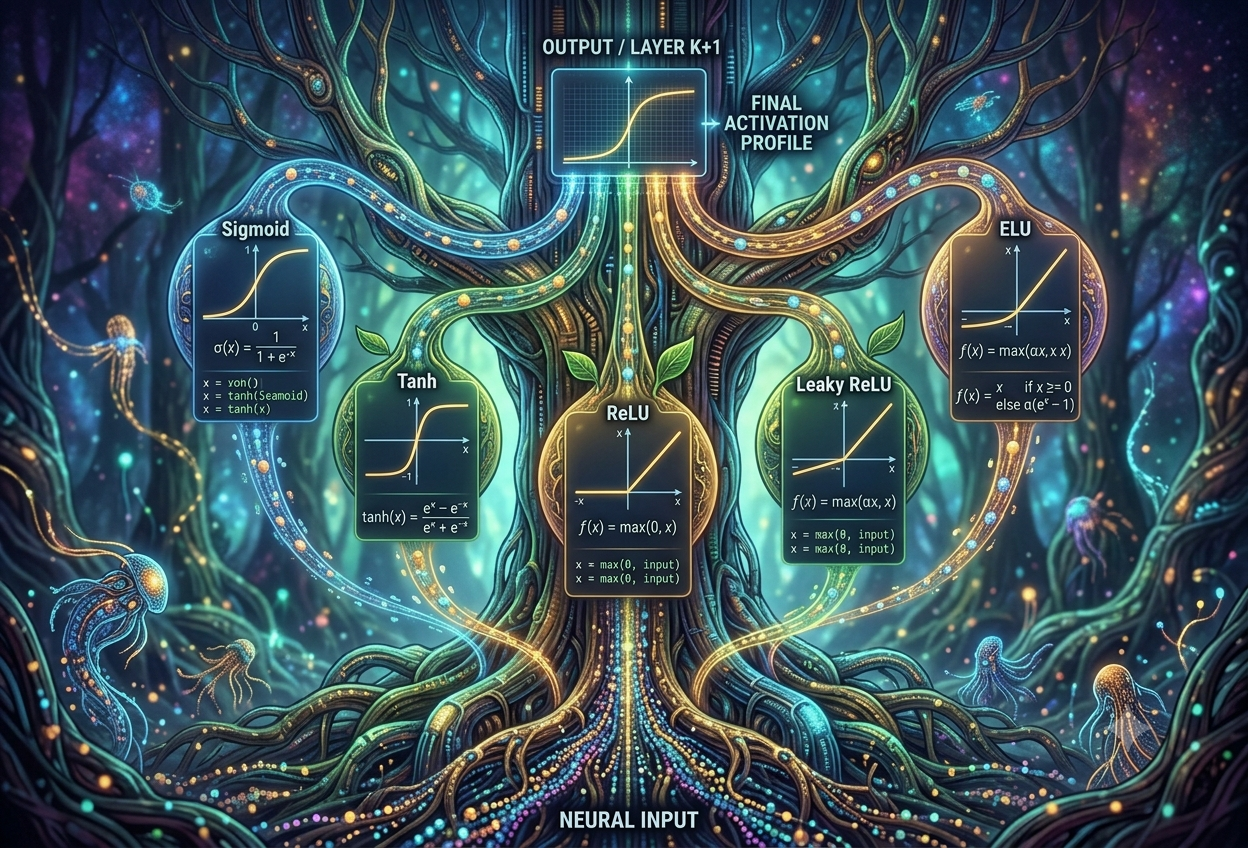
Activation Functions in AI — A Complete Reference Guide
What Is an Activation Function?
Imagine you are playing a video game and your character must decide whether to jump over an obstacle. If the obstacle is big enough, you press jump — otherwise you do nothing. Activation functions work in almost exactly the same way inside an artificial brain.
Every artificial neural network is made of tiny computing units called neurons. Each neuron receives a bunch of numbers as input, multiplies them by importance scores called weights, adds them all up, and then asks one final question: “Should I fire a signal to the next neuron, and if so, how strongly?” The function that answers that question is the activation function.
An activation function is a mathematical rule that transforms the raw, combined input of a neuron into a meaningful output signal — deciding whether and how strongly that neuron should respond.— Core concept in Deep Learning
Think of it as a gatekeeper sitting at the exit of every neuron. The gatekeeper reads the total message coming in and decides what signal to let out. Without this gatekeeper, every layer of the network would just be a plain multiplication — and the whole network would behave as one giant straight line, unable to learn anything truly interesting.
The Simple Formula
Every neuron performs this two-step calculation before it passes a value to the next layer:
The w values are the weights (how important each input is), b is a bias (a small offset to shift the decision), and f is the activation function. Everything before the activation is linear. The activation function is what adds the magic — the non-linearity — that allows the network to learn from complex patterns in the real world.
Picture a lamp with a dimmer switch. The electrical signal (your input) goes in, and the dimmer (activation function) decides how bright the light should glow. Some dimmers only go on or off. Others can make the light very dim, medium, or very bright. The kind of dimmer you use changes how much control you have over the light — and that is exactly what different activation functions do for AI!
The Brain Analogy
Long before computers existed, scientists were fascinated by one question: how does the human brain think? The answer turned out to be surprisingly electrical — and that electricity is what inspired everything in modern AI.
Your brain contains roughly 86 billion neurons. Each neuron is a tiny living cell that collects signals through branches called dendrites and sends signals out through a long tail called the axon. Most of the time a neuron stays quiet — but when it receives enough combined signal from other neurons, it fires, sending a pulse down the axon and activating the next neurons in the chain.
The key similarity is the threshold decision. In biology, a neuron only fires if the combined incoming signal is strong enough. In artificial networks, the activation function plays this exact role — it sets the threshold logic and shapes the output. Scientists Warren McCulloch and Walter Pitts first formalised this idea in 1943, kick-starting the entire field of neural computing.
Your brain fires about 100 trillion signals every second across its 86 billion neurons. Even the biggest AI supercomputers today are still far behind the brain in terms of energy efficiency — but activation functions are one of the key tools helping AI get smarter every year.
Why Do We Need Activation Functions?
Without activation functions, even the deepest, most complex neural network collapses into a single straight line — completely unable to learn the curved, twisting shapes of real-world data.
The Linearity Problem
Let’s think through this step by step. If every neuron just passes its weighted sum to the next layer with no activation function, then Layer 2 is a linear combination of Layer 1, and Layer 3 is a linear combination of Layer 2 — and so on forever. No matter how many layers you stack, the final answer is still just one big linear function of the original inputs. That means you could replace 100 layers with 1 layer and get exactly the same result. All that depth is wasted!
Four Big Reasons We Use Activation Functions
Real data — photos, voices, medical scans — is never a straight line. Activation functions bend the network’s decision boundaries so it can fit these complex shapes.
CoreEach layer in a deep network learns a different level of feature — edges, then shapes, then objects. Non-linearity makes this layered learning possible.
DepthDifferent functions produce different output ranges (0 to 1, −1 to 1, or 0 to ∞). This lets us match the network’s final output to the kind of answer we need — a probability, a category, or a number.
RangeDuring training, the network adjusts its weights using gradients. The right activation function keeps those gradients healthy — not too tiny (vanishing) and not too huge (exploding).
TrainingA Brief History of Activation Functions
The history of activation functions is really the history of how researchers unlocked deeper and deeper AI — each new function solving the problems the previous one created.
Warren McCulloch and Walter Pitts introduced the first mathematical model of a neuron. It used a dead-simple rule: output 1 if the input is above a threshold, output 0 if not — like a light switch.
Frank Rosenblatt used a step function in his Perceptron — the first trainable neural unit. It could classify simple patterns but was limited to linearly separable problems.
The backpropagation algorithm, popularised by Rumelhart, Hinton and Williams, needed a smooth, differentiable activation. The sigmoid function became the standard, enabling the first wave of multi-layer networks.
Researchers discovered that the tanh function, which outputs values between −1 and +1, trained faster than sigmoid because its outputs are centred around zero — a small but important mathematical advantage.
Vinod Nair and Geoffrey Hinton showed that the Rectified Linear Unit (ReLU) outperformed sigmoid and tanh for deep networks. Simpler, faster, and resistant to vanishing gradients — ReLU unlocked the era of deep learning.
Leaky ReLU, PReLU, ELU, and SELU were introduced to fix the “dying ReLU” problem — where neurons can get stuck outputting zero and never recover. Each variant tweaked the formula to keep all neurons active.
Google Brain introduced Swish in 2017. Mish followed in 2019. GELU (Gaussian Error Linear Unit) was adopted in BERT and GPT models. These smoother functions outperformed ReLU on many modern tasks, especially in transformer-based language models.
Researchers began exploring learnable activation functions — ones whose shape is not fixed but adapts during training, allowing the network to discover the best possible gating function for its specific task.
Every Major Activation Function Explained
Below we walk through every important activation function — with its formula, shape, strengths, weaknesses, and real-world uses. Think of this as your complete field guide.
The linear function simply passes the input through, possibly scaled by a constant. It produces no non-linearity whatsoever, which means stacking multiple linear layers is pointless — the entire network becomes equivalent to a single layer.
When it is used: Occasionally in the output layer of regression models, where the network needs to predict any real number without restriction.
✓ Pros
Fast, simple. Good for regression output layers where the answer can be any number.
✗ Cons
Zero non-linearity. Cannot learn complex patterns. Gradient is always constant — no learning signal variation.
f(x) = 0 // if x < 0
Like a simple light switch: it is either fully on or fully off. This was the original activation used in the McCulloch–Pitts neuron model. It works for very simple classifiers but completely fails in deep learning because its gradient is zero everywhere — the network cannot learn from its mistakes.
✓ Pros
Extremely simple. Great for binary decisions. Easy to understand.
✗ Cons
Cannot be used with backpropagation (zero gradient). Useless in multi-class problems.
The sigmoid squashes any input — no matter how large or small — into the range 0 to 1. This makes it perfect for representing probabilities. If the output is 0.9, you can say “there is a 90% chance this email is spam.” The S-shaped curve is smooth and differentiable everywhere, which makes learning via backpropagation possible.
Real use: Output layer of binary classification models (is this a cat? yes/no). Heart disease risk prediction. Spam filters.
✓ Pros
Output always between 0 and 1 — interpretable as probability. Smooth gradient. Well-studied mathematically.
✗ Cons
Vanishing gradient problem in deep networks. Outputs not centred at zero — slows learning. Slow due to exponentiation.
When sigmoid values get close to 0 or 1, the gradient (the “learning signal”) becomes nearly zero. In a deep network with many layers, multiplying many near-zero gradients together makes the signal disappear completely before it reaches the early layers — so those layers stop learning. This is called the vanishing gradient problem, and it’s why sigmoid was eventually replaced by ReLU in hidden layers.
Tanh is like a stretched and shifted version of sigmoid. Instead of squashing inputs to 0–1, it squashes them to −1 to +1. This zero-centred output is a significant advantage: it means the gradients during training are more balanced, and the network often learns faster than it would with sigmoid.
Real use: Recurrent neural networks (RNNs), LSTM cells for sequence data (text, time series). Hidden layers where zero-centred output matters.
✓ Pros
Zero-centred — faster convergence than sigmoid. Stronger gradients near origin. Better for hidden layers.
✗ Cons
Still suffers vanishing gradient at extreme values. Similar cost to sigmoid. Not sparse — all neurons always fire.
ReLU is beautifully simple: if the input is positive, pass it through unchanged. If it is negative, output zero. That is it. Yet this tiny rule changed the entire field of deep learning. ReLU is very fast to compute (just a comparison, no exponentiation), creates sparse networks (many neurons are off at any given moment), and dramatically reduces the vanishing gradient problem for positive inputs.
Real use: Image recognition (CNNs), object detection (YOLO, ResNet, VGG), most hidden layers in general deep learning.
✓ Pros
Extremely fast. Solves vanishing gradient for positives. Creates sparse, efficient activations. Dominant in CNNs.
✗ Cons
“Dying ReLU” — neurons that receive only negatives permanently output zero and stop learning. Output not bounded.
Imagine a water filter. If dirty water (negative number) comes in, the filter blocks it completely — zero water out. If clean water (positive number) comes in, it passes through exactly as is. ReLU is like that filter for neuron signals — it blocks the bad signals and passes the good ones straight through!
f(x) = αx // if x ≤ 0 (α ≈ 0.01)
Leaky ReLU fixes the dead neuron problem by allowing a tiny trickle of signal through even for negative inputs. The slope on the negative side is a small constant (typically 0.01). PReLU (Parametric ReLU) takes this further — the slope α is not fixed but is a learnable parameter, so the network itself decides how much to let through.
✓ Pros
No dead neurons. Keeps learning alive even for negative inputs. PReLU adapts its slope automatically.
✗ Cons
α value must be tuned carefully for Leaky ReLU. PReLU adds trainable parameters and can overfit on small datasets.
f(x) = α(ex − 1) // if x ≤ 0
ELU (Exponential Linear Unit) uses an exponential curve for negative inputs, making the transition smooth. This tends to produce more accurate models than Leaky ReLU on complex tasks. SELU (Scaled ELU) adds carefully chosen scale factors so that activations automatically stay normalised (mean ≈ 0, variance ≈ 1) as they pass through layers — eliminating the need for batch normalisation in some architectures.
✓ Pros
Smooth everywhere. ELU has better representational accuracy. SELU is self-normalising — can replace batch norm.
✗ Cons
More expensive than ReLU. SELU only self-normalises under strict conditions (specific init, pure MLP architectures).
Softmax is different from all other functions we have discussed — it operates on an entire layer of neurons rather than one neuron at a time. It takes a list of raw scores (called logits) and converts them into a proper probability distribution: every output is between 0 and 1, and all outputs sum to exactly 1.0. This makes it perfect for the final layer of a classifier that needs to choose between multiple categories.
Real use: Image classification (cat? dog? bird?), natural language — predicting the next word, medical diagnosis across multiple diseases.
✓ Pros
Produces valid probability distribution. Perfect for multi-class output. Outputs are interpretable — largest probability is the predicted class.
✗ Cons
Not used in hidden layers. Susceptible to overconfidence. Can be numerically unstable (fixed with log-sum-exp trick).
Mish: f(x) = x · tanh(ln(1 + ex))
Swish was discovered in 2017 by Google Brain researchers using an automated search process. Rather than just clipping negatives to zero (like ReLU), Swish multiplies the input by its own sigmoid, creating a smooth, slightly curved function that allows small negative values. Mish is a similar idea but with a slightly different formula, producing an even smoother curve. Both functions consistently outperform ReLU on deep networks in practice.
✓ Pros
Smooth and differentiable. Allows small negative values. Empirically outperforms ReLU on deeper models. Swish is used in EfficientNet.
✗ Cons
More expensive than ReLU. Gain over ReLU is task-dependent. Not as widely supported in all frameworks.
// Φ = Gaussian CDF
≈ 0.5x(1 + tanh[√(2/π)(x + 0.044715 x3)])
GELU multiplies the input by the probability that a standard normal random variable is less than or equal to that input. This creates a stochastic gating effect — the function treats each input as though it is deciding probabilistically whether to pass the signal through or not. This aligns well with the attention mechanisms in transformer models. GELU is used in BERT, GPT-2, GPT-3, and almost every modern language model.
✓ Pros
State-of-the-art for NLP and transformer models. Smooth everywhere. Theoretically grounded in Gaussian probability. Widely supported.
✗ Cons
More expensive than ReLU. Not as intuitive — harder to explain. Approximation required for efficient computation.
Common Problems with Activation Functions
Even the best activation functions come with pitfalls. Knowing these problems is what separates a good AI practitioner from a great one.
Vanishing Gradients
When a network is very deep, the gradients (the error signals that tell the weights how to adjust) can shrink exponentially as they travel backwards from the output layer to the input layer. Sigmoid and tanh are the main culprits — their derivatives are at most 0.25 and 1 respectively, so multiplying dozens of them together approaches zero fast. The first layers of the network effectively stop learning.
Use ReLU, Leaky ReLU, ELU, or GELU in hidden layers. Use proper weight initialisation (He init for ReLU, Glorot for tanh/sigmoid). Add skip connections (as in ResNet) so gradients have a shortcut path.
Exploding Gradients
The opposite problem: gradients grow exponentially as they travel backwards, causing the weights to change by enormous amounts during each training step. The network becomes wildly unstable. This is more common in recurrent networks.
Gradient clipping (cap gradients at a maximum value). Proper weight initialisation. Batch normalisation. Use LSTM or GRU cells which include built-in gating mechanisms in recurrent networks.
Dying ReLU
When a ReLU neuron receives negative inputs consistently during training, it outputs zero — and its gradient is also zero, so the weights never update. The neuron is “dead” and cannot recover. This can happen to a large fraction of neurons in a poorly initialised network.
Use Leaky ReLU, PReLU, or ELU instead of standard ReLU. Use careful weight initialisation. Reduce the learning rate. Use batch normalisation before the activation.
Computational Cost
Functions like sigmoid, tanh, ELU, GELU, and Mish all require computing exponentials (ex), which are expensive operations when performed billions of times per training step. ReLU requires only a simple comparison, making it significantly faster — which is why it remains the default choice when training speed matters most.
How to Choose the Right Activation Function
There is no single “best” activation function — the right choice depends on your task, your architecture, and where in the network you are placing the function.
| Where / What Task | Recommended Function | Why |
|---|---|---|
| Hidden layers (general) | ReLU | Fast, effective, well-understood default |
| Very deep networks / CNNs | Leaky ReLU or ELU | Avoids dying ReLU problem |
| Transformers / NLP models | GELU or Swish | Smoother gradients, proven in BERT & GPT |
| Recurrent networks (RNN/LSTM) | Tanh (internal), Sigmoid (gates) | Zero-centred output, bounded values for stability |
| Binary classification output | Sigmoid | Maps to 0–1 probability for yes/no decisions |
| Multi-class classification output | Softmax | Converts scores into a proper probability distribution |
| Regression output (any real number) | Linear (no activation) | No need to constrain the output range |
| Very small datasets | Sigmoid or Tanh | ReLU variants can be unstable with few examples |
| Self-normalising networks (no BatchNorm) | SELU | Automatically normalises layer activations |
A Simple Decision Tree
Where Are Activation Functions Used?
Activation functions are everywhere — in the phone in your pocket, the hospital scanner checking your health, the car driving itself down the road, and the assistant reading these words to you.
Computer Vision
ReLU powers image classifiers like ResNet and VGG. Every time your phone unlocks with Face ID or Instagram adds a filter, dozens of ReLU activations are firing inside a convolutional neural network. Leaky ReLU and Swish are increasingly used in object detection systems like YOLO.
Natural Language Processing
GELU is the activation of choice in almost every modern language model — BERT, GPT-3, GPT-4, and beyond. When ChatGPT understands your question or translates a document, GELU activations are processing every word in every transformer layer.
Healthcare & Medicine
Sigmoid outputs give doctors probability scores for disease risk. Neural networks using ReLU hidden layers analyse MRI and CT scans to detect tumours, diabetic retinopathy, and skin cancer with accuracy matching specialist physicians.
Autonomous Vehicles
Self-driving cars use deep convolutional networks with ReLU and Swish activations to recognise pedestrians, traffic signs, lane markings, and other vehicles in real time, processing camera feeds dozens of times per second.
Reinforcement Learning & Gaming
AlphaGo, AlphaFold, and game-playing AI agents use ReLU and tanh activations in their policy and value networks. The same functions that decide your neural network’s output also decide whether an AI should move a chess piece or fold a protein.
Recommendation Systems
Netflix, Spotify, and Amazon use deep learning with ReLU activations to predict which movie, song, or product you will enjoy next — all based on patterns learned from millions of other users’ behaviours.
Scientific Research
AlphaFold 2 — which predicted the structure of nearly every known protein — uses a mixture of softmax, ReLU, and custom gating functions to solve one of biology’s hardest problems, saving years of laboratory work.
Finance & Banking
Fraud detection models use sigmoid outputs (probability of fraud) backed by ReLU hidden layers trained on transaction histories. Credit scoring models use similar architectures to estimate the risk of loan default.
Pros & Cons Summary Table
A quick reference comparing every major activation function across the dimensions that matter most in practice.
| Function | Output Range | Vanishing Gradient? | Dying Neurons? | Computation | Best Use |
|---|---|---|---|---|---|
| Linear | (−∞, +∞) | No | No | ⚡ Fastest | Regression output |
| Step | {0, 1} | Yes (zero grad) | Yes (all stuck) | ⚡ Fastest | Perceptrons only |
| Sigmoid | (0, 1) | ⚠️ Yes (severe) | No | 🐢 Slow | Binary output layer |
| Tanh | (−1, +1) | ⚠️ Yes (moderate) | No | 🐢 Slow | RNN hidden, LSTM |
| ReLU | [0, +∞) | Partial (positive) | ⚠️ Yes | ⚡ Fast | CNN hidden layers |
| Leaky ReLU | (−∞, +∞) | Partial | No | ⚡ Fast | Improved ReLU |
| ELU | (−α, +∞) | Partial | No | 🔶 Medium | Deep hidden layers |
| SELU | (−λα, +∞) | No (self-norms) | No | 🔶 Medium | MLP without BatchNorm |
| Softmax | (0, 1) · Σ=1 | Partial | No | 🔶 Medium | Multi-class output |
| Swish | (−~0.28, +∞) | No | No | 🔶 Medium | EfficientNet, deep nets |
| Mish | (−~0.31, +∞) | No | No | 🔶 Medium | Object detection |
| GELU | (−~0.17, +∞) | No | No | 🔶 Medium | Transformers, LLMs |
The Future of Activation Functions
The search for the perfect activation function is far from over. As AI models grow more complex and are applied to harder problems, researchers are pushing the boundaries of what these mathematical gatekeepers can do.
Instead of choosing a fixed shape, future networks may learn their own activation functions during training — adapting the shape of every neuron’s gatekeeper to best fit the task at hand.
EmergingSome research shows that different parts of a network benefit from different activation shapes. Using a learnable combination of multiple functions can outperform any single choice.
ResearchAs quantum computing matures, researchers are exploring activation functions designed for quantum neural networks — where the very nature of computation is fundamentally different from classical electronics.
FutureWith growing concerns about the carbon footprint of AI training, researchers are designing activation functions that achieve high accuracy with far fewer floating-point operations — reducing energy consumption per inference.
Green AIEvery great leap in AI capability has been accompanied by a better activation function. The next breakthrough is probably already being scribbled on a researcher’s whiteboard right now.
Kids’ Corner 🎉 — Everything Explained Simply
If you are 10 years old (or you just love simple explanations), this section is for you. Every activation function explained with everyday things you know!
Linear = A dimmer switch
Whatever power you put in, you get exactly the same power out — just maybe a bit brighter or dimmer. No surprises. But you cannot make the light change colour, only brightness.
Step = A traffic light
It is either red (stop = 0) or green (go = 1). There is no in-between. Easy to understand, but you cannot tell how fast to go — just stop or go.
Sigmoid = A volume knob
Start at zero (silent), end at 1 (full volume). You can be anywhere in between. If you push the knob too far either way, it gets stuck near zero or one — like the vanishing gradient!
Tanh = A thermometer
Goes from −1 (very cold) to +1 (very hot) with 0 in the middle being room temperature. Balanced around zero, so it tells you both how cold AND how hot something is.
ReLU = A spotlight
If it’s bright (positive), the spotlight shines exactly that much. If it’s dark (negative), the spotlight stays completely off. Simple, fast, and very popular!
Softmax = Sharing a pizza
You have slices for Cat, Dog, and Bird. Softmax makes sure all the slices are shared fairly and add up to the WHOLE pizza (100%). The animal that gets the most pizza is the winner!
Swish & GELU = A gentle wave
Instead of turning off completely like ReLU, these allow a tiny ripple of information to sneak through even in the negative zone. Like a wave that never quite goes to zero.
Leaky ReLU = A locked door with a crack
Most signals go through the main door (positive numbers). Negative numbers are locked out — but there is a tiny crack that lets a little bit through, so no signal is completely wasted.
ELU = A smooth ramp
For negative numbers it curves down gently — not a sharp drop like ReLU. Imagine a playground slide that smoothly curves at the bottom instead of having a sharp corner.
Every time you use Siri, Google Assistant, or any AI — billions of tiny decisions are being made every second by activation functions. They are the reason AI can understand your voice, see your face, and chat with you. They are small mathematical rules, but together they create something that feels almost magical!
Sources & References
Detailed overview of types, mathematical formulations, advantages, disadvantages, and application guidance.
Mathematical examples, visual explanations, and code illustrations of major activation functions.
Concise definitional reference covering key activation types and their roles in network training.
Practitioner-focused guide covering function selection, pros/cons, and architectural considerations.
Hands-on tutorial from ReLU to Softmax with implementation examples in Python/TensorFlow.
Comprehensive blog covering common pitfalls, the dying ReLU problem, and advanced function variants.
Accessible tutorial aimed at beginners, with practical Python examples and clear visual diagrams.
In-depth breakdown of mathematical properties, gradient behaviour, and real-world model recommendations.
Career-oriented overview covering what functions are used in industry and how to reason about the choice.
Community-authored deep dive with annotated visual graphs and intuitive analogies for each function.
Enterprise and research perspective on how activation functions influence model architecture decisions.
Patent and innovation-focused look at the evolution and technical definitions of activation functions.
Quick-reference glossary with concise definitions, formula notations, and use-case pointers.