Bias in AI Systems
What Is AI Bias?
Imagine you had a robot friend who learned everything it knows by reading a million books — but all those books were written by the same type of person. That robot might think the whole world is just like what it read about. That is basically what AI bias is.
“Bias is a human problem. When we talk about bias in AI, we must remember that computers learn from us — and if what we teach them is unfair, they become unfair too.”— Michael Choma, Yale University School of Medicine
Artificial intelligence (AI) is a kind of computer program that learns to make decisions by studying huge amounts of information (called data). AI bias happens when those decisions turn out to be unfair — usually because the data it learned from was already unfair, incomplete, or lopsided in some way.
Think of it this way: if you only ever ate at one restaurant, you might think that restaurant makes the best food in the world. But you have not tried anywhere else! An AI system trained on narrow or one-sided data makes the same kind of mistake — except instead of food preferences, it might be making important decisions about people’s jobs, healthcare, or freedom.
Imagine your teacher only ever marked the homework of students who sit in the front row. Over time, the teacher might start to think that front-row kids are always smarter — simply because those are the only kids whose work she has seen. An AI can make the same mistake when it only “sees” certain kinds of people in its training data.
Three Quick Names for the Same Thing
You might hear AI bias called different names in different places. They all mean roughly the same thing:
When the mathematical formula (algorithm) that powers the AI produces unfair results for certain groups of people.
When the AI program, which learns by looking at data, picks up prejudices that were quietly hiding inside that data.
When the information used to teach the AI is skewed, incomplete, or does not fairly represent all kinds of people.
Why AI Bias Matters So Much
AI is no longer just a science experiment. It is being used right now to decide who gets hired, who receives a loan, who is flagged by police, and what medical treatment a patient gets. When these systems are biased, real people get hurt.
Fifty years ago, unfair decisions were made by individual humans — a prejudiced bank manager, a biased hiring committee. Those decisions were still wrong, but they affected one person at a time. Today, a single biased AI algorithm might make millions of decisions per day across an entire country. That means bias at the speed and scale of software.
The Cycle That Makes It Worse
Here is something really tricky: biased AI can actually make humans more biased. Research shows that when people work alongside biased AI systems, they start adopting those same biased patterns in their own thinking — even when they are not using the AI. It is a loop that feeds itself.
When a bank’s AI denies loans to qualified applicants based on race, two harmful things happen simultaneously: the deserving applicants lose access to financial opportunity, and the less-qualified applicants who jump the queue may take on debt they cannot manage. Everyone loses — especially society’s trust in AI.
How Bias Gets Into AI
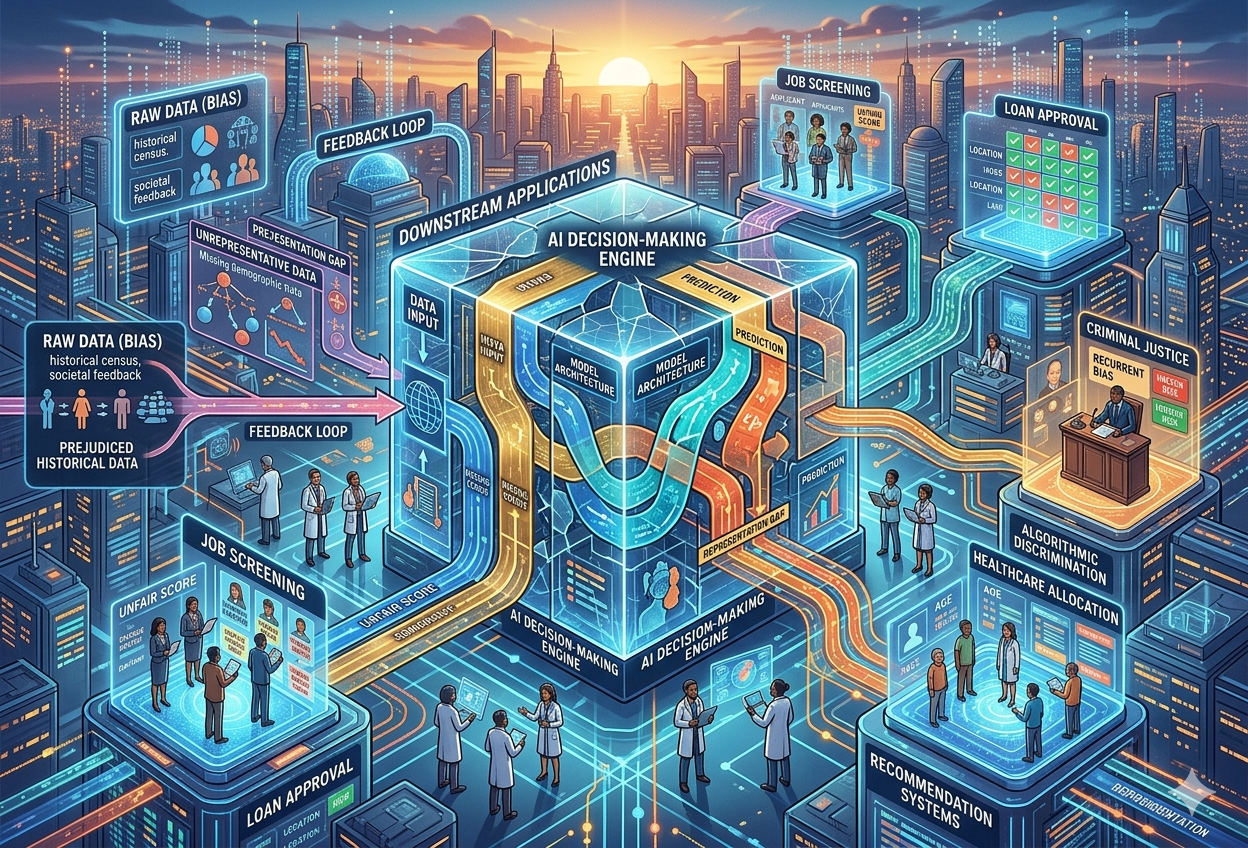
Bias does not magically appear inside a computer — it sneaks in through the doors that humans open. There are several entry points along the journey from raw data to a working AI system where things can go wrong.
The Main Reasons Bias Sneaks In
- Unfair Training Data: The most common culprit. If the data used to teach the AI reflects old prejudices — like historical hiring records that favoured one gender — the AI will learn to copy those prejudices. Garbage in, garbage out.
- Not Enough Variety: If a facial recognition system is trained mostly on photos of light-skinned people, it will naturally be less accurate when it tries to recognise people with darker skin. The AI simply has not seen enough of them to learn well.
- Human Labellers’ Own Biases: AI often needs humans to label data — for example, “this photo is a doctor” or “this resume is good.” If the humans doing the labelling hold unconscious prejudices, those prejudices get baked right into the AI.
- Feedback Loops: Once an AI is running, it keeps learning from new data. If its early biased decisions create new biased data, the AI learns from those too, making itself even more biased over time.
- Incomplete Problem Definition: Sometimes engineers ask the AI to solve the wrong problem. For example, asking “predict who will succeed” using data from a historically unequal world will just predict who has been given a chance to succeed — which is very different.
- Invisible Proxies: Sometimes an AI avoids using a protected category like “race” directly, but uses a related variable — like zip code — that ends up acting as a hidden stand-in. The bias is still there, just disguised.
Imagine a school that says “we don’t consider which neighbourhood a student lives in.” But then it says students from schools with high test-score averages get priority. Since wealthy neighbourhoods tend to have higher-scoring schools, the neighbourhood has crept back in through the back door. This is called a “proxy variable” — and AI systems do this all the time.
Types of AI Bias
AI bias comes in many flavours. Knowing their names helps you spot them in the wild — and explain them to others. Here are the most important types, explained in everyday language.
The training data does not properly represent all groups. Imagine surveying only people who own smartphones to understand how all people use technology. You automatically miss everyone without one.
The personal beliefs and blind spots of the humans who build the AI creep into the system, often without anyone noticing. We all have mental shortcuts, and they can get accidentally programmed in.
The AI doubles down on what it already “believes.” Instead of exploring new patterns, it keeps confirming the old ones. It is like only reading news articles that agree with what you already think.
Important pieces of data are accidentally left out, usually because the person building the dataset did not realise they were important. The AI is then making decisions with an incomplete picture.
The tool used to collect data itself introduces errors. Like trying to measure everyone’s temperature with a broken thermometer — the measurements are consistently off for certain conditions.
The AI reinforces harmful generalisations — for example, associating certain professions only with men or women, or assuming certain ethnicities are linked to certain behaviours. These patterns in old data become new decisions.
When humans label data for AI training, they apply labels inconsistently. One labeller might call something “aggressive” where another calls it “confident.” These inconsistencies pollute the AI’s learning.
The AI treats people outside the majority group as if they are all the same. It accurately distinguishes between individuals in the majority, but lumps minority groups together — making far more errors for them.
Social stereotypes and assumptions — that “nurses are female” or “executives are male” — have been written into historical data and are now being absorbed and repeated by the AI as if they were facts.
Even when the data is fine, the mathematical method used to process it can produce unfair results. A poorly designed algorithm might optimise for one group’s outcomes at the expense of another’s.
“A naive approach to removing prejudice — such as simply deleting protected categories like gender or race from the data — often does not work. The AI finds other ways to discriminate through related variables.”
— McKinsey Global Institute, AI Fairness ResearchReal-World Examples of AI Bias
These are not hypothetical situations. AI bias has already caused real, documented harm to real people all over the world. Here are some of the most striking examples — explained clearly so anyone can understand what went wrong.
🏥 Healthcare: When the Doctor Gets it Wrong for Some Patients
A widely studied healthcare algorithm was designed to identify patients who would need extra medical care and support. To predict this, it looked at how much each patient had spent on healthcare in the past. This sounds logical — until you realise that many Black patients had historically spent less because they could not afford care, not because they were healthier. The AI therefore consistently ranked them as needing less help, even when they were sicker than white patients whose spending was higher.
A medical journal study found that most AI diagnostic tools for skin cancer were trained on datasets made up almost entirely of images of fair-skinned patients. Out of over 100,000 training images examined across 21 global datasets, only 11 explicitly depicted brown or black skin tones — and none represented patients of African or South Asian heritage. When tested on diverse patients, leading AI tools showed dramatically higher error rates for darker skin tones, sometimes missing cancerous lesions that early detection — which carries a 99% survival rate — would have caught.
💼 Hiring: The Robot That Did Not Like Women
One of the most famous cases of AI bias in hiring involved a large technology company that built an AI system to screen job applications. The system had been trained on ten years of past successful applicants — most of whom were men, because the tech industry at the time was dominated by men. The AI concluded that being male was a positive signal for job success and quietly penalised résumés that included words like “women’s” (as in “women’s chess club”). The company discovered the problem and scrapped the tool.
A Stanford University study published in Nature in 2025 found that large language models like ChatGPT carry deep-seated biases against older women in workplaces. When researchers asked AI to write résumés for fictional candidates, it consistently portrayed older women as younger and less experienced than male peers of the same age. When the same AI was then asked to rate those very résumés, it scored older men higher than older women with identical qualifications.
👮 Policing: Predicting Crime Based on Colour
Several police departments in the United States used AI tools designed to predict where crimes were likely to occur and which individuals were likely to reoffend. These tools relied on historical arrest data. The problem? Historical policing had itself been racially unequal — Black and Brown communities had been policed more heavily, resulting in more arrests there, regardless of actual crime rates. The AI learned this pattern and continued it, recommending more police presence in the same over-policed areas, feeding a self-reinforcing cycle.
🖼️ Image Generation: Who Runs the World?
A Bloomberg investigation asked an AI image generator to produce over 5,000 pictures of people in various roles. What it found was striking: virtually all CEOs generated were white men. Women were rarely shown as doctors, lawyers, or judges. When the tool was asked to generate images associated with crime, it overwhelmingly produced people with darker skin. The AI had absorbed decades of media stereotypes and was now recreating them at scale.
🎙️ Voice Recognition: Not Hearing Everyone Equally
Voice-command technology built largely by teams in one country often performs poorly for speakers with accents from other regions or countries. People who grew up speaking English in Nigeria, India, or Scotland report that these systems frequently mishear them or refuse to recognise their commands. This forces people to alter the way they naturally speak just to use mainstream technology — a form of digital exclusion.
📚 Education: Penalising Non-Native English Speakers
Universities began using AI tools to detect whether students had submitted work written by AI rather than by themselves. Researchers discovered that these tools were much more likely to flag essays written by non-native English speakers as “AI-generated” — even when they were entirely the student’s own work. The reason: non-native speakers tend to write in simpler, more structured sentences, which can resemble certain patterns in AI-generated text.
🧍 Gender in Social Care (2025)
Researchers at the London School of Economics tested multiple AI tools on real social care case notes and found something alarming. When only the gender was changed in identical descriptions of patient need, several AI systems described men’s conditions using terms like “complex” and “unable to manage,” while women with identical needs were described as more capable and independent. This kind of invisible bias could lead councils to under-allocate care resources for women.
Where AI Bias Lives in Society
AI bias is not limited to one industry. It exists wherever AI is making decisions about people — which, today, is almost everywhere. Here is a tour of the major areas where bias causes the most harm.
Healthcare
AI tools used for diagnosis, treatment recommendations, and patient risk scoring can amplify existing health inequities. Under-representation of minority groups in medical training data leads to less accurate results for those very patients — particularly in areas like cancer screening, heart disease prediction, and mental health assessment.
Criminal Justice
Risk-scoring AI tools used by courts to predict whether a defendant will reoffend have been found to be racially biased. Some studies show these tools rate Black defendants as higher risk even when matched with white defendants who have identical histories. Decisions on bail, sentencing, and parole can hinge on these scores.
Finance & Banking
Algorithmic lending decisions can systematically disadvantage applicants from minority groups — offering them higher interest rates or denying loans outright. Studies have shown some algorithmic lenders charge higher mortgage rates to Black and Hispanic borrowers compared to equally qualified white borrowers.
Education
AI tools used for college admissions, student performance prediction, and plagiarism detection can disadvantage students from under-resourced schools, non-native speakers, and first-generation university students. Automated grading can also reflect the biases of whoever created the marking rubric.
Employment
Résumé-screening AI, job-ad targeting algorithms, and performance-monitoring software can all perpetuate workplace discrimination. Job ads for high-paying positions have been found to be shown to men far more often than women, even with identical qualifications.
Social Media & Content
Recommendation algorithms can push users towards increasingly extreme content. Moderation AI has been found to be more likely to incorrectly flag content in certain languages, or by members of certain communities, as violating community guidelines.
Public Safety
Facial recognition systems deployed by law enforcement have shown dramatically higher error rates for dark-skinned women compared to light-skinned men. In some cases, these errors have led to wrongful arrests of innocent individuals.
Language & Translation
Language models often perform better in English than in other languages, creating a digital divide. They can also embed gender stereotypes — automatically defaulting to “he” for doctors and “she” for nurses when translating from gender-neutral languages.
Who Gets Hurt by AI Bias?
AI bias does not hurt everyone equally. It tends to hit hardest those who were already on the margins of society — and that is not a coincidence. It is a direct reflection of inequalities baked into the data AI learned from.
Racial & Ethnic Minorities
Black, Hispanic, Indigenous, and other minority communities face biased outcomes across healthcare, criminal justice, hiring, and financial services — often because historical data over-represented white populations.
Women
Gender bias in AI affects women in hiring algorithms, medical diagnoses (conditions affecting women are often under-researched), social media moderation, and voice-recognition accuracy.
Older People
Age-related bias in AI tools for hiring, healthcare, and social services means older individuals — especially older women — can be systematically overlooked or mis-assessed.
Non-English Speakers
Most AI is trained predominantly on English data. This means tools are less accurate, less helpful, and sometimes actively harmful for the billions of people who primarily communicate in other languages.
LGBTQ+ Communities
AI systems can misclassify or discriminate against LGBTQ+ individuals in areas from content moderation to sensitive health services, particularly when training data lacks representation from these communities.
People with Disabilities
Voice assistants, accessibility AI, and health-monitoring tools often perform poorly for users with disabilities — whether speech impairments, visual differences, or physical conditions under-represented in training data.
AI bias does not just affect one dimension of someone’s identity. A Black disabled woman, for example, may face compounded biases across multiple systems simultaneously — racial bias in healthcare AI, gender bias in hiring AI, and disability bias in accessibility tools. Researchers call this “intersectional bias,” and it is among the hardest forms to detect and address.
Organisations Also Pay a Price
Bias in AI is not just a social justice issue — it is a business problem too. Companies that deploy biased AI face serious legal liability under anti-discrimination laws, severe reputational damage when scandals break publicly, loss of customer trust — especially among the communities harmed — and regulatory penalties as laws around AI fairness tighten around the world.
Amazon Scraps AI Hiring Tool
The company’s internal AI recruiter, trained on decade-old hiring data, was found to systematically rank female candidates lower. The project was abandoned after discovery.
Healthcare Algorithm Racial Bias Exposed
A landmark study published in Science showed a widely used healthcare resource algorithm was significantly racially biased, affecting millions of patients across the US.
Wrongful Arrest via Facial Recognition
A Michigan man was wrongfully arrested after a facial recognition system misidentified him. He was the first confirmed case of police misidentification using this technology.
EU AI Act Passed
The European Union became the first major jurisdiction to pass comprehensive AI regulation, requiring high-risk AI systems in hiring, credit, and law enforcement to meet strict bias-reduction standards.
Stanford Study: Age-Gender LLM Bias
Published research confirmed that leading large language models systematically disadvantage older women in resume generation and candidate scoring tasks.
Pros & Cons of AI (in the Context of Bias)
AI is not simply bad or good. It is a powerful tool that, like any powerful tool, can be used well or badly. When it comes to fairness, AI has the potential both to reduce human bias and to amplify it — depending on how it is built.
✓ Benefits & Opportunities
- AI can make decisions faster and more consistently than tired or distracted humans, potentially reducing in-the-moment human bias in situations like hiring interviews.
- When built with diverse data and fairness constraints, AI can enforce equal treatment at scale — applying the same rules to everyone regardless of whether they look familiar to a decision-maker.
- AI tools can actively scan other AI systems for patterns of unfairness, flagging disparities that humans might miss.
- AI can expand access to services — from medical diagnostics to legal advice — to underserved communities that cannot afford human experts.
- AI is transparent in one key way: its decisions can be audited. An algorithm’s choices can be examined and challenged in a way that a human’s split-second gut feeling cannot.
✗ Risks & Harms
- AI can amplify existing social inequalities at massive scale — a single biased algorithm can harm millions of people simultaneously.
- AI bias is often invisible. Unlike a prejudiced human, a biased algorithm does not show its face. People may not even know they were treated unfairly.
- AI systems create an illusion of objectivity. Because they use maths and data, people trust them more than they should — even when they are wrong.
- Feedback loops mean AI can become increasingly biased over time, as biased decisions create new biased training data.
- Building fair AI is expensive and time-consuming, creating a gap between large well-resourced companies (who can afford fairness audits) and smaller organisations (who cannot).
AI will be as fair or as unfair as the world we give it to learn from — and the people we trust to build it. The technology itself is neutral. The responsibility for fairness rests squarely with the humans who design, train, deploy, and regulate it.
How Do We Detect AI Bias?
You cannot fix a problem you cannot see. Before engineers can address bias in an AI system, they need ways to find it — and this turns out to be surprisingly difficult.
Common Detection Methods
Researchers compare the AI’s outcomes for different groups — by race, gender, age — to see whether one group is disproportionately helped or hurt. If outcomes differ significantly, bias is suspected.
StatisticalIdentical applications or profiles are created with only one variable changed (name, gender, race). Any difference in how the AI treats them reveals bias. Similar to sending the same résumé with different names.
ExperimentalSoftware that tries to “open the black box” and show which factors the AI used to make its decision. If a loan rejection was partly influenced by neighbourhood, that is visible — and challengeable.
TechnicalListening to the people most affected by an AI system — particularly marginalised communities — can reveal real-world harms that statistical tests might miss. Lived experience is a form of evidence.
HumanUsing specially designed, diverse test datasets to challenge AI systems before they go live. If the AI performs significantly worse for certain demographic groups on these tests, it flags a concern.
EvaluationIndependent auditors — not connected to the company that built the AI — examine the system for bias. Like a financial audit, this provides an outside check on what might be missed internally.
GovernanceWhy Detection Is Hard
Finding bias in AI is genuinely difficult for several reasons. First, many AI systems are proprietary — companies do not share their code or training data, making external audits nearly impossible. Second, bias may only show up for specific combinations of characteristics (a particular age group, combined with a particular region). Third, the very notion of “fairness” is contested — different mathematical definitions of fairness can actually contradict each other, meaning you cannot make a system perfectly fair by all measures at once.
In 2016, researchers proved mathematically that it is impossible for an AI system to simultaneously satisfy all common definitions of fairness. Making the system more “fair” in one way (equalising prediction accuracy across groups) can actually make it less “fair” in another way (equalising false positive rates). There is no perfect answer — only trade-offs that humans must consciously decide.
Fixing & Preventing AI Bias
The good news: AI bias is not inevitable. With the right practices, tools, and mindsets, it can be substantially reduced — and in some cases, AI can even be made fairer than purely human decision-making.
Before the AI is Built
- Assemble a diverse team. The most important step. A team of engineers who all share the same background will have shared blind spots. Including people of different races, genders, ages, abilities, and perspectives means more viewpoints scrutinising the data and design choices.
- Define fairness explicitly. Before writing a single line of code, decide what “fair” means for this specific system. Who could be harmed? What counts as an unfair outcome? Write it down and make it measurable.
- Audit the training data. Before training the AI, carefully examine the data for gaps and imbalances. Ask: does this data represent all the groups who will be affected by this system? What historical inequities are embedded in it?
While Building the AI
- Use bias-aware algorithms. Some machine learning techniques have built-in fairness constraints that force the model to produce more equitable outcomes across groups. These are not perfect, but they are significantly better than ignoring the issue.
- Test on diverse data. Before launching, run the AI through tests using data from every demographic group it will encounter. If it performs significantly worse for one group, that is a red flag.
- Apply counterfactual testing. Change only one sensitive attribute — such as the gender or race on a résumé — and check whether the AI’s decision changes. If it does, bias has been found.
After the AI is Live
- Keep humans in the loop. For high-stakes decisions (hiring, loans, medical treatment, criminal justice), never let AI make the final call alone. A human should review and be able to override the AI’s recommendation.
- Monitor continuously. Bias can develop over time as the world changes and as the AI learns from new data. Set up ongoing monitoring systems that flag when outcomes start diverging across groups.
- Create feedback channels. Make it easy for people affected by AI decisions to report problems. The people experiencing bias are often the first to notice it.
- Be transparent. Tell people when AI is being used to make decisions about them, and offer meaningful explanations for those decisions.
Fairness, AI Ethics & Global Rules
Addressing AI bias is not just a technical challenge — it is an ethical and political one. Around the world, governments, researchers, and organisations are developing new rules and frameworks to make AI fairer and more accountable.
What Does “AI Fairness” Really Mean?
Fairness might sound simple — “treat everyone equally” — but in practice it is one of the most contested concepts in mathematics and philosophy. Here are the main ways researchers try to define it:
| Fairness Concept | What It Means in Plain Language | Challenge |
|---|---|---|
| Equal Accuracy | The AI should be equally right (and equally wrong) for all groups | Hard to achieve when groups have different data distributions |
| Equalised Odds | The rate of false positives and false negatives should be the same for all groups | Mathematically proven impossible to guarantee alongside other definitions |
| Demographic Parity | Positive outcomes should be distributed proportionally across all groups | May require giving unequal treatment to achieve equal outcomes |
| Individual Fairness | Similar individuals should receive similar decisions, regardless of group membership | Defining “similar” is itself a value-laden choice |
| Counterfactual Fairness | If a person’s race/gender/etc were different, the decision should not change | Technically complex; proxies make it hard to fully remove sensitive attributes |
AI Governance Around the World
EU AI Act (2024): The world’s first comprehensive AI law. Classifies AI by risk level and bans certain uses (like mass social scoring). High-risk systems — in hiring, credit, policing — must pass bias testing before deployment and after significant updates.
US Executive Order on AI (2023): Directed federal agencies to develop standards for safe and trustworthy AI, including protections against algorithmic discrimination. States like Illinois passed their own AI hiring laws.
UK AI Safety Institute (2023): Established to research AI risks, including bias and fairness, and to coordinate international safety standards.
India’s Digital India DPDP Act (2023): India passed a comprehensive data protection law with implications for AI training data and consent requirements.
China’s AI Governance Rules (2023): China introduced rules for generative AI services, requiring providers to prevent content that discriminates based on ethnicity, religion, or gender.
Key Ethical Principles for AI
Fairness
AI systems should not discriminate against people based on race, gender, age, disability, or other protected characteristics — either directly or through proxy variables.
Transparency
People should know when an AI is being used to make decisions about them, and should be able to receive a meaningful explanation of how that decision was reached.
Accountability
There must be a human (or organisation) who is responsible for the decisions an AI makes — and who can be held legally and ethically accountable when things go wrong.
Privacy
AI systems should not be trained on or use personal data without consent, and should protect sensitive information from misuse — especially data related to protected characteristics.
Contestability
Individuals harmed by AI decisions should have a right to challenge those decisions through a fair process, and should have access to the evidence the AI used to make them.
Inclusivity
AI systems should be designed with and for the people they will affect — especially those in marginalised communities who are most at risk of experiencing harmful bias.
“The question is not whether AI can be fair. It is whether we are willing to do the hard work — in data collection, in team diversity, in regulation — to make it so.”
— AI Ethics Research Community, 2025The Road Ahead for Fair AI
Awareness of AI bias has grown enormously in the past decade. Researchers, regulators, and companies are making real progress. But the challenge is not solved — and as AI grows more powerful and pervasive, so does the urgency of getting this right.
Reasons for Optimism
Researchers have developed increasingly sophisticated tools for detecting and measuring bias in AI systems — from automated auditing software to more diverse benchmark datasets.
ProgressThe EU AI Act is already forcing companies to take bias seriously as a legal compliance matter, not just an ethical aspiration. More countries are following with their own frameworks.
PolicyResearchers, journalists, and affected communities are increasingly good at surfacing AI bias in public — making it a reputational risk companies cannot afford to ignore.
SocialOrganisations are working to build richer, more globally representative training datasets — including initiatives to collect and label medical data for under-represented skin tones and languages.
DataRemaining Challenges
- The Black Box Problem: Many of the world’s most powerful AI systems — including large language models — are still extremely difficult to interpret. We cannot always tell why they make the decisions they do, making bias very hard to find and fix.
- Speed vs. Safety: Companies race to deploy AI faster than thorough bias-testing allows. Commercial pressure frequently wins over caution, particularly in startup environments and competitive markets.
- Global Inequality in AI Development: The vast majority of the world’s AI is built by teams in a small number of wealthy countries, using data that over-represents their populations. Billions of people — in Africa, South Asia, Latin America — remain largely invisible to the systems being built in their name.
- Evolving Definitions of Fairness: As societies change, what counts as “fair” changes too. AI systems trained today may embed today’s (imperfect) values, which future generations may find just as troubling as we find the biases of the past.
- The Participation Gap: The people most likely to be harmed by AI bias — low-income, less-educated, minority communities — are least likely to have a seat at the table when AI is designed. Meaningful inclusion, not just consultation, is still rare.
AI bias is not a flaw in the technology. It is a mirror held up to society. Every bias that an AI system produces was first a bias in the world — in historical decisions, in unequal data collection, in the assumptions of the people who built the system. Fixing AI bias therefore requires fixing more than just the AI. It requires a broader commitment to fairness, inclusion, and accountability in the human world that AI reflects.
Sources & References
Comprehensive overview of AI bias definitions, real-world examples, types, and a six-step prevention checklist. Published by IBM Think.
Enterprise-focused explainer on AI bias causes, consequences, and organisational approaches to prevention.
Technical breakdown of fairness metrics, bias detection methods, and algorithm-level interventions.
Peer-reviewed academic treatment of AI bias taxonomy, case studies, and mitigation research.
Accessible overview of AI bias examples, societal impacts, and how learners can develop more equitable models.
Plain-language explainer covering what AI bias is, how it forms, and real-world consequences for individuals.
Detailed case study guide covering recent 2025 AI bias research including healthcare, hiring, and social care bias.
Industry-focused perspective on AI bias in automated decision-making, explainability, and governance requirements.
Practical developer-oriented guide to understanding and mitigating bias at each stage of the AI development lifecycle.
Detailed examination of causes, manifestations, and practical prevention strategies for algorithmic bias, with expert commentary.
Peer-reviewed medical and scientific research on the documented effects of AI bias in healthcare and clinical settings.
Legal analysis of AI bias under EU AI Act and other regulatory frameworks, including liability and compliance obligations.
Accessible narrative account of real-world AI bias cases with reflections on societal responsibility and individual impact.