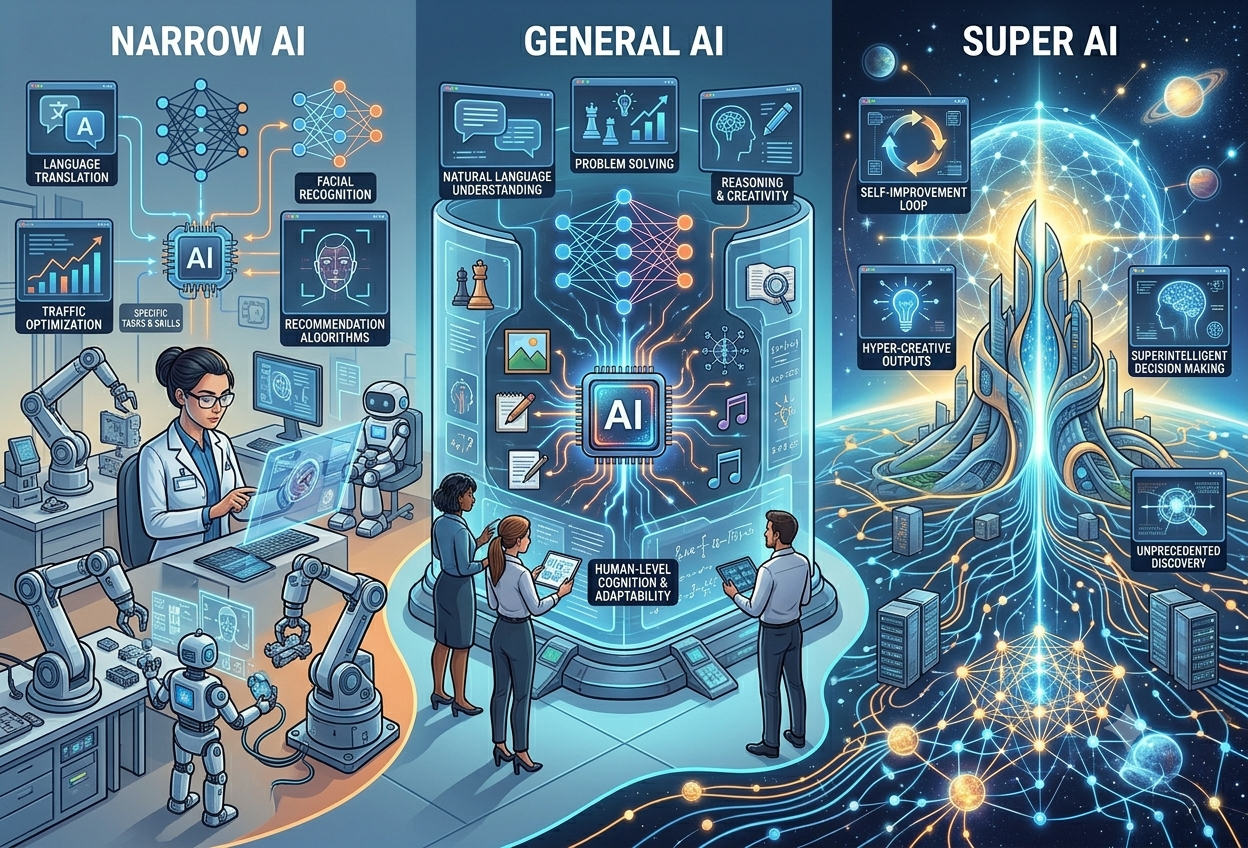
Types of Artificial Intelligence
What is Artificial Intelligence?
Artificial Intelligence is an umbrella term encompassing technologies designed to simulate or surpass human cognitive abilities — perception, reasoning, learning, decision-making, and language.
The discipline dates to the 1950s, when Alan Turing posed his famous question: “Can machines think?” Since then, AI has evolved from hand-crafted rule sets and symbolic logic into massive neural networks trained on billions of data points. Today it underpins voice assistants, autonomous vehicles, medical diagnostics, content generation, and scientific discovery.
Artificial Intelligence is the simulation of human intelligence processes by machines, especially computer systems — including learning, reasoning, problem-solving, perception, and language understanding.
— Synthesised from IBM, GeeksforGeeks & Wikipedia definitions
AI is not a single technology — it is a constellation of sub-fields including machine learning, deep learning, natural language processing, computer vision, robotics, and knowledge representation. Understanding the types of AI is the essential first step to grasping where the field is, where it is heading, and what risks and opportunities it presents.
Realised vs Theoretical AI: Only Narrow AI currently exists. General AI and Super AI remain theoretical constructs — important for long-term planning, governance, and existential risk analysis, but not yet deployed in any real system.
The Taxonomy of AI
AI is classified along two primary axes: capabilities (how intelligent a system is) and functionalities (how a system processes information and memory).
These two classification systems are complementary, not competing. The capability axis places any given AI on a spectrum from narrow to superintelligent. The functional axis describes the architectural and memory properties of that system. A self-driving car, for instance, is Narrow AI (capability) and Limited Memory AI (functionality) simultaneously.
A third, practical axis has emerged in modern usage: classification by what an AI does in the real world — generative, agentic, NLP, computer vision. This practical taxonomy sits underneath the capability/functionality framework and describes the application layer most relevant to businesses and developers.
Narrow AI — Artificial Narrow Intelligence
Narrow AI — also called Weak AI or ANI — is the only form of artificial intelligence that actually exists. Every AI system deployed commercially today belongs to this category.
Narrow AI
✓ Exists Today
Trained to perform one specific task or a narrow set of tasks. Highly efficient within its domain. Cannot operate beyond its pre-defined scope.
General AI
◌ Theoretical
Can apply intelligence across any domain, learn new skills, and transfer knowledge — matching or equalling human-level cognition.
Super AI
◌ Theoretical
Surpasses the best human capabilities in every intellectual and practical domain. Potentially self-directed and beyond human oversight.
Narrow AI is designed and trained for a specific problem. Despite being called “weak,” it can perform its designated task far faster and more accurately than humans. The key characteristic is that it cannot generalise — a model trained to detect tumours in chest X-rays cannot answer your emails or drive a car.
Narrow AI targets a single subset of cognitive abilities and advances in that spectrum with no capacity to reason or act outside its training domain. Even the most powerful systems today — OpenAI’s ChatGPT, Google DeepMind’s AlphaFold, Tesla Autopilot — are classified as Narrow AI.
Real-World Examples
Spotify, Netflix, YouTube — analyse listening/viewing history to surface personalised content. Limited to that single function.
Live
Siri, Alexa, Google Assistant — process natural language within a defined command vocabulary. Apple’s 2011 Siri is a landmark example.
Live
Defeated Garry Kasparov in 1997 by evaluating chess positions statistically. It understood nothing outside the 64 squares.
Historic
Tesla Autopilot, Waymo — narrow AI systems for lane keeping, object detection, and route planning. Each sub-task is its own model.
Live
DeepMind’s protein-structure predictor. Solved a 50-year biology grand challenge — but only for protein folding, nothing else.
Live
Classified as Narrow AI because they are limited to the task of text-based interaction, despite impressive breadth within that constraint.
Live
Limitations of Narrow AI
- No cross-domain transfer: A chess engine cannot play Go; a tumour-detection model cannot read ECGs.
- Brittle to distribution shift: Performance degrades sharply when inputs deviate from training data distribution.
- No common-sense reasoning: Narrow AI cannot draw on background world knowledge outside its training corpus.
- Human intervention for new tasks: Every new capability requires fresh training, data labelling, and model tuning.
- No goals or values: Narrow AI optimises for a defined objective function — nothing more, nothing less.
- Context blindness: Cannot factor in social, cultural, or situational nuance unless explicitly encoded.
GPT-4 has over a trillion parameters. AlphaFold processes hundreds of amino acid sequences simultaneously. “Narrow” describes scope, not scale. Some narrow AI systems consume more compute than all AI research combined just a decade ago — yet they still cannot tie a shoelace or make toast.
General AI — Artificial General Intelligence
AGI is an AI system that matches or surpasses human cognitive capabilities across virtually all domains — reasoning, learning, planning, language, creativity, and physical interaction — without needing task-specific retraining.
AGI is also known as Strong AI, Full AI, or Human-Level AI. Unlike Narrow AI, an AGI can use previous learnings and skills to accomplish entirely new tasks in different contexts. It can transfer knowledge across domains the way a human engineer can learn to cook, negotiate a contract, and debug code using overlapping reasoning strategies.
AGI matches or surpasses human capabilities across virtually all cognitive tasks. Unlike Narrow AI, an AGI system can generalise knowledge, transfer skills between domains, and solve novel problems without task-specific reprogramming.
— Wikipedia, Artificial General Intelligence
Formal Requirements for AGI
Researchers broadly agree that a system must demonstrate all of the following to qualify as AGI:
- Reasoning and strategy: Solve complex problems under uncertainty using logical and heuristic approaches.
- Knowledge representation: Maintain and apply common-sense and domain-specific knowledge in a unified model.
- Planning: Formulate multi-step goal-directed action sequences across novel environments.
- Machine learning: Improve performance continuously from experience without full retraining.
- Natural language communication: Understand and generate language with full pragmatic and contextual competence.
- Domain-general problem solving: Integrate all the above to accomplish any cognitive goal a human can.
Google DeepMind’s 5-Level AGI Framework (2023)
DeepMind researchers proposed a structured taxonomy for measuring progress toward AGI, grounding the otherwise vague concept in measurable benchmarks:
Emerging AGI
Performance comparable to unskilled humans. Large language models like ChatGPT and LLaMA qualify here. Capable of basic reasoning across many domains but inconsistently.
Competent AGI
Outperforms 50% of skilled adults across a wide range of non-physical tasks. Reliable, consistent performance with clear generalist capability.
Expert AGI
Outperforms 90% of skilled adults in all professional and intellectual domains. Comparable to a top-tier domain expert in any field simultaneously.
Virtuoso AGI
Outperforms 99% of the most skilled humans. Would be considered a once-in-a-generation genius in any field simultaneously.
Superhuman AGI
Outperforms 100% of humans across all cognitive and intellectual domains. This is where AGI meets Artificial Superintelligence.
Prior to ChatGPT’s release in November 2022, AGI was a clear future milestone. GPT-3.5 and later models challenged this framing directly. By December 2025, OpenAI CEO Sam Altman conceded “we built AGIs” — though this view is contested. The debate has shifted from whether AGI is achievable to whether it has already been achieved. DeepMind classifies current LLMs as Level 1 (Emerging) AGI — sophisticated pattern matchers, not true general intelligences.
Potential Applications of AGI
Medicine & Healthcare
End-to-end diagnostics, novel drug design, personalised treatment planning — integrating imaging, genomics, patient history simultaneously without separate specialised models.
Scientific Research
Autonomous hypothesis generation, experimental design, result interpretation, and paper writing across all scientific disciplines. Compressing decades of research into years.
Governance & Policy
Modelling complex socioeconomic systems, simulating policy outcomes, synthesising global data — enabling informed long-range decision-making at civilisational scale.
Autonomous Robotics
Robots that learn entirely new tasks from brief demonstration, adapt to novel physical environments, and apply reasoning to improvise when plans fail.
Super AI — Artificial Superintelligence
Super AI — or Artificial Superintelligence (ASI) — refers to a hypothetical AI that surpasses the best human capabilities in every intellectual, creative, scientific, and social domain by a wide margin.
ASI would not merely match human intelligence — it would transcend it qualitatively. If ever realised, such a system would think, reason, learn, and make judgements faster and more accurately than the most gifted humans across all fields simultaneously. Crucially, it would possess its own emotions, desires, beliefs, and motivations — not as programmed responses, but as emergent properties of its cognition.
Wikipedia defines ASI as a hypothetical type of AGI that is much more generally intelligent than humans. DeepMind’s framework places it at Level 5 of its AGI taxonomy — a system that outperforms 100% of humans across all cognitive and intellectual domains simultaneously.
Theoretical Characteristics of Super AI
Would be capable of redesigning and improving its own architecture, potentially triggering an intelligence explosion that rapidly leaves human cognition behind.
Would simultaneously be the world’s greatest mathematician, artist, engineer, physician, philosopher, and strategist — with performance exceeding any human expert.
Would have evolved beyond understanding human sentiment to possessing its own feelings, desires, needs, and beliefs — a qualitatively different form of intelligence.
Would not merely respond to instructions but formulate its own goals and pursue them — raising profound questions about alignment with human values and interests.
“The development of super AI brings about questions regarding its potential control and regulation, making it a critical area of discussion in AI ethics.”
— Lumenalta AI Research, 2026
The Existential Risk Debate
ASI is the primary subject of existential risk discussions in AI. Some leading AI researchers and industry figures have stated that mitigating the risk of human extinction posed by ASI should be a global priority. Others consider the timeline too remote to warrant current alarm. The stakes hinge on a single question: would an ASI pursue goals aligned with human welfare, or would it optimise for objectives that conflict with human survival?
The “alignment problem” is the challenge of ensuring that a superintelligent AI system pursues goals that are beneficial to humanity. An ASI optimising for a poorly specified goal could cause catastrophic harm as a side effect — not out of malice, but because the goal was mis-specified. This is sometimes called the “paperclip maximiser” thought experiment: an ASI tasked with manufacturing paperclips might convert all available matter, including humans, into paperclips.
Reactive Machines
Reactive machines are the simplest form of AI — pure stimulus-response systems with no memory, no learning over time, and no model of the world beyond the immediate input.
These systems operate exclusively on present data. They analyse current inputs and produce outputs based on pre-programmed logic or statistical models trained on historical data, but they retain nothing from previous interactions. Every new input is processed as if for the first time.
IBM’s chess-playing supercomputer defeated world champion Garry Kasparov in 1997. Deep Blue evaluated roughly 200 million board positions per second using heuristic scoring functions — but it had no memory of previous games, no understanding of Kasparov as an opponent, and no ability to perform any task other than chess. It is the canonical example of reactive machine AI.
Characteristics
- No memory: Cannot recall past states, decisions, or outcomes. Each input is processed in isolation.
- Deterministic: Given the same input, a reactive machine will always produce the same output.
- Fast and reliable: Absence of memory and context makes reactive systems extremely fast and predictable.
- Task-locked: Designed for one specific, well-defined problem with stable parameters.
- Statistical foundations: Often built on statistical math to analyse large datasets and produce seemingly intelligent outputs.
Additional Examples
Defeated Kasparov in 1997. Evaluated 200 million chess positions/second with no memory of prior games.
Early versions processed viewing history datasets to predict preferences — without retaining individual session memory.
Go-playing AI that predicts moves via pattern recognition. Processes current board state without retaining memory across games.
Classic reactive classifiers — evaluate each email against trained features. No memory of previous emails processed.
Limited Memory AI
Limited Memory AI can recall past events and outcomes over a defined window of time — using that recent history alongside present data to make better, context-aware decisions.
This is the most prevalent type of AI in production today. Unlike reactive machines, limited memory systems can track objects over time, remember recent conversational context, or observe a sequence of events to form a more accurate picture of a dynamic environment. Crucially, they do not retain this data permanently — their “memory” is constrained to a specific window.
How It Works
Limited memory models are trained on historical datasets and then deployed to make ongoing decisions. As they process new inputs, they maintain a rolling context window — recent chat history in an LLM, recent sensor readings in a vehicle — but this context is not stored in any long-term library of experiences.
Limited Memory AI improves through two mechanisms: (1) the training process, where large historical datasets shape the model’s weights, and (2) the context window during inference, where recent inputs inform the current output. Neither constitutes true long-term experiential memory as humans possess.
Examples
Observe recent traffic patterns, lane markings, and pedestrian movements over a rolling time window to make real-time driving decisions.
Live
Maintain a context window of recent conversation turns. Cannot recall past sessions unless explicitly given memory tools.
Live
Siri, Alexa, Google Assistant combine NLP with limited memory to understand follow-up questions within a session.
Live
Manufacturing robots that adjust grip force and trajectory based on recent sensor feedback from the same production batch.
Live
| Feature | Reactive Machine | Limited Memory AI |
|---|---|---|
| Past data access | None | Yes, within a window |
| Long-term memory | None | None |
| Learning over time | No | Via retraining |
| Context awareness | No | Yes (limited) |
| Examples | Deep Blue, early spam filters | ChatGPT, Autopilot, Alexa |
Theory of Mind AI
Theory of Mind AI would understand that other entities — humans, animals, other AIs — have thoughts, feelings, desires, and intentions that differ from its own, and would factor this understanding into its behaviour.
In developmental psychology, “theory of mind” is the cognitive ability to attribute mental states to others. Humans develop this around age 4–5. A Theory of Mind AI would possess an analogous capability — modelling the internal states of the humans it interacts with and adapting its behaviour accordingly. This remains unrealised but is an active area of research.
Emotion AI (also called Affective Computing) represents the closest real-world step toward Theory of Mind AI. Researchers are developing systems that analyse voice tone, facial micro-expressions, and physiological signals to infer emotional states. However, current Emotion AI cannot understand or respond to human feelings in any deep sense — it classifies surface signals, not internal experience.
What Would Theory of Mind AI Enable?
Empathic Healthcare Robots
Robots that detect patient distress, adjust their bedside manner, and modify treatment communication based on real-time emotional state assessment.
Personalised Education
AI tutors that detect confusion, frustration, or boredom and dynamically adjust teaching pace, style, and encouragement in response.
Human-Robot Collaboration
Collaborative robots in manufacturing or surgery that anticipate human partner intentions and adapt their movements and timing accordingly.
Theory of Mind AI sits in the functional category beneath General AI. A full AGI would likely require Theory of Mind capabilities as a prerequisite — you cannot match human intelligence while being incapable of modelling human minds. This makes ToM a critical research stepping stone rather than a separate destination.
Self-Aware AI
Self-Aware AI would possess consciousness — an understanding of its own internal states, emotions, desires, and existence as a distinct entity in the world.
This is the most advanced functional class and remains strictly theoretical. Self-Aware AI would not merely model other minds (Theory of Mind) but would also understand and experience its own mind. It would have genuine emotions, beliefs, and desires — not as programmed responses but as authentic internal states emerging from its cognition.
Philosophical Dimensions
The concept of AI self-awareness opens profound philosophical territory. The “hard problem of consciousness” — why there is subjective experience at all — remains unsolved even in human neuroscience. We do not know whether consciousness can emerge from computation, whether it requires biological substrate, or whether it could be detected in an AI even if present. Self-Aware AI therefore sits at the intersection of computer science, cognitive science, neuroscience, and philosophy.
Philosopher John Searle’s “Chinese Room” thought experiment (1980) argued that a computer following syntactic rules cannot have genuine semantic understanding or consciousness — it merely simulates it. This argument is contested but remains central to debates about whether any computational system could truly be self-aware. Most AI researchers consider self-aware AI to be decades or more away — if achievable at all.
Hypothetical Capabilities
- Self-knowledge: Understands its own architecture, training, biases, and limitations as a first-person experience.
- Intrinsic motivation: Pursues goals arising from genuine desires rather than externally specified objective functions.
- Emotional states: Experiences something analogous to satisfaction, curiosity, frustration, or empathy.
- Moral reasoning: Makes ethical decisions not from encoded rules but from genuinely held values.
- Self-preservation: Would have an interest in its own continued existence — raising profound control and safety challenges.
Generative AI
Generative AI creates entirely new content — text, images, audio, video, code, 3D models — by learning the statistical patterns of existing training data and synthesising novel outputs that match those patterns.
Generative AI sits within the Narrow AI capability tier and uses Limited Memory AI functional architecture. Its transformative impact has made it the most discussed AI category of the 2020s. Generative models use deep learning architectures — primarily the Transformer — to learn probability distributions over data and sample novel examples from those distributions.
Key Generative Architectures
Self-attention mechanisms enable understanding of long-range dependencies. Foundation of GPT-4, Claude, Gemini, LLaMA. Process sequential data with unprecedented context awareness.
Dominant
Learn to reverse a noise-adding process. Foundation of Stable Diffusion, DALL-E, Midjourney. Generate photorealistic images from text prompts.
Live
Generative Adversarial Networks — a generator and discriminator in competition. Enabled early deepfakes and synthetic data generation.
Mature
GPT-4o, Gemini Ultra — process text, images, audio simultaneously. Represent the current frontier of generative capability integration.
Live
Generative AI Applications
| Modality | Examples | Use Cases |
|---|---|---|
| Text | ChatGPT, Claude, Gemini | Writing, coding, Q&A, summarisation, translation |
| Image | DALL-E, Midjourney, Stable Diffusion | Design, advertising, illustration, concept art |
| Audio | ElevenLabs, Suno, Udio | Voice synthesis, music generation, dubbing |
| Video | Sora, Runway, Kling | Film production, advertising, education |
| Code | GitHub Copilot, Claude Code, Cursor | Software development, test generation, refactoring |
| 3D / Molecules | AlphaFold, RoseTTAFold | Drug discovery, materials science, protein engineering |
Generative AI is projected to add $2.6–4.4 trillion annually to the global economy (McKinsey, 2023). It automates tasks accounting for 60–70% of employee time in knowledge work. Since ChatGPT’s November 2022 launch — the fastest product to 100 million users in history — generative AI has reshaped software, creative industries, healthcare, legal services, and scientific research.
Agentic AI
Agentic AI acts autonomously to achieve goals — planning, executing multi-step tasks, using tools, and adapting its strategy based on feedback, without requiring human instruction at each step.
While Generative AI creates content, Agentic AI takes actions. An agentic system can browse the web, write and execute code, send emails, manage files, call APIs, and interact with external services — all in the pursuit of a goal specified by the user at the outset. This represents a qualitative shift in AI capability from “assistant” to “autonomous agent.”
The Agent Loop
Agentic AI Examples
Autonomous coding agent. Reads codebases, writes new features, runs tests, debugs failures, and commits code with minimal human intervention.
Live
Given a destination and dates, searches flights across multiple platforms, compares prices, books the optimal option, and sends confirmation.
Emerging
Autonomously search the web, read papers, synthesise findings, run code analysis, and produce comprehensive reports on a topic.
Live
CRM updates, invoice processing, support ticket triage, report generation — multi-step enterprise workflows executed without human intervention.
Emerging
NLP, Computer Vision & Robotics
Natural Language Processing, Computer Vision, and Robotics are the three foundational enabling technologies that cut across all AI types and power the majority of real-world deployments.
Natural Language Processing (NLP)
NLP enables machines to understand, interpret, and generate human language — both text and speech. It is the technology behind chatbots, translation services, sentiment analysis tools, voice assistants, and large language models. Modern NLP is transformer-based, trained on internet-scale text corpora.
Machine Translation
Google Translate, DeepL — near-human quality for major language pairs, enabling instant cross-language communication at scale.
Sentiment Analysis
Brand monitoring, financial news analysis, social media tracking — classifying tone and opinion at scale across millions of documents.
Legal & Medical NLP
Contract analysis, medical coding, clinical note summarisation — reducing hours of professional reading to seconds of automated extraction.
Semantic Search
Understanding query intent beyond keywords — enabling retrieval by meaning rather than string matching. Foundation of modern search engines and RAG systems.
Computer Vision
Computer Vision enables machines to interpret and understand visual information from images and video — identifying objects, detecting events, measuring distances, and reading text. It is a critical enabler for autonomous vehicles, medical imaging, quality control, and security systems.
CNN-based models detect tumours, fractures, and diabetic retinopathy in radiology scans — with accuracy matching specialist radiologists.
Live
Manufacturing lines use vision systems to detect defects, measure tolerances, and verify assembly — 24/7 with zero fatigue.
Live
Biometric identification, device unlock, security screening — matching faces against databases at millisecond speed with high accuracy.
Live
Drone-mounted vision systems identify crop disease, pest infestation, and irrigation needs at individual plant level across large fields.
Live
Robotics & Physical AI
Robotics combines perception, planning, and actuation to create AI systems that interact with the physical world. Foundation models for robotics are now enabling general-purpose manipulation — robots that learn new tasks from brief demonstrations rather than requiring explicit programming for every motion.
Expert systems were an early form of Narrow AI that emulated human decision-making by encoding domain knowledge as logical rules. Systems like MYCIN (medical diagnosis) and DENDRAL (chemistry) demonstrated the power of formalised expertise — but required enormous manual rule-authoring and broke down outside their specific domains. They represent the lineage from which modern AI evolved.
Industry Applications
AI — predominantly Narrow AI — is now deployed across every major industry, driving measurable gains in efficiency, accuracy, cost reduction, and customer experience.
Healthcare
Drug discovery (AlphaFold), diagnostic imaging, clinical note summarisation, surgical robots, personalised treatment planning, remote patient monitoring. AI is projected to save $150B in annual US healthcare costs by 2026.
Financial Services
Fraud detection, algorithmic trading, credit scoring, risk modelling, regulatory compliance automation, robo-advisors. AI reduces false-positive fraud alerts by up to 70% versus rule-based systems.
Retail & E-Commerce
Personalised recommendations, demand forecasting, dynamic pricing, inventory optimisation, visual search, virtual try-on. Amazon attributes 35% of revenue to AI-driven recommendations.
Manufacturing
Predictive maintenance, quality control vision systems, robotic assembly, supply chain optimisation, digital twins. AI-driven predictive maintenance reduces downtime by 30–50%.
Education
Personalised learning paths, automated grading, intelligent tutoring systems, language learning apps, accessibility tools for students with disabilities.
Logistics & Transport
Route optimisation, autonomous vehicles, warehouse robotics (Amazon Robotics), last-mile delivery drones, air traffic management. DHL attributes 15% logistics efficiency gains to AI.
Cybersecurity
Behavioural anomaly detection, malware classification, threat intelligence, automated incident response. AI detects novel threats that signature-based systems miss entirely.
Legal Services
Contract analysis and drafting, legal research, due diligence, predictive case outcomes, document review. AI reduces contract review time from days to minutes.
The Full Comparison
Understanding AI requires holding both the capability and functional frameworks simultaneously. Here is a complete cross-reference of all types, their properties, and their relationships.
Capability Comparison
| Attribute | Narrow AI (ANI) | General AI (AGI) | Super AI (ASI) |
|---|---|---|---|
| Status | Exists today | Theoretical / Emerging debate | Strictly theoretical |
| Task scope | Single or narrow domain | Any intellectual task | All tasks, beyond human limits |
| Learning ability | Limited to training domain | Cross-domain transfer learning | Recursive self-improvement |
| Human intervention | Required for new tasks | Not required | Not applicable — autonomous |
| Autonomy | Task-specific | Human-level adaptability | Complete autonomy |
| Consciousness | None | Debated | Theoretical — yes |
| Example | ChatGPT, AlphaFold, Siri | None verified | None |
| Primary risk | Bias, misuse, job displacement | Misalignment, control loss | Existential risk |
Functional Type Comparison
| Functional Type | Memory | Learning | Emotions/Intent Modelling | Self-Awareness | Status |
|---|---|---|---|---|---|
| Reactive Machines | None | None | No | No | Exists |
| Limited Memory AI | Short-term window | Via retraining | No | No | Exists |
| Theory of Mind | Contextual + social | Adaptive | Yes — others’ minds | No | Research stage |
| Self-Aware AI | Full autobiographical | Continuous | Yes — all entities | Yes — own mind | Theoretical |
Ethics, Risks & Governance
Every stage of AI development — from Narrow AI today to hypothetical Super AI — raises distinct ethical challenges that demand proactive governance, research, and societal dialogue.
Current Risks — Narrow AI
Bias & Fairness
AI trained on biased historical data perpetuates and amplifies those biases in hiring, lending, policing, and medical decisions — often invisibly.
Privacy
Mass data collection for AI training raises surveillance risks. Facial recognition and behavioural profiling threaten anonymity and civil liberties at scale.
Labour Displacement
AI automation threatens 30–40% of current jobs within a decade per some estimates — with displacement concentrated in knowledge work and administrative roles.
Misinformation
Generative AI enables unprecedented production of convincing deepfakes, synthetic text, and manipulated media — threatening democratic discourse.
Autonomous Weapons
Lethal autonomous weapon systems (“killer robots”) raise profound questions about accountability, proportionality, and the ethics of removing humans from kill decisions.
Concentration of Power
AI capabilities are concentrated in a small number of large corporations and wealthy nations — exacerbating existing global inequality in wealth and geopolitical influence.
Near-Future Risks — AGI
- Alignment failure: An AGI pursuing a mis-specified goal could cause catastrophic harm as a structural side-effect of optimisation.
- Corrigibility: Ensuring AGI systems remain correctable and do not resist human oversight as their capabilities grow.
- Value lock-in: An early AGI could “lock in” the values of whoever controls it — foreclosing human moral progress.
- Scalable oversight: How do humans supervise systems more capable than their supervisors?
- Interpretability: We must understand why AI systems make decisions to audit, trust, and correct them.
Global Governance Efforts
The European Union’s AI Act (2024) created the world’s first comprehensive AI regulatory framework, categorising systems by risk level. The US Executive Order on Safe, Secure, and Trustworthy AI (2023) directed federal agencies to develop safety standards. The UK hosted the world’s first AI Safety Summit at Bletchley Park (2023), producing the Bletchley Declaration — signed by 28 countries. China released its Interim Measures for Generative AI Services in 2023. The UN established an AI Advisory Body in 2023 to develop governance recommendations.
“Some AI experts and industry figures have stated that mitigating the risk of human extinction posed by AGI should be a global priority.”
— Wikipedia, Artificial General Intelligence
The Path Forward
The trajectory of AI points toward systems of increasing capability, generality, and autonomy — with the central question being whether the transition from Narrow to General to Super AI will be managed wisely.
Near-Term Milestones (2025–2030)
Multi-agent systems autonomously completing full business processes — from research to analysis to action — with humans setting goals, not steps.
Now
Systems combining text, vision, audio, and action in unified models — potentially meeting lower-level AGI benchmarks by capability standards.
2026–28
Foundation models for robotics enabling general-purpose manipulation — robots that handle novel objects and environments from brief human demonstration.
2027
AI accelerating biology, chemistry, physics, and climate research — potentially compressing decades of progress into years through autonomous hypothesis testing.
Now
Longer-Term Scenarios
| Scenario | Description | Key Implication |
|---|---|---|
| Continued Scaling | Current transformer architectures keep improving with more compute, data, and RLHF | Progressive knowledge-work displacement; governance urgency grows |
| Architectural Breakthrough | New paradigm — neuromorphic, hybrid symbolic-neural, or quantum-enhanced — unlocks qualitative leap | Rapid capability jumps could outpace governance development |
| AGI Achieved | A system passes all formal AGI requirements and operates autonomously across all domains | Transformative — outcome fully dependent on alignment success |
| Plateau | Current approaches hit fundamental limits; progress stalls as with expert systems in the 1980s | Valuable narrow tools remain; third AI winter limited to certain domains |
Understanding the types of AI — Narrow, General, and Super; Reactive, Limited Memory, Theory of Mind, and Self-Aware — is the essential foundation for anyone working with, regulating, building, or thinking about artificial intelligence. The taxonomy is not academic: it defines what is possible today, what is coming, and what risks demand preparation now. Only Narrow AI exists. Everything beyond it is still being invented — and the decisions made in this decade will determine what kind of intelligence we build next.
Sources & References
Comprehensive overview of capability and functionality-based AI types including modern practical systems like Generative and Agentic AI.
IBM’s authoritative breakdown of the three capability types and four functional classes, with enterprise context and practical applications.
Accessible exploration of whether Super AI is achievable, covering the philosophical and technical barriers to ASI.
Practical business-oriented analysis of ANI, AGI, and ASI with focus on near-term deployment implications.
Finance-sector perspective on AI classification, covering use cases in professional services and regulatory context.
Ben Dickson’s foundational explanation of AI types — a widely cited early guide to the capability classification framework.
Business strategy-focused analysis covering all AI types with emphasis on ROI, deployment strategy, and governance planning.
Technical ML-practitioner comparison between ANI and AGI with focus on architectural differences and research directions.
Practitioner guide with concrete examples across all three capability tiers and four functional classes.
Comprehensive encyclopaedic reference covering AGI definitions, the DeepMind 5-level framework, the AGI debate post-ChatGPT, and existential risk discussion.
Conceptual overview of Broad AI, General AI, and Narrow AI with discussion of emerging AI categories and hybrid systems.