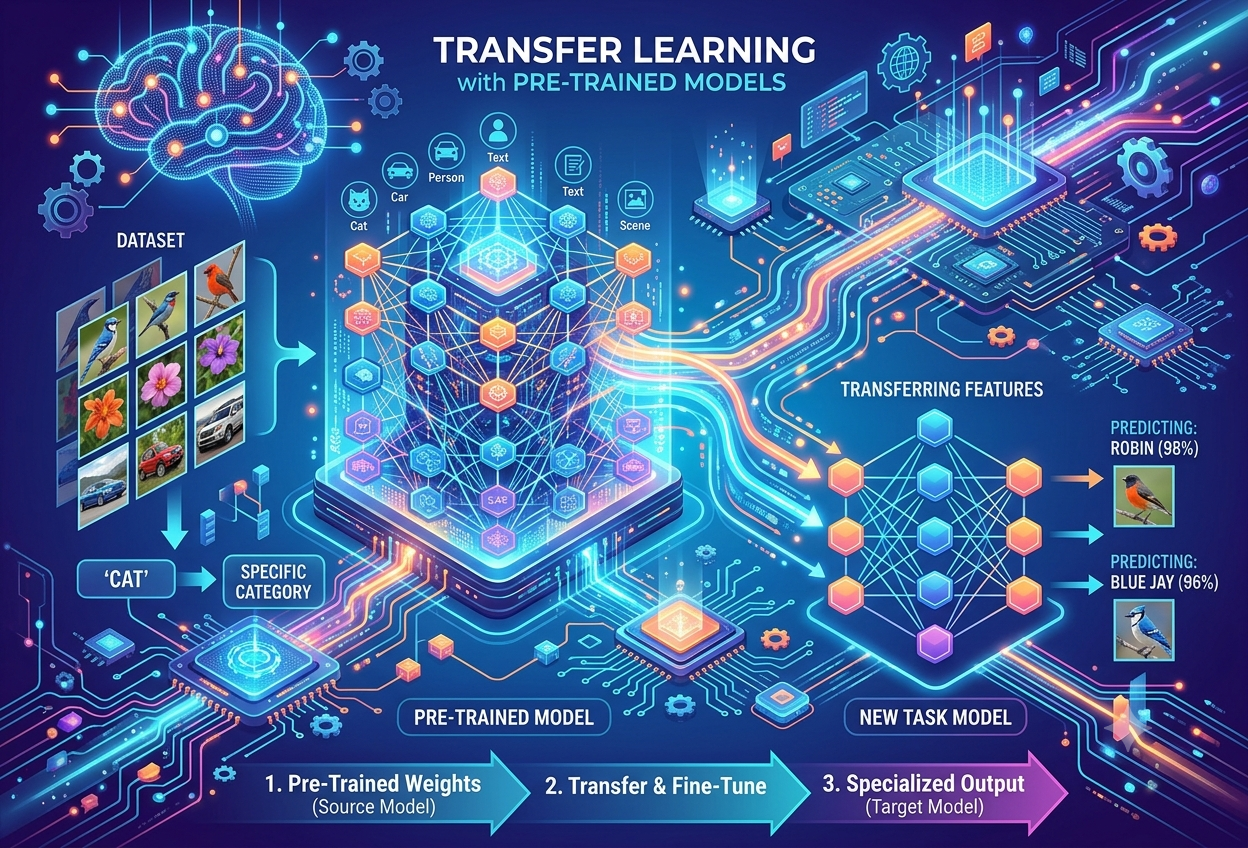
Transfer Learning with Pre-Trained Models
What Is Transfer Learning?
Imagine you already know how to ride a bicycle perfectly. Now someone hands you a motorbike for the very first time. You do not need to relearn balance, steering, or how to lean into a turn — you already understand those things deep down. You only need to learn the new parts: the throttle, the brakes, the extra weight. That head start, that reuse of old knowledge for a new but related skill, is exactly what transfer learning is in the world of artificial intelligence.
“Transfer learning involves taking a pre-trained model, typically trained on a large and diverse dataset, and adapting it for a specific task — particularly useful when the target dataset is smaller or lacks the diversity needed to train a high-performance model from scratch.”— Adapted from computer vision research literature, 2025
In machine learning, a model is a computer program that learns patterns from data. Training one completely from zero is a bit like teaching a newborn baby everything about the world — every shape, every colour, every object — using only the pictures you show it. That takes an enormous number of pictures and an enormous amount of time. Transfer learning skips most of that slow childhood. Instead, it starts with a model that has already been through that long learning process on a huge dataset, and simply teaches it the smaller, specific new task it actually needs to do.
The model that has already learned the big, general lesson is called a pre-trained model. The new, smaller, more specific task you want it to learn is called the target task. Transfer learning is the bridge that carries useful knowledge from the first to the second.
Imagine you spent years learning to recognise hundreds of different dog breeds — labradors, poodles, huskies, and more. One day, someone asks you to learn to recognise wolves instead. You would not need to start from zero! You already know what fur looks like, what four legs and a tail look like, what pointy ears look like. You would only need to learn the small differences that make a wolf a wolf instead of a dog. A computer using transfer learning does the exact same clever shortcut.
A Quick Look at the Vocabulary
A handful of terms come up constantly in any discussion of transfer learning. Getting comfortable with them early makes everything else in this guide click into place much faster.
A model already trained on a large, general dataset — such as ImageNet, which contains over 14 million labelled images across 1,000 categories.
The new, usually smaller and more specific job the model needs to learn — recognising a particular disease on X-rays, for example.
The process of carefully adjusting a pre-trained model’s internal settings so it performs well on the new target task.
Why Transfer Learning Matters So Much
Training a powerful deep learning model entirely from scratch is one of the most resource-hungry things you can do in modern computing. Transfer learning exists because almost nobody — not even most large companies — can afford to repeat that enormous effort for every single new task.
The Three Walls That Transfer Learning Breaks Through
Building a deep neural network the traditional way runs headfirst into three walls almost every single time: not enough labelled data, not enough computing power, and not enough time. Transfer learning chips away at all three simultaneously.
Training from scratch typically needs millions of labelled examples. Most real-world problems — a rare disease, a niche product category — simply do not have that much labelled data sitting around.
Wall 1Training a large neural network from nothing can require powerful hardware running continuously for days or weeks — completely impractical for an individual developer or a small team.
Wall 2Even with the necessary data and hardware, the actual training process for a complex model from scratch can take an extraordinarily long time to converge to good performance.
Wall 3Transfer learning offers a shortcut around all three walls at once. Because a pre-trained model has already absorbed general knowledge from a massive dataset, it needs comparatively little new data, modest extra computing power, and far less additional training time to become genuinely useful at a brand-new but related task.
Transfer learning is not merely a time-saving trick — it is often the only practical way certain AI applications can exist at all. A hospital with only a few hundred confirmed scans of a rare condition could never train an accurate diagnostic model from scratch. With transfer learning, that same small dataset becomes enough to fine-tune an already-capable model into something genuinely useful.
Democratising Access to Powerful AI
Perhaps the most significant impact of transfer learning is how it has levelled the playing field. Building a foundation model from nothing remains the privilege of a small number of very well-resourced research labs and large technology companies. But because those organisations frequently publish their pre-trained models openly, smaller teams, students, hobbyists, and startups around the world can build genuinely impressive applications on top of that shared foundation — without ever needing to recreate the original training effort themselves.
How It Works: General vs. Specific Features
To understand why transfer learning works at all, it helps to peek inside a neural network and see what it actually learns, layer by layer. The surprising discovery that makes everything in this guide possible is that not all layers learn the same kind of knowledge.
Edges First, Specifics Last
When a deep neural network is trained on images, its very first layers tend to learn extremely simple, universal visual building blocks — edges, corners, colour blobs, and basic textures. Its middle layers begin combining those simple building blocks into more complex shapes — curves, circles, repeating patterns, and simple parts of objects. Only its final layers learn highly specific, task-dependent concepts — the particular combination of shapes and textures that make something recognisably “a cat’s face” or “a stop sign” rather than just “an edge” or “a curve.”
This gradual shift from general to specific is the entire secret behind transfer learning. Because the early and middle layers have learned things that are useful for almost any visual task — not just the one the model originally trained on — those layers can be reused, largely unchanged, on a completely new problem. Only the final, highly specialised layers usually need to be replaced or adjusted.
Think about everything you learned in your first years of school: how to hold a pencil, how letters and numbers look, how to listen and pay attention. Those skills are useful no matter what subject you study next — maths, art, or science. But the specific facts you learn in a history class are only useful for history. A neural network’s early layers are like those first-years-of-school basic skills, and its last layers are like the very specific facts from one particular subject.
Frozen Layers vs. Modifiable Layers
This general-to-specific structure leads directly to one of the most important practical ideas in transfer learning: deciding which layers to freeze and which to leave modifiable.
Layers whose learned settings are locked in place and left completely untouched during the new training process, preserving the valuable general knowledge gained from the original task.
Layers that are allowed to keep learning and adjusting during the new training process, so the model can adapt its knowledge to the specific quirks of the new target task.
Choosing the right balance between frozen and modifiable layers is more art than strict science, and it depends heavily on how much new data is available and how similar the new task is to the original one — a decision framework explored in depth a little later in this guide.
Feature Extraction vs. Fine-Tuning
Once you accept that early layers hold general knowledge and later layers hold specific knowledge, two clear strategies emerge for actually using a pre-trained model. Almost every transfer learning project chooses between these two approaches — or some careful blend of the two.
Strategy One: Feature Extraction (The Fixed Approach)
In this approach, every single layer of the pre-trained model except the very last one is completely frozen. The model is used purely as a fixed feature extractor — it takes in a raw image and outputs a rich, meaningful summary of that image’s content, without changing anything internally. Only a brand-new final layer, designed to match the new target task, is added and trained from scratch on top of those frozen features.
Strategy Two: Fine-Tuning (The Adjustable Approach)
In this approach, the pre-trained model’s weights are not locked in place. Instead, training continues across some or even all of the network’s layers, gently nudging its existing knowledge to better fit the new target task. The new final layer is still added, exactly as in feature extraction, but now the rest of the network is also allowed to adapt, usually using a very small learning rate to avoid erasing the valuable knowledge already stored inside it.
A Real Example, With Real Numbers
A well-known beginner exercise trains a model to tell ants apart from bees using only about 120 training photographs of each — a genuinely tiny dataset by deep learning standards. Starting from a pre-trained ResNet model, the fine-tuning approach reached roughly 94% validation accuracy after 25 training cycles, while the feature-extraction approach — which trains far fewer parameters and runs noticeably faster — reached an even higher roughly 96% validation accuracy on that same small dataset. The lesson is not that one strategy always wins; it is that both strategies can turn 120 photographs into a genuinely capable classifier, something that would be essentially impossible training a network from scratch.
| Factor | Feature Extraction | Fine-Tuning |
|---|---|---|
| Training speed | Faster — far fewer parameters to update | Slower — more parameters being adjusted |
| Data needed | Works well with very small datasets | Benefits from somewhat more data |
| Risk of overfitting | Lower, since most weights stay fixed | Higher if the dataset is too small |
| Best when… | New task is very similar to original task | New task differs meaningfully from original task |
| Computational cost | Lower — ideal for limited hardware | Higher — needs more memory and compute |
When in doubt, start with feature extraction. It is faster, cheaper, and harder to get wrong. Only move to fine-tuning — and only unfreeze additional layers gradually, from the top down — if feature extraction alone does not reach the accuracy your project needs.
The Size-Similarity Matrix
Choosing between feature extraction, fine-tuning, or training from scratch does not have to be a guessing game. A simple but powerful mental model — often called the Size-Similarity Matrix — turns this decision into a clear, two-question process.
The two questions are: How much data do I have for my new task? And: How similar is my new task to the original dataset the pre-trained model learned from? Plotting the answers to these two questions against each other produces four distinct situations, each with its own best strategy.
You have plenty of data, but it looks quite different from the original training data. You can afford to train more extensively, even starting from the pre-trained weights as a useful initialisation rather than pure random values.
The easiest situation of all. With ample data that closely resembles the original training data, fine-tuning the classifier and the upper layers of the network typically works extremely well with relatively little risk.
The hardest situation. With little data that also looks quite different from the original training data, careful partial fine-tuning combined with data augmentation is usually necessary to avoid overfitting.
With little data that closely resembles the original training data, pure feature extraction is usually the safest and most effective choice — freeze the convolutional base and train only a new classifier on top.
“As a rule of thumb, consider that your dataset is small if it has less than a thousand images per class. Regarding dataset similarity, let common sense prevail.”
— Practical computer vision guidance, adaptedA Worked Example
Suppose your target task is recognising a few hundred photographs of unusual mushroom species, and your pre-trained model learned from ImageNet, which does include some natural objects and outdoor scenes. Your dataset is small, and the domain is moderately similar — somewhere between Quadrant 3 and Quadrant 4. The sensible starting point is feature extraction, with a backup plan of unfreezing just the last block of layers and adding data augmentation if accuracy falls short.
Types of Transfer Learning
“Transfer learning” is really an umbrella term covering several distinct flavours, each suited to a different combination of tasks, domains, and available labels. Knowing the names helps when reading research papers or choosing the right tool for a specific situation.
The source and target domains are the same, but the tasks differ. A model pre-trained on general text is fine-tuned for a specific function such as sentiment analysis.
The source and target tasks are the same, but the domains differ. A spam-detection model trained on emails is adapted to work on text messages instead.
Both the source and target tasks lack labels entirely. The model learns common structure in unlabelled data to improve feature learning on a different unlabelled dataset.
The source and target share the same kind of features but differ in their statistical distribution — for example, adapting a model trained on daytime photos to work on nighttime photos.
Several related tasks are learned at the same time from the same data, with the model sharing useful knowledge across all of them simultaneously rather than transferring sequentially.
Extreme cases where a model must learn a new category from just one example (one-shot) or even zero examples (zero-shot), relying entirely on transferred general knowledge.
Putting Names to Familiar Ideas
Many of these categories describe situations you may have already pictured intuitively. Inductive transfer learning is what happens whenever a general-purpose model like BERT is fine-tuned for one specific job. Domain adaptation is what happens when a voice assistant trained mostly on American English accents is adjusted to understand British English. Zero-shot learning is what allows some modern AI systems to correctly describe an animal they have technically never been shown a single labelled photo of, simply by combining knowledge of related animals and descriptive language.
Imagine you are extremely good at chess. Transductive transfer learning would be like using your chess skill to get better at checkers — same kind of board game, slightly different rules. Domain adaptation would be like playing chess outdoors on a windy day for the first time after only ever practising indoors — the “rules” of chess do not change, but the conditions around you did. Zero-shot learning would be like correctly guessing the rules of a brand-new board game you have never played, just by recognising it shares ideas with games you already know.
Why the Categories Matter in Practice
These distinctions are not just academic labelling for its own sake. Recognising which category your project falls into helps you anticipate how much labelled data you will realistically need, how much performance drop to expect from domain mismatch, and which published research or pre-trained models are most likely to transfer well to your specific situation.
Popular Pre-Trained Models
A handful of pre-trained models show up again and again across research papers, tutorials, and production systems. Getting to know their names and specialities makes it far easier to pick a sensible starting point for any new project.
Vision Models
Introduced “residual connections” that allow extremely deep networks to train successfully without losing the learning signal. Variants like ResNet-18 and ResNet-50 are go-to choices for image classification.
An influential, conceptually simple architecture built from a deep stack of small convolutional filters. Remains a popular, easy-to-understand baseline for transfer learning experiments.
Processes an image at multiple scales simultaneously within the same layer, helping it capture both fine detail and broader context efficiently.
Designed to be lightweight and fast enough to run directly on phones and other small devices, while still benefiting from transfer learning.
Language & Multimodal Models
Reads text in both directions at once to build a deep contextual understanding of language, making it a strong foundation for classification, named entity recognition, and question answering.
Generates text one word at a time based on everything written before it, excelling at content generation, summarisation, and conversational applications.
Trained on pairs of images and their text descriptions, learning to bridge visual and language understanding in a single shared representation.
Refined descendants of BERT — one optimised to be smaller and faster, the other optimised for even stronger language understanding through improved training.
There is rarely one single “best” pre-trained model for every situation. A good starting question is simply: what problem was this model originally solving, and how closely does that resemble my problem? A model pre-trained heavily on everyday object photographs is an excellent starting point for another everyday object task, but a poor starting point for, say, satellite imagery or microscope slides, where a more specialised pre-trained model may serve far better.
Where to Find Them
Most popular deep learning frameworks make these models available with just a few lines of code. Keras provides a long list of ready-to-use pre-trained vision models, PyTorch’s torchvision.models module offers similar access, and the Hugging Face Transformers library has become the standard hub for downloading pre-trained language and multimodal models contributed by researchers and companies worldwide.
Step-by-Step: How to Apply Transfer Learning
With the theory in place, here is what actually happens, in order, when someone applies transfer learning to a real project — distilled into a clear, repeatable workflow.
- Select a pre-trained model. Choose one trained on a large, well-regarded dataset relevant to your domain — ResNet or VGG for general images, BERT or GPT for general text.
- Examine the model’s input requirements. Pre-trained models expect input in a specific size and format. Images often need resizing to match what the model originally trained on, such as 224×224 pixels.
- Remove or replace the final layer. The original final layer was built for the source task’s specific categories. Swap it out for a new layer matching the number of categories in your target task.
- Decide which layers to freeze. Use the Size-Similarity Matrix from the previous section to choose between pure feature extraction, partial fine-tuning, or broader fine-tuning.
- Prepare your target dataset. Apply appropriate preprocessing and, where helpful, data augmentation to expand a small dataset’s effective diversity.
- Train with a small learning rate. Especially when fine-tuning, use a noticeably smaller learning rate than you would for training from scratch, to avoid erasing valuable pre-trained knowledge too quickly.
- Monitor validation performance closely. Watch for overfitting, which shows up as training accuracy climbing while validation accuracy stalls or falls.
- Evaluate, iterate, and adjust. Based on validation results, consider unfreezing additional layers, gathering more data, or adjusting hyperparameters before finalising the model.
A Glimpse of What This Looks Like in Code
Modern deep learning libraries make this entire workflow remarkably concise. In a popular framework, loading a pre-trained vision model, swapping its final layer, and choosing whether to freeze the rest can be done in only a handful of lines — for instance, loading a ResNet model with its pre-trained weights, replacing its final fully connected layer with one sized for your number of categories, and then either leaving the rest frozen (feature extraction) or allowing it to keep training (fine-tuning) by toggling a single setting on each layer’s parameters.
The learning rate controls how large a step the model takes when adjusting its internal settings during training. A pre-trained model’s weights already encode genuinely valuable knowledge. A learning rate that is too large can erase that knowledge in just a few training steps — effectively throwing away the very advantage transfer learning was meant to provide. Using a smaller learning rate during fine-tuning protects that investment.
Transfer Learning in Generative AI
Transfer learning has found a powerful new home inside generative AI — the branch of artificial intelligence that creates new images, text, music, and more. Several specialised strategies have emerged specifically to help generative models adapt their creative abilities to new domains.
Teacher-Student Learning (Knowledge Distillation)
In this approach, a larger, more complex “teacher” model passes its knowledge down to a smaller, simpler “student” model, which learns to mimic the teacher’s behaviour. This is especially valuable for deploying powerful capabilities on devices with limited computing power, such as smartphones, since the smaller student model can deliver similar results with far less computational overhead.
Domain Adversarial Training
This strategy trains a generative model to produce output indistinguishable from real data in a new target domain. A separate “discriminator” network attempts to tell real data apart from generated data, and the generator keeps improving until its creations become convincingly realistic — for example, adapting a model trained on photographs so it can generate convincing artwork in a particular artistic style.
Feature Disentanglement
Here, different aspects of data — such as content and artistic style — are separated into distinct, independently controllable representations. A face-generation model using this technique might learn to separate “who someone looks like” from “what artistic style the portrait is painted in,” allowing the two to be mixed and matched freely.
Cross-Modal Transfer Learning
This strategy transfers knowledge between entirely different types of data — text and images, for instance. A model trained on pairs of written descriptions and matching pictures can learn to generate a relevant new image directly from a text description it has never seen before, effectively carrying its understanding across the boundary between language and vision.
Zero-Shot and Few-Shot Generation
Generative models can also be asked to create something they have seen very few — or even zero — direct examples of during training. By learning rich, flexible representations of many related concepts, a model can combine and recombine pieces of what it already knows to plausibly generate something genuinely new, such as imagining a rarely seen animal by blending features learned from more common ones.
Teacher-student learning is a bit like an older sibling teaching a younger one everything they know, but in a simpler way the younger one can easily follow. Cross-modal transfer is like being so good at describing things in words that someone else could draw a picture just from your description, even though they never saw the real thing themselves.
Real-World Applications
Transfer learning is not confined to research papers — it quietly powers a remarkable range of practical AI systems across very different industries, almost all of which share one thing in common: not enough labelled data to train a model from scratch.
Medical Image Analysis
A model originally trained for general object classification can be fine-tuned to analyse X-rays and detect particular diseases, turning a limited supply of confirmed medical scans into a genuinely useful diagnostic aid.
Robotics
Robotic systems have been trained first in simulated environments and then had that learned knowledge transferred to physical hardware, allowing complex dexterous tasks to be learned safely before ever touching the real world.
Natural Language Processing
Pre-trained language models like BERT and GPT are fine-tuned for tasks such as news categorisation, named entity recognition, and multilingual translation, often needing only a modest amount of task-specific labelled text.
Speech Recognition
Voice assistant developers fine-tune models pre-trained on vast amounts of general audio data so they can understand specific accents and voice commands, improving accuracy in smart home and mobile applications.
Other Notable Use Cases
- Financial forecasting: Models pre-trained on broad financial data across many markets are fine-tuned on specific stocks, aiding investment strategy and risk management.
- Indoor climate control: Researchers have applied transfer learning to classify how warmly people are dressed indoors, helping smart heating systems respond automatically to real comfort needs.
- Manufacturing quality inspection: Vision models pre-trained on general object datasets are fine-tuned to spot specific visual defects on a particular production line.
- Creative AI tools: Writing assistants and paraphrasing tools use transfer learning from large language models to power features like rewording suggestions, grammar checking, and automatic summarising.
“Access to pre-trained models fine-tuned for specific tasks makes deep learning more accessible and efficient — particularly helpful since real-world problems often lack millions of labeled data points for training complicated models from scratch.”
— Machine learning industry guidance, adaptedA doctor studying a rare illness might only have a small number of confirmed scans to learn from. By starting with a model that already understands what shapes, edges, and patterns generally look like in medical images, doctors and engineers working together can teach it the specific signs of that rare illness using just those few scans — instead of needing millions of examples that simply do not exist.
Pros, Cons & Limitations
Transfer learning is genuinely powerful, but it is not a magic fix for every machine learning problem. Understanding where it shines and where it struggles is essential before relying on it for a serious project.
✓ Genuine Advantages
- Dramatically reduces the amount of labelled data needed
- Cuts training time from weeks to hours or even minutes
- Lowers computational cost compared to training from scratch
- Often improves final accuracy, especially on smaller datasets
- Makes powerful AI accessible to smaller teams and individuals
✗ Real Limitations
- Domain mismatch can sharply reduce how well knowledge transfers
- Small target datasets still risk overfitting during fine-tuning
- Pre-trained models are often large and resource-intensive to run
- Bias present in the original training data carries over
- Adapting to very different tasks can require extensive rework
Domain Mismatch: The Most Common Failure Mode
Transfer learning assumes that knowledge learned from the source domain is genuinely useful for the target domain. When the gap between the two is too large — say, transferring from everyday object photographs to satellite imagery of farmland — the pre-trained features may provide little real benefit, and in some documented cases can even slightly hurt performance compared to careful training from scratch with strong data augmentation.
The Bias Inheritance Problem
If the dataset a model was originally pre-trained on contains biases or gaps — for instance, underrepresenting certain groups of people or certain types of objects — those same biases tend to carry forward into every new task the model is later fine-tuned for. Transfer learning multiplies a pre-trained model’s usefulness, but it just as efficiently multiplies its flaws, which means checking for inherited bias deserves real attention rather than being assumed away.
Resource and Deployment Constraints
Many of today’s best-performing pre-trained models, particularly large language models, contain hundreds of millions or even billions of internal parameters. Even though fine-tuning such a model is far cheaper than training it from nothing, running and fine-tuning it can still demand serious computing hardware — a real constraint for teams without access to powerful GPUs or cloud computing budgets.
Transfer learning is best understood as a powerful head start, not a guaranteed shortcut to a perfect model. It still requires careful thought about domain similarity, dataset size, layer-freezing strategy, and the possibility of inherited bias. Skipping that careful thought and blindly fine-tuning any available pre-trained model on any available dataset can still produce a disappointing result.
Best Practices for Transfer Learning
Experienced practitioners tend to follow a fairly consistent set of habits when applying transfer learning, regardless of whether they are working with images, text, or another data type entirely.
Match the Domain First
Always check how similar your target task’s data really is to the pre-trained model’s original training data before committing to a strategy.
Resize Inputs Correctly
Make sure your input data matches the exact size and format the pre-trained model expects, or add a clear preprocessing step that converts it.
Start Slow With Learning Rate
Use a noticeably smaller learning rate than you would for training from scratch, especially when fine-tuning deeper layers.
Watch Validation, Not Just Training
Track validation accuracy closely — a model that performs brilliantly on training data but poorly on validation data is quietly overfitting.
Unfreeze Gradually
If feature extraction alone is not enough, unfreeze just the topmost layers first rather than the entire network at once.
Combine With Data Augmentation
Especially with small datasets, pairing transfer learning with data augmentation techniques further reduces the risk of overfitting.
A Sensible Default Workflow
For most new image classification projects, a dependable starting recipe looks like this: pick a well-known pre-trained model relevant to your domain, freeze its layers entirely, train only a new final classifier layer, and measure validation accuracy. If that result is not good enough, gradually unfreeze the topmost block of layers and fine-tune with a small learning rate, checking validation performance after each change. Resist the temptation to unfreeze everything at once — gradual, measured adjustments make it far easier to understand what actually helped.
There is no single universally correct transfer learning recipe. The Size-Similarity Matrix is a strong starting compass, but the most reliable process is still iterative: start with the simplest reasonable approach, measure carefully, and adjust one variable at a time based on real validation results rather than assumptions.
The Road Ahead for Transfer Learning
Transfer learning has grown from a clever workaround for limited data into one of the foundational ideas underpinning nearly all of modern deep learning. Where is this idea heading next?
Trends Shaping the Future
Today’s largest pre-trained models are increasingly designed from the outset to be flexible starting points for thousands of different downstream tasks, rather than specialists in just one original job.
TrendNew techniques allow huge models to be adapted by training only a tiny fraction of their total parameters, dramatically cutting the compute and memory needed for fine-tuning.
TrendModels increasingly transfer knowledge across text, images, audio, and video simultaneously, rather than staying confined within a single type of data.
TrendGrowing research attention is going toward detecting and reducing bias inheritance during fine-tuning, rather than treating it as an unavoidable side effect.
TrendOpen Questions That Remain
- The domain-gap question: Researchers are still working out reliable ways to predict, before training even begins, how well a given pre-trained model will transfer to a genuinely new domain.
- The efficiency question: As foundation models keep growing larger, finding ways to fine-tune them with ever less computing power remains an active and important area of research.
- The forgetting question: Fine-tuning a model on a narrow new task can sometimes cause it to “forget” some of its broader original capabilities, an effect researchers are still working to better understand and prevent.
- The fairness question: Ensuring that transferred knowledge does not also transfer hidden unfairness remains an unsolved and increasingly important challenge as these models reach more people.
“Instead of starting the learning process from scratch, we start with patterns learned from solving a related task.”
— A simple but enduring description of transfer learningTransfer learning works because knowledge, once learned well, rarely needs to be learned again from nothing. From a model that recognises a thousand everyday objects becoming the backbone of a life-saving medical diagnostic tool, to a language model trained on the open internet becoming a specialised legal research assistant, the same underlying idea keeps proving its worth: general understanding, carefully redirected, is one of the most efficient paths to specific expertise.
Overview of pre-trained models, feature extraction, fine-tuning, and a worked PyTorch object detection example.
In-depth guide covering transfer learning mechanics, key stages, types, and real-world cases across NLP, vision, robotics, and finance.
Clear explainer on frozen versus modifiable layers, when to use transfer learning, and popular pre-trained models.
Detailed walkthrough of fine-tuning strategies and the Size-Similarity Matrix decision framework, with a Keras example.
Professional perspective on applying pre-trained models to accelerate enterprise AI development.
Cloud-provider explainer covering transductive, inductive, and unsupervised transfer learning, plus generative AI strategies.
Peer-reviewed academic research contributing to the technical foundations of modern transfer learning methods.
Practical introduction to repurposing pre-trained models for new classification tasks.
Official tutorial demonstrating fine-tuning versus feature extraction on a real ants-vs-bees dataset with code and results.
Accessible guide to ResNet, BERT, and GPT, with a practical code example and tips for successful fine-tuning.