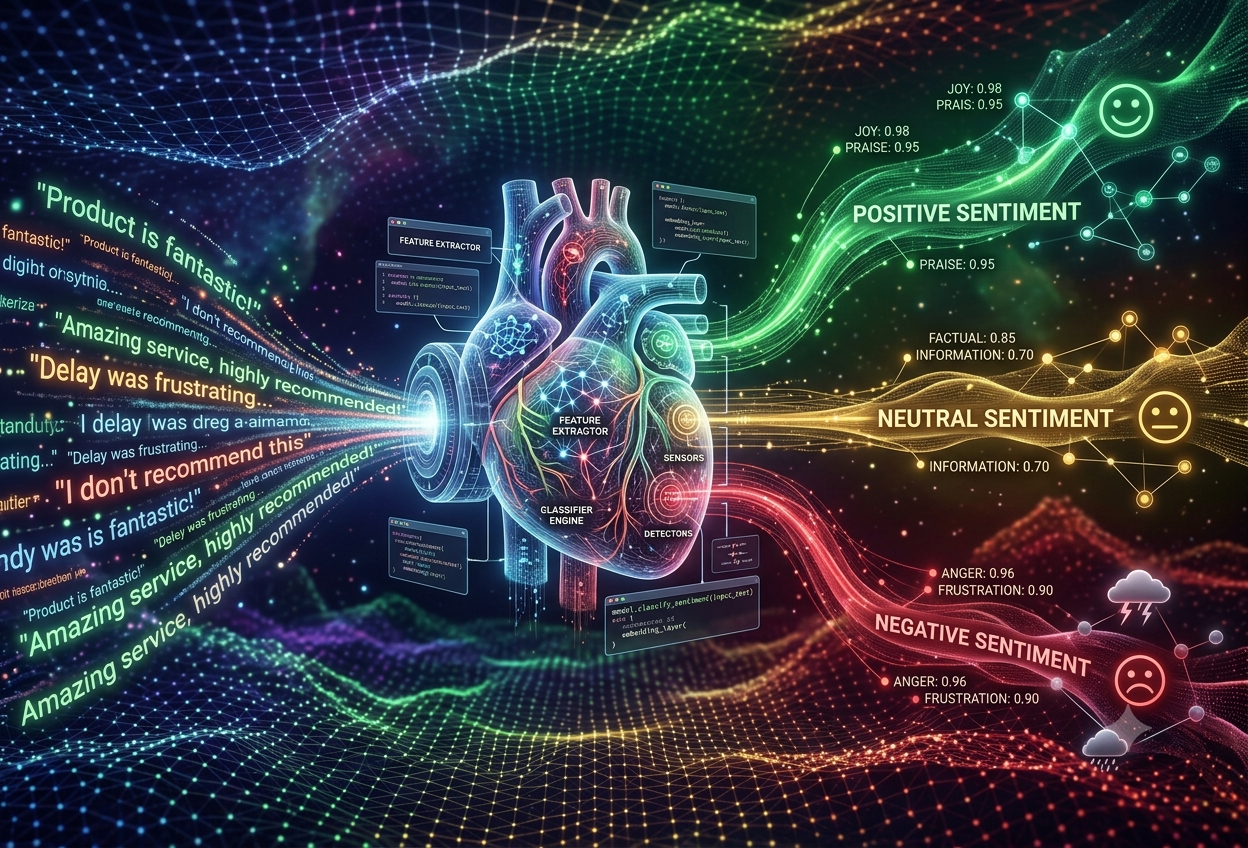
Sentiment Analysis — A Practical NLP Task
What Is Sentiment Analysis?
Every day, billions of human beings write how they feel — in reviews, tweets, comments, messages, and emails. Sentiment analysis is the technology that teaches computers to read those feelings, classifying text as positive, negative, or neutral, and often going much further to detect specific emotions like joy, anger, or frustration.
Also known as opinion mining or emotion AI, sentiment analysis sits at the intersection of Natural Language Processing (NLP), machine learning, and computational linguistics. It transforms unstructured, emotionally charged human text into structured, measurable data that systems can act upon.
Imagine you could read 10,000 product reviews in one second and instantly know if people mostly loved or hated a product. That’s what sentiment analysis does — but for computers. Instead of a human reading “This pizza was absolutely amazing! The crust was perfect!” and thinking “they liked it”, the computer reads the same words and figures out on its own that this sentence is very positive. It’s like teaching a robot to understand feelings.
Sentiment analysis is the computational process of identifying and categorising opinions expressed in text, with the goal of determining the writer’s attitude — positive, negative, or neutral — toward a subject, product, person, or event.— Core definition, computational linguistics research community
Why Sentiment Analysis Matters
The volume of human-generated text on the internet doubles roughly every two years. No team of humans can read and categorise that much text manually. Sentiment analysis is the only scalable way to listen to what billions of people are actually saying.
Every second, around 6,000 tweets are posted, 1,000 photos are uploaded to Instagram, thousands of product reviews appear on Amazon, and millions of messages are sent across messaging platforms. Buried in all of that text is an ocean of opinion, preference, frustration, and enthusiasm. For a business, a politician, a healthcare provider, or a public institution, understanding that ocean in real time is extraordinarily valuable — and essentially impossible without automated analysis.
Customer Feedback at Scale
A company receiving 50,000 product reviews per month cannot have a human read each one. Sentiment analysis converts that flood of unstructured opinions into dashboards showing satisfaction trends over time, automatically flagging products whose ratings are declining and identifying specific aspects (delivery speed, packaging quality, product durability) that customers praise or criticise most.
Brand Reputation Monitoring
A single negative viral tweet can cause measurable stock price drops. Sentiment monitoring systems watch every public mention of a brand across Twitter/X, Reddit, news articles, and review sites in real time, alerting PR teams the moment sentiment takes a sharp negative turn — long before traditional media coverage or official complaint channels would signal the problem.
Financial Market Intelligence
Hedge funds and algorithmic trading firms use sentiment analysis on news feeds, earnings call transcripts, and social media to predict short-term stock price movements. Research consistently shows that social media sentiment correlates with stock price changes with a lead time of hours to days. Some trading algorithms make buy/sell decisions based purely on sentiment scores.
Political & Public Opinion Research
Political campaigns and research organisations use sentiment analysis to track voter attitudes toward candidates, policies, and events across millions of social media posts. During elections, real-time sentiment dashboards replace slow and expensive traditional polling for day-to-day monitoring. Governments use it to gauge public reactions to new laws and policies.
History & Evolution of Sentiment Analysis
Sentiment analysis has gone through four distinct eras — from hand-crafted word lists to neural networks that understand context better than most humans in their second language.
Linguistic Foundations — Osgood’s Semantic Differential
Psychologist Charles Osgood developed the semantic differential technique, measuring word meanings along emotional dimensions (good/bad, strong/weak, active/passive). This was the conceptual ancestor of all sentiment lexicons — the idea that words could be scored on emotional scales.
Rule-Based Systems and Early Lexicons
The first computational sentiment systems used hand-crafted word lists assigning positive or negative scores to individual terms. Researchers like Hatzivassiloglou and McKeown developed algorithms to determine the orientation of adjectives. The General Inquirer dictionary, containing categorised words with positive/negative tags, became a foundational resource for this era.
The Seminal Paper — Pang, Lee & Vaithyanathan
Bo Pang, Lillian Lee, and Shivakumar Vaithyanathan published the paper that launched modern sentiment analysis as a machine learning problem. Using movie reviews as data, they compared Naive Bayes, Maximum Entropy, and SVM classifiers. This paper established the field’s research direction and is still one of the most cited papers in NLP.
Aspect-Based Sentiment — Hu & Liu
Minqing Hu and Bing Liu’s paper on mining and summarising customer reviews introduced aspect-based sentiment analysis — the idea that a single review might express positive sentiment about a phone’s camera but negative sentiment about its battery. This “feature-level” analysis remains the gold standard for product review analysis today.
Social Media Explosion — Twitter Sentiment
The explosion of Twitter and social media created both an enormous new data source and unique new challenges (slang, abbreviations, emojis, limited context). The SemEval shared tasks on Twitter sentiment analysis became benchmark competitions driving rapid progress. VADER (Valence Aware Dictionary for Sentiment Reasoning) was specifically developed for social media text.
The BERT Era — Contextual Sentiment
Google’s BERT (Bidirectional Encoder Representations from Transformers) transformed sentiment analysis, as it did all of NLP. Pre-trained on massive text corpora and fine-tuned on sentiment datasets, BERT-based models achieved accuracy levels previously unattainable, capturing nuance, irony, and context across long documents with unprecedented precision.
LLM-Powered Sentiment — Zero-Shot and Beyond
Large Language Models like GPT-4 and Claude can perform sophisticated sentiment analysis in a zero-shot setting — no task-specific training required. They can explain why a text has a particular sentiment, identify subtle irony, handle multi-lingual text, and perform fine-grained emotion analysis with a simple prompt. This is rapidly changing how sentiment analysis is deployed in practice.
Types of Sentiment Analysis
Sentiment analysis is not a single technique — it is a family of related tasks that vary in granularity, the emotions they detect, and the level at which they operate (document, sentence, or word/aspect).
The simplest form: assign a single overall sentiment label (positive, negative, or neutral) to an entire document — a review, email, or article. Fast and easy to implement, but loses all the nuance of mixed opinions within the same text. Suitable when you need a quick overall verdict on customer feedback items.
Analyses each sentence independently rather than the whole document. A review might contain sentences like “The camera is incredible” (positive) and “But the battery drains in 3 hours” (negative). Sentence-level analysis captures this contrast that document-level analysis would average away, making it much more actionable for product teams.
The most granular and commercially valuable form. Rather than a single overall score, ABSA extracts specific product or service aspects mentioned in a review and assigns sentiment to each. A hotel review might show: Location (+), Cleanliness (+), Service (-), Price (-). This directly tells operators exactly what to fix or promote.
Instead of the binary positive/negative scale, fine-grained analysis uses a spectrum — often a 5-point or 7-point scale matching star ratings. “This product is okay” is different from “I am mildly disappointed” which is different from “This is the worst purchase I have ever made.” Fine-grained models capture these distinctions and are essential for detailed satisfaction scoring.
Goes beyond polarity to identify specific emotions — joy, sadness, anger, fear, surprise, disgust — using the framework of Paul Ekman’s basic emotions. A customer support message might be classified as “frustrated” rather than just “negative”, enabling more empathetic automated responses. Emotion detection is particularly valuable in healthcare and mental health applications.
Intent-based analysis identifies the underlying purpose behind text — is the writer venting, seeking help, making a purchase decision, or planning to leave? Multilingual sentiment analysis extends these capabilities across languages, critical for global brands monitoring their reputation in dozens of markets simultaneously.
Four Approaches to Sentiment Analysis
The history of sentiment analysis is a story of four generations of technique, each more capable than the last. The right approach for any project depends on the available data, required accuracy, speed constraints, and budget.
Approach 1 — Rule-Based (Lexicon) Methods
The earliest and simplest approach: build a dictionary (lexicon) that assigns each word a sentiment score. To analyse text, count the positive and negative words, apply any negation rules (“not bad” flips the sign of “bad”), and produce a final score. Famous lexicons include AFINN (each word scored −5 to +5), SentiWordNet, and VADER (optimised for social media).
The sentence “The food was absolutely fantastic, but the service was truly terrible!” would be scored by VADER approximately as: “absolutely fantastic” = strong positive (+2.4), “truly terrible” = strong negative (−2.5), with intensity amplifiers (“absolutely”, “truly”) boosting each. Final compound score: slightly negative overall. This happens in microseconds with zero training data required.
Rule-based systems are interpretable (you can always trace exactly why a sentence got a given score), require no training data, and are extremely fast. Their weakness is rigidity: they struggle with irony (“Oh great, another flat tyre”), domain-specific language (medical jargon, legal language), and evolving slang. They also cannot learn new patterns without manual updates to the lexicon.
Approach 2 — Classical Machine Learning
Rather than hand-crafting rules, machine learning approaches learn sentiment patterns from labelled examples. A dataset of pre-labelled reviews (positive/negative) is used to train a classifier that can then predict the sentiment of new, unseen text.
The standard pipeline: convert text to numerical features using Bag of Words (counting word occurrences) or TF-IDF (weighting words by how distinctive they are to a document), then train a classifier. Common algorithms include:
Applies Bayes’ theorem by calculating the probability that a document belongs to a class given its words. Despite its simplistic “naive” independence assumption, it works surprisingly well for text and trains in seconds even on large datasets.
Finds the optimal decision boundary that maximises the margin between sentiment classes in high-dimensional feature space. Long considered the gold standard for text classification before deep learning, SVMs still perform competitively with far less data than neural networks.
Ensemble methods that combine many decision trees. They handle feature interactions well and are resistant to overfitting. Particularly effective when combined with engineered features like sentiment lexicon scores, readability metrics, and syntactic features.
Approach 3 — Deep Learning & Neural Networks
Deep learning models represent a quantum leap in sentiment analysis capability. Rather than manually engineering features from text, deep learning models learn their own representations directly from raw text, capturing context, syntax, and semantics simultaneously.
Recurrent networks with memory cells that capture sequential context — the meaning of earlier words influences interpretation of later ones. Long Short-Term Memory (LSTM) networks were state-of-the-art for sentiment until Transformers arrived. Still used for real-time streaming applications where Transformers are too slow.
Convolutional Neural Networks — originally designed for images — work remarkably well on text by treating sentence matrices like images. 1D convolutions detect local n-gram patterns regardless of their position in the text, making CNNs fast and effective for document-level sentiment classification.
The current state of the art. BERT (and its variants RoBERTa, DistilBERT, ALBERT) use bidirectional self-attention to simultaneously consider every word in context of every other word. Fine-tuned on sentiment datasets, BERT-based models achieve human-level accuracy on many benchmarks.
Traditional models read text left-to-right. BERT reads in both directions at once. In the sentence “I don’t think the movie was bad at all”, the word “bad” would look negative to a left-to-right model. BERT sees “not” at the start and “at all” at the end simultaneously, correctly understanding this as a strongly positive statement. This bidirectional context is why BERT transformed sentiment analysis accuracy.
Approach 4 — Hybrid Methods
Hybrid approaches combine the speed and interpretability of rule-based lexicon methods with the accuracy and generalisation power of machine learning. A common pattern: use VADER to quickly filter obvious positives and negatives (removing 70% of text from the queue with high confidence), then route the ambiguous middle cases to a fine-tuned BERT model. This design achieves near-BERT accuracy at a fraction of the compute cost.
| Approach | Training Data | Speed | Accuracy | Best For |
|---|---|---|---|---|
| Rule-Based (VADER) | None required | Extremely fast | Moderate (70-80%) | Social media, quick prototypes |
| Naive Bayes | Small to medium | Very fast | Good (80-85%) | Simple text, resource-constrained |
| SVM + TF-IDF | Medium | Fast | Good (83-87%) | Document classification |
| LSTM / GRU | Large | Moderate | Very good (88-92%) | Sequential text, real-time |
| Fine-tuned BERT | Medium (transfer) | Slow | Excellent (93-97%) | Production systems, high accuracy |
| LLM (GPT-4 zero-shot) | None | Slowest | Excellent (90-96%) | Complex nuance, new domains |
The Complete NLP Pipeline
Every sentiment analysis system, from a simple script to a production BERT deployment, follows the same fundamental pipeline. Understanding each stage helps you diagnose problems, choose the right tools, and improve model performance.
Stage 1 — Text Preprocessing
Raw text is messy. Before any analysis can happen, it must be cleaned and standardised. The preprocessing steps vary by application but typically include several operations applied in sequence:
- Text cleaning. Remove HTML tags (essential for web-scraped data), special characters, extraneous punctuation, and non-textual markers. Retain emojis if the task is social media analysis — they carry significant sentiment signal. Convert all text to lowercase to prevent “Great” and “great” being treated as different words.
- Tokenisation. Split the continuous text string into individual tokens. This sounds simple but is complicated by contractions (“don’t” → [“do”, “n’t”]), hyphenated words (“well-designed”), and abbreviations (“Mr.”). Different tokenisers handle these differently, significantly affecting downstream performance.
- Stop word removal. Words like “the”, “a”, “is”, “and” appear so frequently across all texts that they provide little discriminative power for sentiment. Removing them reduces noise — but caution: negation words like “not” and “never” are technically stop words in some lists but are critically important for sentiment and must be retained.
- Stemming or lemmatisation. Reduce words to their root forms so “running”, “runs”, and “ran” are treated as the same word. Stemming uses simple rules (chop the “-ing” suffix) and is fast but crude. Lemmatisation uses a vocabulary and morphological analysis to correctly identify “went” as a form of “go” — slower but more accurate.
- Handling emojis and internet language. For social media, emojis must be converted to text descriptions (😊 → “happy face”) or removed. Abbreviations like “lol”, “tbh”, “brb” should be expanded. Repeated characters like “LOOOOVE” need normalisation (“love”).
Stage 2 — Feature Extraction
Machine learning models cannot process raw text — they need numbers. Feature extraction converts tokens into numerical representations that models can learn from:
Creates a vector with one dimension per vocabulary word. Each document is represented by word counts — a sparse vector of mostly zeros. Simple and fast, but loses word order entirely: “I love not having problems” and “I don’t love having problems” produce nearly identical vectors despite opposite meanings.
Improves on BoW by down-weighting common words (Term Frequency × Inverse Document Frequency). “The” appears in almost every document and gets near-zero weight; “electrifying” appearing in many positive reviews gets high weight. Produces more meaningful features than raw counts.
Represent each word as a dense vector of 50–300 numbers that encode semantic meaning. Similar words have similar vectors. The document is represented by averaging its word vectors, capturing meaning beyond simple word counting. A major improvement over BoW for catching synonyms and related concepts.
Unlike static word embeddings, BERT produces different vector representations of the same word depending on its surrounding context. “Bank” in “river bank” and “bank account” get completely different vectors — capturing the disambiguation that earlier methods could not. The richest and most powerful representation currently available.
Stage 3 — Classification and Output
The final stage assigns a sentiment label. For ML models, this means passing features through a trained classifier and thresholding the output probability. For BERT-based models, a classification head (a small neural network layer) is trained on top of the pre-trained representations. The output might be:
- A binary label: Positive or Negative
- A three-class label: Positive, Negative, or Neutral
- A fine-grained score: 1–5 stars or a −1.0 to +1.0 compound score
- Multiple emotion labels: Joy: 0.85, Anger: 0.12, Sadness: 0.03
- Aspect-score pairs: {battery: negative, camera: positive, price: neutral}
Key Models & Algorithms
The machine learning landscape for sentiment analysis has evolved dramatically. Here is a reference guide to the most important models, from classic algorithms still widely used today to state-of-the-art transformer variants.
Valence Aware Dictionary for sEntiment Reasoning. Specifically tuned for social media text, handling ALL CAPS (intensification), punctuation (!!! = stronger), and emojis. Returns compound, positive, negative, and neutral scores. Best for Twitter/Reddit/review analysis without training data.
A simple Python NLP library providing pattern-matching sentiment analysis (polarity: −1 to +1, subjectivity: 0 to 1). Excellent for prototyping and educational purposes. Accuracy is modest but the API is extremely clean and beginner-friendly.
Bidirectional Encoder Representations from Transformers. Fine-tuned BERT models consistently achieve 93–96% accuracy on standard sentiment benchmarks. Multiple variants exist: RoBERTa (robustly optimised), DistilBERT (60% smaller, 97% as accurate), and domain-specific variants like FinBERT (finance), BioBERT (biomedicine), and TweetBERT.
Standard BERT is limited to 512 tokens (~380 words). For long documents — financial reports, legal filings, academic papers — Longformer extends the context window to 4,096 tokens using sparse attention patterns. Essential for document-level sentiment in long-form content.
Large Language Models can perform sophisticated sentiment analysis with a simple prompt — no training data required. They can explain their reasoning, handle irony, and classify multi-lingual text. Accuracy rivals fine-tuned BERT on complex tasks but at significantly higher cost per query.
Distilled BERT models designed for deployment on resource-constrained devices — mobile phones, IoT sensors, edge servers. Achieve 85–90% of BERT accuracy at 5–10% of the parameters, enabling real-time sentiment analysis without cloud connectivity.
Tools, Libraries & Platforms
A rich ecosystem of open-source libraries, cloud services, and pre-trained models makes sentiment analysis accessible to everyone from a student experimenting with Python for the first time to an enterprise deploying at billions of predictions per day.
Python Libraries — The Foundation
NLTK + VADER
The Natural Language Toolkit is Python’s original NLP library. Combined with VADER, it provides ready-to-use rule-based sentiment analysis. Ideal for learning, rapid prototyping, and applications where speed matters more than accuracy.
spaCy + TextBlob
spaCy offers industrial-strength NLP preprocessing (tokenisation, dependency parsing, NER) plus integrations with sentiment models. TextBlob provides a beginner-friendly API for basic sentiment scoring with pattern-based analysis.
Hugging Face Transformers
The most widely used library for deploying BERT-style models. With three lines of code you can load a fine-tuned sentiment model and run predictions. Hosts thousands of pre-trained sentiment models for specific domains (finance, medical, social media) and languages.
# 1. Rule-Based: VADER (no training needed)
from vaderSentiment.vaderSentiment import SentimentIntensityAnalyzer
analyzer = SentimentIntensityAnalyzer()
score = analyzer.polarity_scores(“This product is absolutely amazing!”)
# → {‘neg’: 0.0, ‘neu’: 0.21, ‘pos’: 0.79, ‘compound’: 0.8619}
# 2. Transformer: Fine-tuned BERT (best accuracy)
from transformers import pipeline
sentiment = pipeline(“sentiment-analysis”)
result = sentiment(“The movie was surprisingly brilliant!”)
# → [{‘label’: ‘POSITIVE’, ‘score’: 0.9997}]
# 3. LLM: Zero-shot with GPT-4
prompt = “Classify sentiment (positive/negative/neutral):
‘The delivery was fast but the item was damaged.'”
Cloud Services — Enterprise Scale
Amazon’s managed NLP service performs sentiment analysis, entity detection, and key phrase extraction. Scales automatically, requires no ML expertise, and supports custom model training on domain-specific data. Pay-per-use pricing makes it cost-effective for variable workloads.
Google’s Natural Language API provides sentiment scores at both document and sentence level, returning magnitude (strength of emotion) as well as polarity. Integrates tightly with Google’s data ecosystem and has excellent multilingual support across 10+ languages.
IBM’s enterprise NLP platform includes sentiment analysis as part of a broader text analytics suite. Offers strong governance, audit trails, and compliance features important in regulated industries. Available as on-premise deployment for organisations that cannot use cloud services.
Real-World Applications Across Domains
Sentiment analysis is one of the most widely deployed NLP capabilities in the world, quietly running behind the scenes in products and platforms used by billions of people every day.
E-commerce & Retail
Amazon, Flipkart, and Shopify use sentiment analysis to surface the most useful reviews, flag fake reviews (unusually uniform positive sentiment), identify recurring product defects, and power recommendation engines. Aspect-based analysis tells product teams exactly which features to improve for the next product version.
Finance & Trading
Quantitative trading firms analyse news articles, analyst reports, earnings call transcripts, and Twitter sentiment to generate trading signals. Academic research has confirmed that social media sentiment predicts stock price movements days in advance. Risk management teams use sentiment to detect emerging crises before they hit traditional data sources.
Customer Support
Support ticket routing systems use sentiment to prioritise angry or distressed customers ahead of neutral inquiries. Live chat systems display real-time sentiment scores to support agents, prompting intervention when a conversation turns negative. Escalation systems automatically route highly negative interactions to senior agents or managers.
Healthcare & Mental Health
Clinical researchers analyse patient-reported outcomes and social media posts to track mental health trends at population scale. Crisis intervention services monitor online forums for expressions of suicidal ideation or extreme distress, enabling faster outreach. Patient satisfaction analysis from hospital surveys and online health platforms guides service improvements.
Media & Entertainment
Streaming platforms analyse social media reactions to new shows and movies in the hours after release, predicting long-term viewership from early sentiment signals. Game studios track player sentiment on Reddit and Discord to identify bugs, balance issues, and community frustrations far faster than formal feedback channels would allow.
Public Sector & Research
Government agencies monitor citizen sentiment about public services, disaster response, and policy changes. Epidemiologists track symptom discussions on social media as an early warning system for disease outbreaks. Academic researchers use large-scale sentiment analysis of historical news archives to study how public opinion evolved over decades.
The Hardest Challenges in Sentiment Analysis
Sentiment analysis sounds straightforward — just detect positive and negative words. In practice, human language is endlessly creative, ambiguous, and culturally encoded, presenting challenges that researchers are still actively working to solve.
“Oh great, my laptop died right before the deadline. Best day ever.” Most rule-based systems and many ML models classify this as positive. Detecting sarcasm requires understanding pragmatics, cultural context, and often world knowledge. Even humans agree only about 70% of the time on sarcastic text labels.
“Not bad at all” is strongly positive. “Not as good as I expected” is mildly negative. Negation scope — how far a “not” or “never” extends in a sentence — varies by syntactic structure. Transformers handle this well because they model entire sentence context simultaneously, but lexicon methods often fail badly.
In global social media, users switch between languages mid-sentence (“That movie was so pyaar ❤️ but the ending was terrible”). Training data for most languages beyond English is limited. Cultural context matters enormously — the same word can carry very different emotional weight across cultures.
“This book is an absolute killer” is positive in a thriller review context. “The side effects were killer” in a medical review is clearly negative. Models trained on movie reviews perform poorly on financial text or medical records. Domain adaptation or domain-specific pre-training is required for each new area.
“I had to return this item twice” contains no positive or negative words, yet clearly expresses a negative experience. “My flight landed safely” is technically neutral but contextually positive. Implicit sentiment is carried by factual statements whose emotional valence must be inferred from world knowledge.
Production systems monitoring Twitter must process thousands of posts per second. BERT models take 50-200ms per inference — too slow for raw social media volume. The engineering challenge of achieving high accuracy at high throughput requires careful batching, model distillation, hardware optimisation, and caching strategies.
Sentiment Analysis vs Semantic Analysis
These two terms are often conflated, but they address fundamentally different questions. Sentiment analysis asks “How does the writer feel?” while semantic analysis asks “What does this text actually mean?”
| Dimension | Sentiment Analysis | Semantic Analysis |
|---|---|---|
| Core question | What emotion or opinion is expressed? | What does this text mean? |
| Output | Labels (positive/negative) or scores | Meaning representations, knowledge graphs |
| Focus | Emotional tone, polarity, feelings | Concepts, entities, relationships, context |
| Techniques | Lexicons, classifiers, BERT fine-tuning | NER, dependency parsing, ontologies, coreference |
| Typical input | Reviews, tweets, survey responses | Documents, knowledge bases, conversations |
| Typical output | “The customer is unhappy with the delivery” | “Person X → performed action → receive → Object Y” |
| Where used | Brand monitoring, review analysis, CX | Search engines, chatbots, knowledge graphs |
In practice, advanced NLP pipelines often combine both: semantic analysis to understand what is being discussed (which product, which feature, which person), and sentiment analysis to understand how the writer feels about it. Aspect-Based Sentiment Analysis (ABSA) is the intersection of these two — it performs semantic analysis to identify aspects, then sentiment analysis to score each.
Semantic analysis understands that the sentence is about a laptop’s battery. Sentiment analysis understands that the writer is frustrated. You need both to build a system that actually helps product managers.
— The complementary nature of semantic and sentiment analysis in production NLPHow to Evaluate Sentiment Models
A sentiment model is only as useful as it is accurate. But “accuracy” alone can be deeply misleading — especially when classes are imbalanced (far more positive reviews than negative ones). Understanding the full evaluation toolkit helps you choose and trust the right model.
Accuracy
The proportion of all predictions that are correct. Simple and intuitive, but misleading on imbalanced datasets. If 90% of your data is positive, a model that always predicts “positive” achieves 90% accuracy while being completely useless for detecting negatives.
Precision & Recall
Precision: of all texts the model labelled “negative”, what fraction truly were negative? Recall: of all truly negative texts, what fraction did the model catch? These must be balanced based on the use case — missing a customer complaint (low recall) may be worse than the occasional false alarm.
F1-Score & Macro-F1
The harmonic mean of Precision and Recall. Macro-F1 averages the F1 score across all classes equally, penalising poor performance on minority classes. This is the standard benchmark metric for sentiment analysis research papers and competitions like SemEval.
A confusion matrix shows exactly where your model makes mistakes — which sentiment class does it confuse with which? A model that frequently confuses “very positive” with “positive” is much more acceptable than one that confuses “positive” with “negative”. Always look at the full confusion matrix, not just a single number, before trusting a sentiment model for production deployment.
Strengths & Limitations
Strengths
- Analyses millions of texts in seconds — impossible manually
- Real-time brand monitoring and crisis detection
- Consistent, objective scoring without human fatigue
- Scales without proportional cost increase
- Actionable business intelligence from unstructured data
- BERT models achieve near-human accuracy on clear text
- Fine-tuning allows rapid adaptation to new domains
- Multilingual models cover 100+ languages
Limitations
- Struggles with irony, sarcasm, and cultural nuance
- Domain mismatch degrades performance significantly
- Limited training data for low-resource languages
- Cannot reliably interpret implicit or contextual sentiment
- Deep learning models are black boxes — hard to debug
- Annotated training data is expensive and slow to create
- BERT-scale inference costs prohibitive at very large volume
- May encode societal biases from training corpora
Ethical Considerations
Privacy & Consent
Analysing social media posts at scale raises questions about consent — do users expect their public posts to be mined for business intelligence? In regulated regions like the EU, GDPR considerations apply even to publicly available data when it involves personal opinions linked to identifiable individuals.
Bias in Training Data
Sentiment models trained primarily on English product reviews from Western markets perform poorly on text from other cultural contexts and may systematically misinterpret sentiment in ways that disadvantage certain groups. Demographic biases in training data can lead to higher error rates for text from particular communities.
High-Stakes Misclassification
In mental health monitoring or crisis detection applications, misclassifying a genuine distress signal as neutral can have life-or-death consequences. Sentiment models used in sensitive contexts must be evaluated with extreme care, regularly audited, and always supplemented by human review in high-stakes decisions.
Comprehensive technical overview covering types, approaches, preprocessing steps, ML algorithms, and tools for sentiment analysis with code examples. Updated Dec 2025.
End-to-end guide to NLP-powered sentiment analysis pipelines, from raw text preprocessing through to production deployment considerations and performance benchmarks.
Enterprise-focused analysis of machine learning approaches to sentiment, covering feature engineering, model selection, evaluation, and real-world production considerations.
Hands-on Python tutorial covering sentiment analysis using NLTK, VADER, and classical ML techniques with real datasets and step-by-step code walkthroughs.
Technical deep dive into modern NLP sentiment analysis methods including transformer-based approaches, domain adaptation, and deployment patterns for enterprise systems.
Practical guide to Twitter-specific sentiment analysis challenges including handling of emojis, slang, hashtags, and limited character context with VADER and BERT approaches.
Machine learning platform tutorial demonstrating sentiment analysis at scale using H2O’s automated ML tools, covering data preparation, model training, and deployment.
Peer-reviewed academic survey of sentiment analysis techniques, benchmark datasets, evaluation metrics, and open research challenges. Published in a computational intelligence journal, 2024.
Practitioner’s walkthrough of building a complete sentiment analysis pipeline from scratch, covering both traditional ML and transformer-based approaches with Python code.
Educational overview of NLP concepts applied to sentiment analysis, explaining preprocessing, feature extraction, model training, and evaluation in an accessible format.