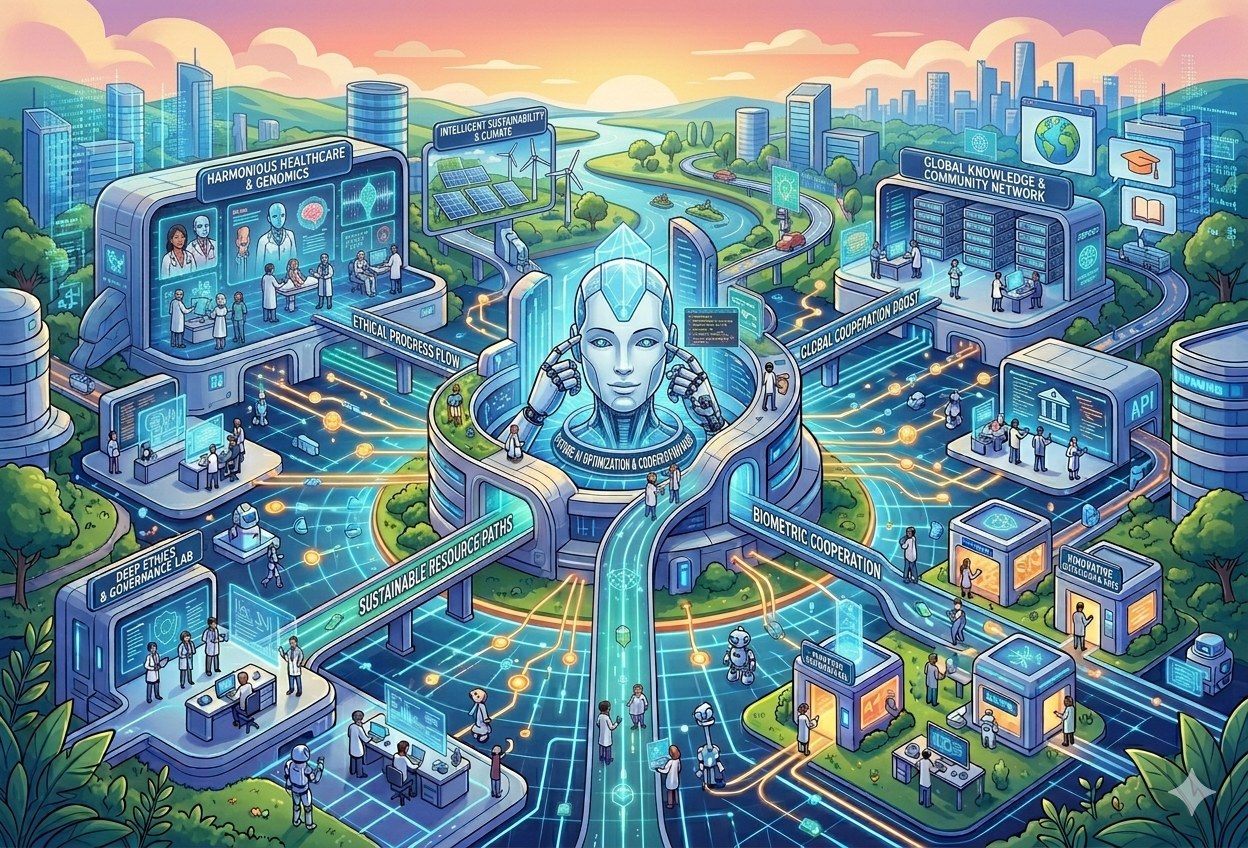
The Future of Artificial Intelligence
What Is Artificial Intelligence?
Artificial Intelligence — or AI — is the science of building computer systems that can think, learn, reason, and solve problems in ways that once required a human brain. It is not science fiction; it is already in your phone, your hospital, your car, and your classroom.
Artificial Intelligence is the branch of computer science dedicated to creating machines that can perform tasks which, when done by humans, require thought, judgement, learning, perception, and language — making computers, in essence, clever collaborators.— Synthesised from leading research institutions, 2026
Explaining AI to a 10-Year-Old 🧒
Imagine you have a very patient robot friend who reads millions of books, watches thousands of videos, and plays millions of games — all in one night! By doing all of that, it starts to notice patterns: “When people say ‘I’m hungry’, they often look for food next.” Over time, the robot can predict what you might want before you even ask. That pattern-spotting, that learning from experience — that is what AI does. It does not actually have feelings or understand the world the way you do, but it has become incredibly good at finding patterns and using them to help people.
Perceive — Sense the world through data (images, text, sound, numbers). Reason — Draw conclusions, spot patterns, and make decisions from what it has perceived. Act — Generate a response, take an action, or produce something useful based on its reasoning.
A Short History of AI
AI is not new — it has been quietly developing for more than seven decades, passing through cycles of excitement, disappointment, and breathtaking comeback. Understanding its history helps us appreciate just how fast and how far it has come.
Alan Turing Asks “Can Machines Think?”
British mathematician Alan Turing published a landmark paper proposing the now-famous “Imitation Game” — a test of whether a machine could carry on a conversation indistinguishable from a human. This laid the philosophical foundation for everything that followed.
The First AI Program
Christopher Strachey wrote a checkers-playing program that completed an entire game on the Ferranti Mark I — the first documented demonstration of a machine successfully executing a strategy-based task.
Neural Network Pioneers Emerge
Geoffrey Hinton, Yann LeCun and other researchers demonstrated that layered artificial neural networks could learn from examples — planting the seeds of modern deep learning decades before hardware would be powerful enough to run it at scale.
Deep Blue Defeats Garry Kasparov
IBM’s chess-playing computer became the first machine to defeat a reigning world chess champion in a formal match — a cultural milestone that captured global attention and announced AI as a serious competitive force.
IBM Watson Wins Jeopardy!
IBM’s Watson system combined natural language understanding, knowledge retrieval, and probabilistic reasoning to beat two all-time Jeopardy! champions — demonstrating that machines could handle nuanced human language and broad factual knowledge.
Transformers Change Everything
Google researchers introduced the Transformer architecture in the paper “Attention Is All You Need,” enabling models to process entire documents simultaneously rather than one word at a time. This architecture became the backbone of every major language model since.
ChatGPT Reaches 100 Million Users in 2 Months
OpenAI’s ChatGPT became the fastest-growing consumer application in history, making conversational AI a household experience overnight and sparking a global race among technology companies to develop competing products.
The Agentic Era Begins
AI systems transition from answering questions to actually completing tasks — browsing the web, writing code, booking travel, and managing workflows with minimal human involvement. The shift from “assistant” to “agent” marks the current frontier of the field.
How Does AI Actually Work?
At its core, AI learns from examples rather than being explicitly programmed with rules. It is trained on enormous collections of data, and through that training, it discovers patterns it can then apply to new situations.
The Learning Pipeline — Simply Explained 🧩
Think of teaching a child to recognise a cat. You don’t write down rules like “four legs, whiskers, pointy ears” — you just show the child thousands of pictures of cats and say “cat.” Eventually, the child’s brain builds its own internal model of what a cat looks like. AI works the same way, just with millions of examples and mathematical patterns instead of a biological brain.
When we say an AI model is “trained,” it means the system has been exposed to massive amounts of data and has adjusted billions of tiny internal settings — called “parameters” or “weights” — until its predictions match the correct answers. A model like GPT-4 has over one trillion such parameters, each tuned to contribute to accurate, helpful responses.
The Three Major Techniques
The model learns from labelled examples — each input is paired with the correct answer. Like a student learning from a textbook with an answer key. Used in email spam filters, medical image reading, and credit scoring.
The model finds patterns in data with no labels at all. Like sorting a pile of coloured balls without being told the colours’ names first. Used in customer segmentation, anomaly detection, and content recommendation engines.
The AI learns by trial and error, receiving rewards for good decisions and penalties for bad ones — just like training a dog with treats. Used in game-playing AI (like AlphaGo), robotics, and autonomous vehicle navigation.
Types of AI — A Clear Classification
Not all AI is alike. The field spans a wide spectrum, from highly focused tools that do one thing brilliantly to theoretical systems that could potentially match human cognition across all domains.
Masters a single domain with exceptional skill. Every AI product you use today — search engines, virtual assistants, image generators, language translators — is Narrow AI. Brilliant within its lane, helpless outside it.
A hypothetical system capable of learning and performing any intellectual task a human can do — switching between mathematics, creative writing, and emotional support without special retraining. The long-term goal of AI research.
An entirely theoretical construct where machine intelligence surpasses human cognitive capacity across every field simultaneously. Widely discussed in philosophical circles; not an engineering target today.
A sub-category of Narrow AI that creates original content — text, images, code, music, video. Powered by large language models and diffusion models. The fastest-growing segment of AI today, reshaping creative and knowledge work.
The Generative AI Explosion
Generative AI — the ability to create original text, images, code, music, and even video from a simple prompt — is the single most transformative shift in technology since the smartphone. It has moved from research laboratory to household tool in under three years.
When OpenAI released its first GPT model in 2018, it attracted mostly specialist interest. By 2022, ChatGPT turned Generative AI into a global conversation, reaching 100 million active users faster than any application in internet history. Today, every major technology company — from Google (Gemini) and Anthropic (Claude) to Meta (Llama) and China’s DeepSeek — is racing to build and improve these systems.
Generative AI has the potential to add trillions of dollars to the global economy — not by replacing human effort, but by dramatically amplifying it.
— Synthesis of McKinsey, IBM, and World Economic Forum projections, 2025What Makes Generative AI Different?
Traditional AI classifies things (is this email spam or not?) or predicts things (will this customer churn?). Generative AI does something more creative: it produces brand-new content that has never existed before, drawing on patterns learned from billions of examples. It is the difference between a music critic and a composer.
Imagine a DJ who has listened to every song ever made. When you ask for “something like Taylor Swift but with a reggae beat,” the DJ blends what they have heard and creates a brand-new track. Generative AI is like that DJ — it has “listened to” billions of sentences, pictures, and code files, and it can remix them into something new on demand.
Agentic AI — From Chatbot to Colleague
The next great leap in AI is not making models smarter at answering questions — it is making them capable of taking actions, completing multi-step tasks, and working autonomously like a tireless digital employee.
Traditional AI assistants respond to prompts and stop. Agentic AI systems take a goal, break it into steps, execute each step (browsing the web, writing and running code, sending emails, querying databases), and deliver a finished result — all without requiring the human to manage each micro-task.
A traditional AI chatbot is like a very knowledgeable waiter — it can tell you anything on the menu in great detail. An Agentic AI is like a full kitchen: you say “I want a birthday dinner for 10,” and it plans the menu, orders the ingredients, cooks all the courses, and sets the table. You just show up and eat.
How Agentic AI Systems Work
Major technology firms are already deploying Agentic AI for software development, customer support resolution, financial research, and supply chain management. By 2034, analysts expect agentic systems to handle the majority of routine white-collar knowledge tasks — not replacing workers, but enabling each person to manage far larger workloads with fewer repetitive interruptions.
Multimodal AI — Many Senses, One System
Early AI models were specialists: one for text, another for images, another for sound. Multimodal AI combines all of these senses into a single, unified system — closer to how humans actually perceive and make sense of the world.
When you look at a photograph, listen to someone speak, and read their caption simultaneously, your brain integrates all three streams into one coherent understanding. Multimodal AI replicates this by processing text, images, audio, and video together, with the market for these systems projected to grow at a compound annual rate of nearly 37% through the end of the decade.
Describe what is in a photograph, read handwritten notes, or generate detailed captions automatically. Powers medical imaging analysis and accessibility tools for the visually impaired.
Real-time transcription with full contextual understanding. Translate a conversation between two languages simultaneously while preserving tone, emphasis, and meaning.
Watch a video and answer questions about it, automatically generate meeting summaries from recordings, or detect safety hazards in real-time security footage.
Combine satellite imagery, weather readings, and historical data to predict crop yields, natural disasters, or traffic congestion hours before they occur.
Modern smartphones use multimodal AI every day. When you point your camera at a restaurant menu and it automatically translates the text into your language — that is visual AI and language AI working together in real-time. The same technology, scaled enormously, is what makes advanced multimodal AI so powerful.
Smaller, Smarter, Cheaper Models
For years, the assumption was that bigger was always better in AI. Larger models with more parameters produced better results. Now, researchers have discovered that smaller, carefully trained models can match — and sometimes exceed — the performance of giant predecessors at a fraction of the cost.
The emergence of models like Meta’s Llama series, OpenAI’s GPT-4o mini, and China’s DeepSeek R1 (which matched leading Western models at a reported fraction of the training cost) has demonstrated that efficiency matters as much as raw scale. This trend has profound implications: AI capable enough for practical business use could soon run directly on smartphones and laptops, eliminating cloud dependency entirely.
| Model Approach | Size | Cost | Best For | Example |
|---|---|---|---|---|
| Frontier Large Models | 100B+ params | Very High | Complex reasoning, research, creative tasks | GPT-4, Claude Opus, Gemini Ultra |
| Mid-Size Efficient Models | 7B–70B params | Moderate | Business automation, coding, customer support | Llama 3, Mistral Large, Claude Sonnet |
| Small On-Device Models | 1B–7B params | Very Low | Mobile apps, real-time response, privacy-first | GPT-4o mini, Phi-3, Gemma |
| Specialised Domain Models | Varies | Low–High | Medical, legal, scientific, financial domains | Med-PaLM, BloombergGPT |
Democratisation — AI for Everyone
For most of computing history, the most powerful tools were locked behind expensive licences, specialist degrees, and enterprise contracts. AI is dismantling those barriers at remarkable speed, making capabilities once available only to Fortune 500 companies accessible to any individual with an internet connection.
What Does Democratisation Look Like?
- No-Code AI Platforms: Drag-and-drop tools that let non-programmers build custom AI models by uploading examples and setting parameters — no maths or coding required.
- Open-Source Models: Major AI systems like Meta’s Llama are released free for the world to use, study, modify, and improve — accelerating innovation globally and preventing any single company from monopolising the technology.
- Auto-ML: Automated Machine Learning tools handle data preparation, feature selection, and model tuning automatically, allowing data analysts without deep AI expertise to build production-grade models.
- API-Driven Integration: Any business can now add AI capabilities — translation, summarisation, image generation, fraud detection — to their existing products in hours rather than years, by calling a cloud API.
- Voice-First Interfaces: Natural language is becoming the programming language of AI. Non-technical users can describe what they want in plain words and receive fully functional AI-powered results.
Democratised AI means a small business owner in rural India can access the same customer analytics tools as a multinational corporation. A doctor in a remote clinic can access AI-powered diagnostic support equivalent to a world-class hospital. The geographic and economic barriers that once separated access to powerful tools are dissolving.
Industry Transformations
AI is not merely a technology upgrade — it is a fundamental restructuring of how entire industries operate, compete, and create value. Every sector is being reshaped, some far faster than others.
Healthcare & Medicine
AI analyses medical scans with radiologist-level accuracy, predicts patient deterioration before symptoms appear, accelerates drug discovery from decades to months, and personalises treatment plans to individual genetic profiles. During vaccine development, AI models helped sequence mRNA targets in days rather than years.
Finance & Banking
Fraud detection models analyse millions of transactions per second to catch suspicious patterns in real time. AI-powered credit assessment considers thousands of variables simultaneously, expanding access to lending for people traditional scoring algorithms would have rejected. Algorithmic trading executes strategies at speeds no human can match.
Manufacturing & Robotics
AI-powered computer vision systems inspect products at superhuman speed and precision, catching defects invisible to the naked eye. Predictive maintenance systems monitor machinery vibration, temperature, and noise to predict failures weeks before they occur — eliminating costly downtime. Collaborative robots (cobots) now work safely alongside human colleagues.
Education
AI tutoring systems adapt lesson pacing, difficulty, and teaching style to each student individually — providing the kind of one-on-one attention historically available only to the wealthy. AI can identify a student struggling with a concept days before a teacher might notice, enabling early intervention. Language learning apps use AI to provide native-speaker-quality conversation practice anytime.
Transportation & Logistics
Autonomous vehicles use AI to perceive their surroundings with 360-degree sensor fusion, navigate complex urban environments, and predict the behaviour of other drivers. In logistics, AI optimises delivery routes in real time, reducing fuel consumption and delivery times simultaneously. Drone delivery networks are being managed by AI coordinators.
Retail & E-Commerce
Recommendation engines predict what you want to buy before you know yourself, generating a disproportionate share of e-commerce revenue. Inventory management AI predicts demand spikes weeks in advance. Cashier-free stores use computer vision to charge customers automatically as they pick up and walk out with items.
Energy & Sustainability
AI balances power grids dynamically as renewable energy sources fluctuate, preventing blackouts and reducing waste. Deep learning models analyse geological data to identify mineral deposits for battery production. AI-optimised buildings can cut energy consumption by 30–40% without sacrificing occupant comfort.
Creative Industries
Generative AI is a collaborator, not a replacement, for creative professionals — helping designers rapid-prototype visual concepts, assisting writers to overcome blocks, enabling indie game developers to produce assets at AAA quality, and giving musicians new instruments to compose with. The creative economy is expanding, not contracting.
AI & the Future of Work
AI is already changing what work looks like day to day. Understanding exactly how — and separating fact from fear — is essential for anyone planning their career or managing a team in the years ahead.
A significant survey by Deloitte in 2025 revealed that 74% of businesses are prioritising their technology spending on AI and GenAI, nearly 20 percentage points higher than the next priority areas. This signals that AI adoption in the workplace is not a gradual experiment — it is becoming core infrastructure.
Three Major Shifts EY Research Identifies
Task Redistribution
AI is absorbing the repetitive, data-intensive, and pattern-matching portions of jobs — freeing human workers to focus on creativity, relationship-building, ethical judgement, and complex problem-solving where AI still falls short.
Skill Evolution
The most in-demand workplace skills are shifting from technical execution (data entry, report compilation, code generation) to human-AI collaboration skills: prompt engineering, AI output evaluation, and strategic AI deployment.
Leadership Transformation
Managers are becoming AI orchestrators — setting objectives for AI agents, evaluating their outputs, and intervening on edge cases. The leader of the near future manages both human teams and AI systems simultaneously.
The evidence suggests the real risk is not “AI replacing workers” but rather “workers who use AI replacing workers who do not.” A lawyer who uses AI for research, contract review, and document drafting can handle a caseload previously requiring three lawyers. The skill is not the legal knowledge — it is knowing how to direct AI effectively.
AI Accelerating Scientific Discovery
Perhaps the most profound impact of AI in the long run will not be on commerce or entertainment — it will be on science. AI is enabling researchers to explore spaces of possibility too large for human analysis and to make discoveries that might otherwise have taken decades.
DeepMind’s AlphaFold solved a 50-year-old biology grand challenge by predicting the 3D structure of proteins from amino acid sequences. It has mapped over 200 million protein structures — accelerating research in medicine, agriculture, and materials science.
AI can screen billions of molecular combinations in silico — virtually — in the time it would take a lab to test thousands physically. The first AI-designed drug candidates are now in clinical trials, compressing a process that typically takes 10–15 years.
AI weather models now produce 10-day forecasts with accuracy that previously required the world’s most powerful supercomputers, but in minutes rather than hours. Climate models using AI can simulate decades of atmospheric behaviour in days.
AI systems comb through telescope data to identify exoplanets, gravitational wave events, and new galaxy types that human astronomers would miss across the sheer volume of observations. NASA and ESA routinely use AI to triage mission data.
AI Transforming Marketing & Business Growth
Marketing has historically been a field of creative intuition and slow feedback loops. AI is giving it the precision of engineering — personalising every touchpoint, optimising every campaign, and predicting customer behaviour with increasing accuracy.
- Hyper-Personalisation: AI analyses browsing patterns, purchase history, and contextual signals to deliver different messages to different customers in real time — no two visitors to a website necessarily see the same homepage.
- Predictive Analytics: AI models identify which customers are likely to churn, which leads are most likely to convert, and what products an individual is likely to need next — often before the customer consciously knows themselves.
- Automated Content at Scale: AI drafts product descriptions, ad copy variations, email subject lines, and social media posts at a volume no human team could match, while A/B testing performance data simultaneously to optimise messages.
- Conversational Commerce: AI chatbots handle customer enquiries, product recommendations, and purchase completion through natural conversation — providing 24/7 service at near-zero marginal cost per interaction.
- Sentiment Analysis: AI monitors social media, reviews, and customer calls in real time to detect emerging reputational risks or product issues hours before they escalate into crises visible to leadership.
Strengths & Limitations of AI
No technology in history has arrived without trade-offs, and AI is no exception. A clear-eyed understanding of both what AI does well and where it still struggles is essential for anyone using, deploying, or regulating it.
✅ Strengths
- Processes enormous volumes of data at speeds impossible for humans — finding patterns in billions of data points in seconds.
- Available 24 hours a day, 365 days a year, without fatigue, mood swings, or need for breaks.
- Consistent and repeatable — performs the same analysis with the same accuracy every single time, reducing human error in routine tasks.
- Continuously improves as more data is collected — gets better over time without requiring salary negotiations or retraining courses.
- Can operate in environments too dangerous, too remote, or too tedious for human workers — deep sea, radioactive sites, extreme repetitive quality inspection.
- Personalises experiences at a scale no human team could achieve — serving millions of individual preferences simultaneously.
✗ Limitations
- “Hallucinations” — AI can generate confident, plausible-sounding information that is factually wrong, requiring human verification for high-stakes decisions.
- Reflects the biases present in its training data — if that data overrepresents certain demographics or viewpoints, the AI’s outputs will too.
- Lacks genuine understanding, common sense, and contextual wisdom — it finds statistical patterns, not true meaning.
- Massive energy and water consumption during training — the environmental cost of large AI models is substantial and growing.
- Opaque decision-making in complex models — understanding exactly why an AI reached a particular conclusion (the “black box” problem) remains technically challenging.
- Deeply dependent on data quality — poor, biased, or incomplete training data produces unreliable, potentially harmful outputs regardless of model sophistication.
Ethics, Risks & Responsible AI
The power of AI is also the source of its most serious risks. As AI systems make consequential decisions affecting human lives — in hiring, lending, healthcare, and criminal justice — questions of fairness, accountability, and safety become urgent.
The Key Risks to Understand
Algorithmic Bias
AI models trained on historically biased data can perpetuate and amplify discrimination in hiring, lending, policing, and medical treatment — often invisibly. Detecting and correcting bias requires ongoing audit, not just initial training care.
Misinformation & Deepfakes
Generative AI makes it trivially easy to create convincing fake images, videos, and written content at scale. The same technology that creates helpful content can fabricate false information indistinguishable from genuine reporting.
Privacy Erosion
AI can synthesise personal data from multiple public and private sources to build detailed profiles of individuals who never consented to profiling. Facial recognition and behavioural prediction capabilities raise profound civil liberties concerns.
Over 60 countries have now developed national AI strategies that include regulatory frameworks. The European Union’s AI Act, enacted in 2024, is the world’s first comprehensive AI law — categorising AI applications by risk level and imposing strict requirements on high-risk uses such as biometric surveillance, critical infrastructure, and medical device AI. Other jurisdictions are developing their own frameworks, signalling that the era of unregulated AI deployment is drawing to a close.
Jobs, Skills & Career Opportunities
The labour market impact of AI is complex and contested, but one thing is clear: it will not affect all jobs equally. Some roles will be automated almost entirely; others will be deeply enhanced; and entirely new job categories — many not yet named — will emerge.
Roles Likely to Evolve Most Dramatically
| Role Category | AI Impact Level | Direction of Change | Human Value That Remains |
|---|---|---|---|
| Data Entry & Routine Processing | Very High | Largely automated | Exception handling, quality oversight |
| Content Creation & Copywriting | High | Augmented by AI tools | Creative strategy, brand voice, originality |
| Software Development | High | Accelerated, not replaced | Architecture, complex problem-solving, leadership |
| Healthcare Professionals | Moderate | Enhanced diagnostics & admin relief | Patient relationship, ethical judgement, empathy |
| Teachers & Educators | Moderate | AI handles tutoring; humans handle inspiration | Mentorship, social development, motivation |
| Trades & Physical Services | Low–Moderate | Assisted, not displaced | Manual dexterity, site adaptation, trust |
Emerging AI-Native Career Paths
Specialists who craft instructions that elicit optimal outputs from AI models — understanding how to guide model behaviour, avoid pitfalls, and structure complex workflows through language.
Governance professionals who audit AI systems for bias, ensure regulatory compliance, and advise organisations on responsible deployment policies. A fast-growing role in regulated industries.
Human experts who evaluate AI outputs, provide preference data, and help models learn better values and behaviour through Reinforcement Learning from Human Feedback.
Technical leaders who design how AI components integrate into business systems — selecting models, designing data pipelines, ensuring security, and measuring return on investment.
The Road to AGI & Beyond
The ultimate long-term question in AI research is whether it is possible to build a system of Artificial General Intelligence — a machine that can learn and perform any intellectual task that a human being can, with comparable flexibility and judgment.
Artificial General Intelligence would not merely be a smarter search engine or a faster calculator — it would be a genuinely novel form of intelligence, capable of scientific discovery, creative expression, moral reasoning, and open-ended learning across every domain of human knowledge.— Synthesis of perspectives from Anthropic, DeepMind, and OpenAI research publications, 2025
There is genuine debate among leading researchers about the timeline and feasibility of AGI. Some major figures believe it could arrive within a decade; others argue fundamental breakthroughs not yet imagined are necessary. What is broadly agreed is that the progression toward more general, flexible, and autonomous AI systems is clearly underway — and its societal implications warrant serious preparation now.
Science fiction has conditioned us to imagine AGI as threatening. A more grounded view sees AGI as a tool — extraordinarily powerful, but still shaped by the values, goals, and oversight frameworks humans build into it. The organisations leading AGI research (Anthropic, DeepMind, OpenAI) invest enormous resources in alignment research: ensuring that more capable AI systems remain safe, honest, and genuinely helpful to humanity.
How to Prepare — For Everyone
Whether you are a student, a professional, a business leader, or simply a curious person, there are concrete steps you can take right now to ensure AI works for you rather than around you.
For Individuals & Students
- Start using AI tools today. Practical familiarity is the single fastest way to build intuition. Explore AI writing assistants, image generators, coding tools, and research aids. Understanding their strengths and limitations first-hand is invaluable.
- Develop prompt engineering literacy. Learn how to communicate effectively with AI models — how to give context, specify format, ask for step-by-step reasoning, and iterate on outputs. This skill will become as universal as spreadsheet literacy.
- Strengthen uniquely human skills. Critical thinking, ethical reasoning, empathy, cross-cultural communication, and creative vision are capabilities AI augments but cannot replace. These become more valuable as AI commoditises technical execution.
- Stay curious and current. The AI field moves faster than any textbook can track. Follow credible research blogs, newsletters, and institutions. Commit to learning continuously rather than acquiring a one-time qualification.
For Businesses & Organisations
- Identify high-value automation candidates. Map out workflows where repetitive, data-intensive tasks consume disproportionate human time. These are the highest-return candidates for AI augmentation.
- Invest in data quality infrastructure. AI is only as good as the data it learns from. Clean, well-structured, bias-audited data is the foundation of every successful AI deployment.
- Establish AI governance policies. Define acceptable use cases, evaluation criteria, human oversight requirements, and accountability structures before deploying AI in consequential decisions.
- Prioritise workforce upskilling. The organisations that thrive will be those that help employees evolve alongside AI rather than compete with it. Invest in training programmes that build AI collaboration skills at every level.
The question is not whether your organisation will use AI. The question is whether you will shape how it is used — or simply have it happen to you.
— Synthesis of perspectives from EY, IBM, and Harvard research on AI readinessGlossary of Key AI Terms
Every field has its vocabulary. Here are the most essential terms in the AI landscape, explained plainly.
Sources & References
IBM’s ten-year AI forecast covering multimodal AI, democratisation, and enterprise deployment trends. Author: Tim Mucci, published 2024.
Comprehensive coverage of AI’s evolution from 1952 to the present, with analysis of sectoral impacts and emerging use cases. Updated February 2026.
Analysis of near-term AI trends (2026–2028), industry applications, ethical considerations, and preparation strategies for businesses and individuals.
Ernst & Young’s research on how AI is reshaping job roles, leadership requirements, and organisational skill profiles. Published 2025.
Analysis of GenAI integration, workplace adoption statistics from Deloitte’s 2025 survey, and multimodal AI market projections. Updated February 2026.
Academic perspective on AI’s transformative role in enterprise strategy, competitive dynamics, and the human-AI collaboration paradigm.
Technical and societal analysis of Generative AI’s trajectory from India’s premier technology institution, with particular focus on democratisation and access.
Harvard’s analysis of AI-driven transformations in marketing strategy, customer personalisation, and predictive analytics applications. Emerging AI Trends in Marketing.
Career-oriented analysis of AI’s impact on the Indian and global job market, emerging AI-native roles, and skill development pathways for students.
Broad survey of AI’s societal implications, ethical dimensions, and likely technological developments through the remainder of the decade.
Industry practitioner perspectives on AI’s near-term business impacts, compiled through LinkedIn’s professional network commentary and Simplilearn’s research team.
Supplementary data and analysis drawn from McKinsey Global Institute AI reports, WEF Future of Jobs findings, and published AI safety research from leading laboratories.