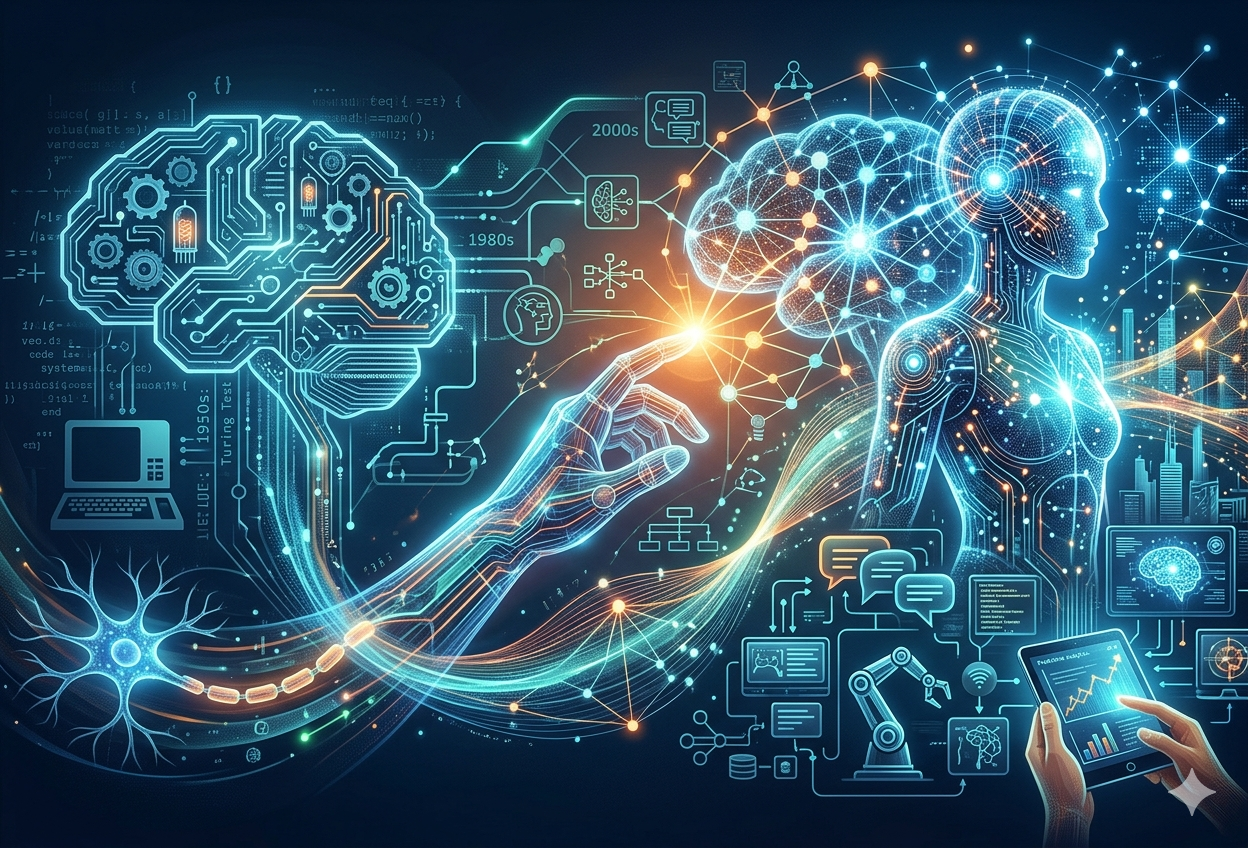
Understanding the History of Artificial Intelligence
What is Artificial Intelligence?
Artificial intelligence is the science and engineering of creating machines capable of performing tasks that, if done by humans, would require intelligence — reasoning, learning, problem-solving, perception, and language understanding.
“Every aspect of learning or any other feature of intelligence can in principle be so precisely described that a machine can be made to simulate it.”
— Dartmouth Conference Proposal, John McCarthy et al., 1956
At its core, AI is a specialty within computer science focused on building systems that can replicate and extend human cognitive abilities. Unlike conventional software — which follows rigidly programmed rules — AI systems can learn from data, identify patterns, adapt to new inputs, and make decisions with varying degrees of human oversight.
The term is applied to an extraordinarily wide range of capabilities: recognising faces in photographs, predicting the next word in a sentence, diagnosing cancer from medical scans, navigating a vehicle through city traffic, writing poetry, composing music, and playing chess at superhuman levels.
The Core Problem AI Tries to Solve
Humans process enormous amounts of sensory data, draw on accumulated experience, and reason under uncertainty — all in milliseconds, with little conscious effort. Replicating this in silicon has proven to be one of the most profound challenges in the history of science.
Drawing logical conclusions from incomplete or ambiguous information.
Improving performance from experience without being explicitly programmed.
Interpreting visual, auditory, and sensory signals from the world.
Understanding and generating natural human language in context.
Setting goals and determining sequences of actions to achieve them.
Navigating emotions, cooperation, and communication with humans.
Ancient Origins & Early Ideas
The dream of creating artificial minds is not a product of the 20th century — it stretches back to ancient mythology, medieval automata, and early philosophical thought about the nature of mind and mechanism.
Mythology and the Concept of Artificial Life
Ancient civilisations told stories of artificial beings with human-like qualities. In Greek mythology, the god Hephaestus forged Talos, a giant bronze automaton tasked with guarding the island of Crete. The myth of Pygmalion described a sculptor who fell in love with a statue that was then brought to life. These stories reveal a deep human fascination with the creation of artificial intelligence long before the technology existed to pursue it.
Early Automatons (400 BCE – 1800s)
Actual mechanical attempts at artificial life have a long history. One of the earliest documented automatons dates to around 400 BCE — a mechanical pigeon created by Archytas of Tarentum, a friend of the philosopher Plato, reportedly capable of movement powered by steam or compressed air.
Archytas’ Mechanical Pigeon
Ancient Greek mathematician Archytas created a steam-powered mechanical bird — one of the earliest recorded self-propelled machines.
Da Vinci’s Robotic Knight
Leonardo da Vinci sketched designs for a mechanical armoured knight capable of sitting, raising its visor, and moving its arms — a landmark in robotics history.
Pascal’s Pascaline
Blaise Pascal invented the first mechanical calculator capable of performing addition and subtraction, laying the groundwork for computing machines.
The Mechanical Turk
Wolfgang von Kempelen presented a chess-playing automaton that toured Europe, defeating Napoleon Bonaparte. It was later revealed to conceal a human player — but it sparked enormous discussion about machine intelligence.
Babbage’s Difference Engine
Charles Babbage designed the Difference Engine — a mechanical computer for tabulating polynomial functions. His later Analytical Engine concept anticipated many principles of modern computing, including conditional branching and loops.
Ada Lovelace — First Algorithm
Ada Lovelace wrote notes on Babbage’s Analytical Engine that included what is widely considered the first computer program. She also speculated that such machines could potentially compose music or produce complex outputs beyond mere number-crunching.
The Word “Robot” is Born
Czech playwright Karel Čapek introduced the word “robot” in his science-fiction play Rossum’s Universal Robots, describing manufactured artificial workers who eventually revolt against their creators — setting the cultural stage for AI anxiety.
Turing’s Universal Machine Concept
Alan Turing published “On Computable Numbers,” describing an abstract universal computing machine — theoretically capable of simulating any algorithmic process. This laid the mathematical foundation for all modern computers.
McCulloch-Pitts Neuron
Warren McCulloch and Walter Pitts published a landmark paper describing a simplified mathematical model of a neuron — the first formal model of an artificial neural network, drawing on both neuroscience and logic.
Donald Hebb — Learning Rule
Donald Hebb’s The Organization of Behaviour proposed what became known as “Hebbian learning” — the principle that synaptic connections strengthen when neurons fire together. This remains a foundational concept in neural network training.
Founding Pioneers of AI
Artificial intelligence was shaped by a small number of extraordinary thinkers whose ideas and discoveries spanned mathematics, philosophy, neuroscience, and computer science.
Conceptualised the universal computing machine, proposed the Turing Test, and wrote the first documented chess program. Considered the father of theoretical computer science and AI.
Coined the term “artificial intelligence” at the 1956 Dartmouth Conference. Created LISP, the first AI programming language. Founded the Stanford AI Laboratory.
Co-founder of the MIT AI Lab. Pioneered work on neural networks, frames, and cognitive science. His book Perceptrons (with Papert) significantly impacted neural network research.
Founded information theory with his 1948 paper “A Mathematical Theory of Communication.” Wrote early papers on chess-playing machines and introduced key concepts in data encoding.
Invented the Perceptron (1958), the first trainable neural network implemented in hardware. His work directly foreshadowed modern deep learning, though it was prematurely dismissed.
Founded cybernetics — the study of control and communication in machines and animals. His 1948 book Cybernetics influenced AI, robotics, and systems theory across generations.
Organised by John McCarthy, Marvin Minsky, Nathaniel Rochester, and Claude Shannon, the two-month workshop at Dartmouth College is widely considered the founding moment of AI as a formal field of research. The proposal stated the belief that “every aspect of learning or any other feature of intelligence can in principle be so precisely described that a machine can be made to simulate it.” Though the breakthroughs hoped for that summer did not materialise, the conference established AI as a distinct scientific discipline and launched the careers of those who would define it for decades.
The Birth of Artificial Intelligence
The 1950s transformed AI from philosophical speculation into scientific endeavour, producing the pivotal Turing Test, the founding term “artificial intelligence,” and the earliest working AI programs.
The Turing Test (1950)
In October 1950, Alan Turing published “Computing Machinery and Intelligence” in the philosophical journal Mind. Rather than trying to define what it means to think, Turing proposed a practical test: if a machine could converse with a human judge via text, and the judge could not reliably determine whether they were talking to a human or a machine, the machine could be considered to have demonstrated intelligent behaviour.
The paper opened with a deceptively simple question: “Can machines think?” Turing argued the question was too vague and proposed replacing it with the Imitation Game. He also addressed nine anticipated objections — including theological objections, claims that machines can only do what they are programmed to do, and arguments from consciousness — demolishing each in turn.
A human judge conducts text-based conversations with two respondents: one a human, one a computer program. If the judge cannot correctly identify which is which more than 50% of the time, the machine is said to have passed the test. Turing predicted that by the year 2000, computers would pass the test — a prediction that proved optimistic by two decades.
The Dartmouth Workshop (1956) — AI is Named
John McCarthy first used the phrase “artificial intelligence” in the proposal for the Dartmouth Conference. By formally naming the field, McCarthy and his colleagues gave researchers a shared vocabulary and mission. The workshop brought together many of the people who would shape the next three decades of AI: Minsky, Shannon, Samuel, and others.
The First AI Programs
Ferranti Mark 1 Chess Program
Dietrich Prinz wrote a chess program for the Ferranti Mark 1 that could solve chess problems (forced-mate puzzles) — one of the first programs to play a recognisable game.
Samuel’s Checkers Program
Arthur Samuel developed a checkers-playing program that learned from its own experience — the first program to genuinely improve its performance through self-play. Samuel later coined the phrase “machine learning” in 1959.
Logic Theorist — Newell & Simon
Allen Newell and Herbert Simon (with Cliff Shaw) created Logic Theorist, widely regarded as the first AI program. It could prove mathematical theorems from Principia Mathematica using heuristic search — demonstrating that a machine could perform symbolic reasoning.
General Problem Solver
Newell and Simon developed the General Problem Solver (GPS), designed to simulate human problem-solving strategies. GPS introduced the concept of means-ends analysis — comparing current state with goal state and selecting actions to reduce the difference.
LISP — The AI Language
John McCarthy invented LISP (List Processing), the first programming language designed specifically for AI research. Its features — symbolic processing, recursion, and dynamic typing — made it uniquely suited to representing knowledge. LISP remained the dominant AI language for over three decades and dialects such as Common Lisp and Clojure are still used today.
The Perceptron
Frank Rosenblatt invented the Perceptron at Cornell — a hardware implementation of a learning neural network. It could learn to classify images through a training procedure. The US Navy funded it and press coverage proclaimed that the machine could walk, talk, see, write, and reproduce itself. Such exaggerated claims planted seeds for the first AI winter.
“We may hope that machines will eventually compete with men in all purely intellectual fields.”
— Alan Turing, Computing Machinery and Intelligence, 1950
Early Progress: Chatbots, Robots & Milestones
The 1960s and early 1970s brought genuine achievements — the first chatbot, the first mobile robot, breakthroughs in natural language processing, and visionary work in computer vision. They also brought growing signs that AI’s hardest problems were far more stubborn than anticipated.
ELIZA — The First Chatbot (1966)
MIT computer scientist Joseph Weizenbaum created ELIZA between 1964 and 1966 — widely considered the first conversational agent. ELIZA’s most famous script, DOCTOR, simulated a Rogerian psychotherapist by rephrasing the user’s own statements as questions. Its responses were minimal and rule-based, yet many users formed emotional attachments to it, convinced they were talking to a human.
User: I am depressed much of the time.
ELIZA: I am sorry to hear you are depressed.
User: It’s true. I am unhappy.
ELIZA: Do you think coming here will help you not to be unhappy?
Simple pattern-matching and scripted responses produced surprisingly convincing dialogue. Weizenbaum was disturbed by how readily people attributed genuine understanding to the program.
Shakey the Robot (1966–1972)
The AI Center at the Stanford Research Institute (SRI) developed Shakey, the first mobile robot able to reason about its own actions. Equipped with a TV camera, a range finder, and sensors, Shakey could perceive its environment, build an internal model of it, plan a path to a goal, and execute that plan — navigating rooms, pushing boxes, and avoiding obstacles.
Key Milestones of the 1960s–70s
Unimate — First Industrial Robot
The first industrial robot, Unimate, began working on a General Motors assembly line in New Jersey — performing dangerous die-casting retrieval and welding tasks that were too hazardous for human workers.
DENDRAL — First Expert System
Edward Feigenbaum and Joshua Lederberg at Stanford created DENDRAL, the first expert system — a program that encoded the specialised knowledge of chemists to identify the molecular structure of organic compounds from mass spectrometry data. It was the first practical demonstration that AI could match domain experts.
Alexey Ivakhnenko — Deep Learning Precursor
Ukrainian scientist Alexey Ivakhnenko published a paper in Avtomatika proposing the Group Method of Data Handling — a multi-layer supervised learning algorithm. Often unacknowledged in Western AI history, this work directly anticipated deep learning by over four decades.
Computer Vision — COPY-DEMO
David Waltz at MIT made foundational progress in computer vision — developing constraint propagation techniques to interpret line drawings of 3D objects. This was one of the first demonstrations that machines could analyse and understand visual scenes.
PROLOG Language Created
Alain Colmerauer and Philippe Roussel developed PROLOG (Programming in Logic) — a logic programming language that became central to AI research in Europe and Japan. PROLOG represented knowledge as logical facts and rules, enabling powerful reasoning systems.
MYCIN — Medical AI
Edward Shortliffe and colleagues at Stanford created MYCIN, an expert system for diagnosing bacterial infections and recommending antibiotic treatments. Tested against human physicians, it performed comparably to specialists — a startling demonstration of medical AI’s potential.
Stanford Cart Navigates Autonomously
The Stanford Cart, a remote-controlled vehicle first built in 1961, successfully navigated a chair-filled room without human assistance in 1979 — a landmark moment in autonomous vehicle research.
The AI Winters: Hype, Disappointment & Retreat
Twice in AI’s history — in the 1970s and again in the late 1980s — enthusiasm outpaced capability, funding collapsed, and the field entered periods of relative stagnation that came to be called “AI winters.”
The First AI Winter (1974–1980)
By the early 1970s, cracks were showing. Problems that had seemed tractable — machine translation, general problem solving — turned out to be vastly more difficult than imagined. Computers were too slow. Data was too scarce. Early approaches, based on hand-coded rules and symbolic logic, could not scale.
In 1973, British mathematician Sir James Lighthill delivered a devastating report to the Science Research Council in the UK, concluding that AI research had failed to deliver on its promises. In the United States, DARPA — which had funded much of the early AI work — sharply curtailed its spending. The term “AI winter” (coined in 1984 by analogy to nuclear winter) captured the chill that had descended.
Lighthill identified three areas of failure: building robots, language processing, and central nervous system modelling. He argued that combinatorial explosion — the exponential growth of possible states in complex problems — meant that early AI techniques could not scale to real-world problems. The report led directly to the cancellation of most AI funding in the UK for nearly a decade.
Brief Revival and the Second AI Winter (1987–1993)
The early 1980s saw a resurgence driven by the commercial success of expert systems — specialised programs that encoded human expertise for industrial applications. Japan’s ambitious Fifth Generation Computer Project (launched 1982) aimed to create AI-powered computers using PROLOG, inspiring matching investments in the UK and USA.
But expert systems proved expensive to build and maintain, brittle in the face of unexpected inputs, and unable to learn. By the late 1980s, the commercial market for expert systems had collapsed. The Lisp Machine market evaporated. Strategic Computing Initiative funding was cut. A second, shorter AI winter began.
Funding Collapse
DARPA and other government agencies drastically reduced AI research budgets after repeated failures to meet promised milestones.
Market Failure
The commercial expert systems market shrank from $1.1B in 1988 to near-zero by 1993 as maintenance costs and brittleness became apparent.
Hardware Limits
Specialised Lisp machines were overtaken by cheaper, more powerful personal computers running standard software — eliminating a key AI hardware market.
The AI winters were not failures but necessary recalibrations. They weeded out overpromising, redirected research toward more tractable problems (particularly statistical and probabilistic methods), and forced a more rigorous, empirical approach. The breakthroughs of the 1990s and 2000s were built on foundations laid during the winters.
Expert Systems & Knowledge Engineering
The 1980s were defined by expert systems — AI programs that encoded the specialised knowledge of human domain experts in rule-based form, achieving genuine commercial value before their limitations caught up with them.
How Expert Systems Worked
An expert system had two key components: a knowledge base containing facts and rules (“if the patient has fever AND infection, then consider antibiotic”), and an inference engine that applied those rules to new inputs to draw conclusions. Building one required intensive “knowledge engineering” — months of interviews with human experts to extract and encode their tacit knowledge.
Notable Expert Systems
| System | Year | Domain | Achievement |
|---|---|---|---|
| DENDRAL | 1965 | Chemistry | First expert system; identified molecular structures from mass spectra |
| MYCIN | 1973 | Medicine | Diagnosed bacterial infections; matched specialist performance |
| XCON (R1) | 1980 | Manufacturing | Configured Digital Equipment Corp. computer orders; saved $25M/year |
| CYC | 1984 | General knowledge | Attempted to encode all human common-sense knowledge into a database |
| PROSPECTOR | 1978 | Geology | Evaluated mineral deposits; discovered a molybdenum deposit worth $100M |
Why Expert Systems Failed
- Brittleness: Systems worked well within their narrow domain but failed catastrophically on edge cases outside the rules.
- Knowledge acquisition bottleneck: Encoding expert knowledge was enormously time-consuming and expensive.
- Maintenance burden: Real-world domains change; keeping rules updated required constant expert involvement.
- No learning: Expert systems could not improve from experience — every improvement required manual reprogramming.
- Common sense deficit: They lacked the common-sense understanding humans take for granted, making them vulnerable to unexpected situations.
The Machine Learning Revolution
The 1990s witnessed a fundamental shift in how AI systems were built: away from hand-coded rules, toward systems that learned statistical patterns from data. This paradigm shift would ultimately transform the entire field.
Deep Blue Defeats Kasparov (1997)
On May 11, 1997, IBM’s Deep Blue became the first computer system to defeat a reigning world chess champion in a regulation match. In the decisive game 6, Deep Blue defeated Garry Kasparov — the highest-rated player in history — in just 19 moves. Deep Blue evaluated up to 200 million chess positions per second using specialised hardware and sophisticated evaluation functions.
The match drew global media attention and raised profound questions: was Deep Blue “thinking”? Most AI researchers argued no — it was exhaustive search with hand-crafted evaluation, not genuine intelligence. But the public impact was immense, forever changing perceptions of what machines could do.
Statistical Learning Takes Centre Stage
Researchers shifted from rule-based systems to methods that could learn directly from data. Three families of algorithms dominated:
Decision Trees
Tree-structured models that split data based on feature thresholds. Easy to interpret; prone to overfitting. Random Forests (ensembles of trees) greatly improved performance.
Support Vector Machines
Found the optimal separating hyperplane between classes. Powerful with high-dimensional data and small datasets; became dominant in text classification and bioinformatics.
Neural Networks Revived
Backpropagation (rediscovered by Rumelhart, Hinton, Williams in 1986) allowed multi-layer networks to learn. Limited by hardware but laid groundwork for deep learning.
The Internet Changes Everything
The explosive growth of the World Wide Web in the 1990s generated an unprecedented quantity of digitised text, images, and behavioural data. This data became the fuel for machine learning. Recommendation systems, spam filters, and search engine ranking algorithms were among the first large-scale machine learning deployments, each improving with every additional data point.
Yann LeCun — Convolutional Networks
Yann LeCun applied backpropagation to a convolutional neural network (LeNet) to recognise handwritten digits for the US Postal Service. This demonstrated that neural networks could process images effectively and directly foreshadowed the computer vision revolution two decades later.
Support Vector Machines Popularised
Corinna Cortes and Vladimir Vapnik published the seminal SVM paper, which became one of the most cited in machine learning history. SVMs dominated classification tasks through the 2000s.
LSTM Networks — Sepp Hochreiter
Sepp Hochreiter and Jürgen Schmidhuber introduced Long Short-Term Memory (LSTM) networks — recurrent neural networks with memory gates that could learn long-range dependencies in sequences. LSTMs later became central to speech recognition and natural language processing.
Deep Blue vs Kasparov
IBM’s Deep Blue defeats world chess champion Garry Kasparov, processing 200 million positions per second and becoming the first computer to beat a reigning world champion in a regulation match.
Google Founded
Larry Page and Sergey Brin incorporated Google. Their PageRank algorithm, which ranked web pages by link structure, was an early application of machine learning to information retrieval and laid the financial foundation for decades of AI research investment.
The Deep Learning Era
The deep learning revolution transformed AI from a field of narrow specialist tools into a general-purpose technology — achieving superhuman performance in image recognition, speech, and games, and reshaping the entire tech industry.
The ImageNet Moment (2012)
The pivotal event of the deep learning era was AlexNet at the ImageNet Large Scale Visual Recognition Challenge in 2012. A convolutional neural network created by Alex Krizhevsky, Ilya Sutskever, and Geoffrey Hinton reduced the top-5 error rate from 26% to 15.3% — a gap so large it stunned the computer vision community and triggered immediate widespread adoption of deep learning.
Three things converged simultaneously: (1) Big data — ImageNet provided 1.2 million labelled training images; (2) GPUs — Graphics Processing Units provided the parallel compute power to train large networks in days rather than years; (3) Algorithmic improvements — ReLU activations, dropout regularisation, and better initialisation schemes resolved the vanishing gradient problem that had stalled deep networks for decades.
Key Deep Learning Milestones
Hinton’s Deep Belief Networks
Geoffrey Hinton published a paper showing that deep neural networks could be pre-trained layer by layer using Restricted Boltzmann Machines. This reinvigorated interest in multi-layer networks and coined the term “deep learning.”
ImageNet Launched
Fei-Fei Li and colleagues at Stanford launched ImageNet — a dataset of over 14 million hand-labelled images across 20,000 categories. The annual ImageNet challenge became the Olympic Games of computer vision.
IBM Watson Wins Jeopardy!
IBM’s Watson defeated champions Ken Jennings and Brad Rutter on Jeopardy! — demonstrating that AI could handle the ambiguity, wordplay, and broad general knowledge of a game show. Watson combined information retrieval, natural language processing, and probabilistic reasoning.
AlexNet — The Breakthrough
AlexNet achieves top-5 error of 15.3% on ImageNet — a 41% improvement over previous methods. The result is so startling that almost every subsequent ImageNet submission uses deep convolutional networks.
GANs — Generative Adversarial Networks
Ian Goodfellow introduced Generative Adversarial Networks (GANs) — a framework where two neural networks (a generator and discriminator) compete, enabling the generation of startlingly realistic synthetic images, video, and audio.
AlphaGo Defeats Lee Sedol
DeepMind’s AlphaGo became the first AI to defeat a professional Go player — a game considered vastly more complex than chess. It used a combination of deep convolutional networks, Monte Carlo tree search, and reinforcement learning, trained on millions of human games and then through self-play.
The Scaling Insight
One of the most important discoveries of the deep learning era was the power of scale. Researchers found that as you increased the size of a neural network (more layers, more parameters) and the quantity of training data, performance improved in a surprisingly smooth and predictable way. This observation would have profound consequences for the next era.
Generative AI, Transformers & the LLM Revolution
The invention of the Transformer architecture in 2017 triggered the most rapid advance in AI history, ultimately producing large language models that could write, reason, code, and converse at near-human levels — and placing AI at the centre of global society.
The Transformer Architecture (2017)
In June 2017, researchers at Google Brain published “Attention Is All You Need” — introducing the Transformer, an architecture built entirely on a mechanism called self-attention that could weigh the relevance of every word in a sequence to every other word simultaneously. Unlike previous recurrent architectures, Transformers processed sequences in parallel, making them radically more trainable on modern hardware.
Self-attention allows a model to determine, for each word in a sentence, how much weight to give every other word when computing its representation. In the sentence “The animal didn’t cross the street because it was too tired,” self-attention lets the model learn that “it” refers to “animal” — a type of reference resolution that earlier models struggled with. This mechanism, scaled massively, is the core of every modern large language model.
The GPT Series
Transformer — “Attention Is All You Need”
Vaswani et al. at Google publish the Transformer paper. The architecture sweeps through NLP benchmarks and becomes the dominant approach in language modelling within two years.
BERT & GPT-1
Google’s BERT (Bidirectional Encoder Representations from Transformers) and OpenAI’s GPT-1 demonstrated that pre-training large Transformers on massive text corpora, then fine-tuning on specific tasks, dramatically outperformed task-specific models. Transfer learning came to NLP.
GPT-2 — “Too Dangerous to Release”
OpenAI released GPT-2 (1.5B parameters) with 117 million words of training data from the web. Its ability to generate coherent, contextually appropriate text was so striking that OpenAI initially declined to release the full model, citing misuse risk — generating enormous public attention.
GPT-3 — 175 Billion Parameters
GPT-3 shocked the world with its ability to write essays, translate languages, answer questions, summarise text, generate code, and complete almost any language task — all from a single model trained with no task-specific data. With 175 billion parameters trained on 570GB of text, it demonstrated that scale alone could unlock remarkable emergent abilities.
ChatGPT — AI Goes Mainstream
OpenAI released ChatGPT on November 30, 2022. It reached 1 million users in 5 days and 100 million in 2 months — the fastest adoption of a consumer technology in history. Built on GPT-3.5 with RLHF (Reinforcement Learning from Human Feedback), ChatGPT made conversational AI accessible to the global public for the first time.
GPT-4 & Multimodal AI
GPT-4 extended language models to multimodal input — accepting text and images together. It passed the bar exam in the top 10% of scores, the USMLE medical licensing exam, and multiple other professional benchmarks. Competitors including Google Gemini, Anthropic Claude, and Meta Llama joined the race.
Reasoning Models & AI Agents
OpenAI’s o1 and o3, Google’s Gemini 2.0, and Anthropic’s Claude 3.7 Sonnet demonstrated chain-of-thought reasoning that dramatically improved performance on mathematics, coding, and logic problems. AI agents capable of browsing the web, writing and executing code, and completing multi-step tasks autonomously became commercially available.
“The development of full artificial intelligence could spell the end of the human race… or it could be the best thing that ever happened to us.”
— Stephen Hawking, BBC Interview, 2014
Types of Artificial Intelligence
AI systems are commonly classified by their capability level and by the approaches used to implement them. Understanding these categories is essential to understanding where any given system sits in the broader landscape.
By Capability Level
All AI that currently exists. Systems designed and trained for a specific task. Deep Blue plays chess but cannot drive a car. GPT-4 generates text but cannot physically interact with the world. Superhuman in their domain; zero transfer to others.
A hypothetical system with the broad, flexible intelligence of a human — able to learn any task, reason across domains, and adapt to new situations. No AGI exists today. Opinions among experts vary widely on when (or whether) it will be achieved.
Entirely hypothetical. An AI vastly more intelligent than the most brilliant humans in every domain — scientific creativity, social intelligence, general wisdom. The subject of intense philosophical and safety research given the potential transformative (and existential) implications.
By Approach
| Approach | Key Idea | Strengths | Limitations |
|---|---|---|---|
| Symbolic AI / GOFAI | Explicit rules & logic representations | Interpretable, provable, works with small data | Brittle, doesn’t scale, requires manual knowledge encoding |
| Machine Learning | Statistical pattern learning from data | Learns from examples, handles uncertainty | Needs labelled data, can learn spurious patterns |
| Deep Learning | Multi-layer neural networks | State-of-the-art on perception tasks, learns features | Opaque, data-hungry, compute-intensive |
| Reinforcement Learning | Learn by trial and error & reward | Can discover superhuman strategies | Sample-inefficient, reward specification is hard |
| Hybrid / Neurosymbolic | Combine neural networks with symbolic reasoning | Interpretability + learning; compositionality | Complex to design; research frontier |
Key Technologies Explained
AI’s capabilities rest on a set of core technical concepts. Understanding these is essential to understanding how modern AI systems work and why they behave as they do.
Neural Networks
Inspired loosely by the structure of biological brains, an artificial neural network consists of layers of nodes (neurons) connected by weighted edges. Input data flows through the network; each layer transforms the representation; the final layer produces a prediction. Training adjusts the weights using backpropagation — computing how each weight contributed to the prediction error and nudging it in the direction that reduces that error.
Natural Language Processing (NLP)
NLP is the subfield concerned with enabling computers to understand and generate human language. Key tasks include: tokenisation (splitting text into units), parsing (understanding grammatical structure), named entity recognition, sentiment analysis, machine translation, question answering, and text generation. Modern NLP is dominated by Transformer-based large language models pre-trained on internet-scale text corpora.
Computer Vision
Computer vision enables machines to interpret and understand images and video. Deep convolutional neural networks extract hierarchical visual features — edges and textures at low levels, shapes and objects at high levels. Applications include face recognition, autonomous driving, medical imaging, satellite analysis, and quality control in manufacturing.
Reinforcement Learning
In reinforcement learning, an agent interacts with an environment, takes actions, receives rewards or penalties, and learns a policy that maximises cumulative reward over time. RL produced some of AI’s most dramatic achievements: Atari game-playing at superhuman levels (DeepMind), AlphaGo and AlphaZero, robotic control, and RLHF (Reinforcement Learning from Human Feedback) — the technique used to align large language models with human preferences.
Large Language Models (LLMs)
An LLM is a neural network (typically Transformer-based) trained on massive text corpora to predict the next token in a sequence. Despite this apparently simple objective, very large models trained on diverse text develop remarkable emergent capabilities: reasoning, code generation, summarisation, translation, and apparent commonsense understanding. Key parameters include model size (number of trainable weights), context window (amount of text the model can attend to), and training data quality and quantity.
GPT-2 (2019): 1.5 billion parameters · GPT-3 (2020): 175 billion parameters · GPT-4 (2023): estimated 1.7 trillion parameters (mixture-of-experts) · Trained on hundreds of billions to trillions of tokens of text, requiring thousands of GPUs running for months.
How AI is Transforming Industries
AI is no longer a laboratory curiosity — it is a production technology reshaping every major industry. The scale of transformation underway is comparable to the industrial revolution or the emergence of the internet.
Healthcare & Medicine
AI-powered diagnostic imaging can detect cancers, retinal diseases, and fractures with radiologist-level accuracy. Drug discovery algorithms have shortened development timelines from decades to years. Predictive models forecast patient deterioration, hospital readmissions, and epidemic spread. Personalised treatment recommendations tailor therapy to individual genomic profiles. DeepMind’s AlphaFold solved the 50-year protein folding problem in 2020 — potentially revolutionising drug development.
Finance & Banking
Algorithmic trading systems execute millions of transactions per second. Fraud detection models analyse transaction patterns in real time, flagging anomalies invisible to human analysts. Credit scoring incorporates thousands of signals beyond simple credit history. Customer service chatbots handle routine queries at scale. Regulatory compliance systems monitor communications for risk automatically.
Transportation & Mobility
Autonomous vehicles from Waymo, Tesla, and others combine computer vision, lidar, and sensor fusion with deep learning to navigate complex urban environments. AI optimises traffic flow, flight routes, and logistics networks. Predictive maintenance monitors vehicle health to prevent failures. Ride-sharing algorithms dynamically match supply and demand, reduce empty miles, and optimise pricing.
Retail & E-commerce
Personalised recommendation engines drive over 35% of Amazon’s revenue. Demand forecasting minimises overstock and stockouts. Visual search enables “find similar products” from photographs. Dynamic pricing adjusts in real time to demand signals. Supply chain AI optimises warehouse layouts, staffing, and delivery routing. Customer sentiment analysis monitors brand reputation across millions of data points.
Manufacturing
Computer vision quality control systems inspect products at speeds and accuracy levels impossible for humans — detecting micro-defects in semiconductors, automotive parts, and pharmaceuticals. Predictive maintenance reduces unplanned downtime by anticipating equipment failure days in advance. Robotic systems learn manipulation tasks through demonstration rather than explicit programming. Digital twins simulate entire factory environments to optimise production.
Education
Adaptive learning platforms personalise curriculum difficulty and pacing to each student’s learning trajectory. Automated essay grading provides immediate feedback at scale. Natural language tutoring systems answer student questions and explain concepts interactively. Early warning systems identify students at risk of falling behind. AI translation tools democratise access to educational content across language barriers.
Challenges, Risks & Ethical Considerations
As AI systems become more capable and widespread, a set of profound ethical, social, and safety challenges have emerged — requiring urgent attention from researchers, policymakers, and society at large.
Algorithmic Bias
AI systems trained on historical data can perpetuate and amplify existing societal biases — producing discriminatory outcomes in hiring, lending, criminal justice, and healthcare. Bias can enter through training data, feature selection, or model architecture.
Privacy & Surveillance
Facial recognition, predictive policing, and behavioural profiling raise deep questions about privacy and civil liberties. AI enables surveillance at scales previously impossible, threatening the presumption of anonymity in public spaces.
Labour Displacement
Automation of cognitive and physical tasks threatens to displace workers in transportation, manufacturing, legal, medical, and creative fields. While AI will create new jobs, the pace of change may outstrip workers’ ability to transition.
Deepfakes & Disinformation
Generative AI enables the creation of synthetic video, audio, and images indistinguishable from genuine material — threatening journalistic integrity, electoral processes, and personal reputation.
Autonomous Weapons
The prospect of lethal autonomous weapons systems — drones and robots that select and engage targets without human intervention — raises profound questions about accountability, international law, and the ethics of delegating lethal force to algorithms.
Concentration of Power
AI capabilities are concentrated in a small number of corporations and nations. This asymmetry risks exacerbating inequality, enabling regulatory capture, and creating single points of failure in critical infrastructure.
AI Safety and Alignment
As AI systems become more capable, researchers worry about alignment — ensuring that AI systems behave in ways that are consistent with human values and intentions, even as they become more capable than the humans overseeing them. Key challenges include:
- Specification: Correctly defining what we want AI to do — avoiding reward hacking and unintended side effects.
- Robustness: Ensuring systems behave safely across the full distribution of inputs, including adversarial attacks and out-of-distribution scenarios.
- Interpretability: Understanding why AI systems make the decisions they make — essential for debugging, auditing, and trust.
- Corrigibility: Ensuring AI systems remain correctable and do not resist human oversight.
- Scalable oversight: Developing mechanisms for humans to supervise AI systems even when those systems are more capable than human overseers.
The European Union’s AI Act (2024) created the world’s first comprehensive AI regulatory framework, categorising systems by risk level. The US Executive Order on Safe, Secure, and Trustworthy AI (2023) directed federal agencies to develop safety standards. The UK hosted the world’s first AI Safety Summit at Bletchley Park in November 2023, producing the Bletchley Declaration — signed by 28 countries committing to collaborative safety research. China released its Interim Measures for Generative AI Services in 2023. The United Nations Secretary-General established an AI Advisory Body in 2023 to develop governance recommendations.
The Future of Artificial Intelligence
The trajectory of AI points toward systems of increasing capability, generality, and autonomy — with implications so far-reaching that reasonable people hold radically different views about what the coming decades will bring.
Near-Term Trends (2025–2030)
AI systems that autonomously take multi-step actions in the world — browsing the web, writing code, managing files, and interacting with external services on behalf of users.
Now
Models that seamlessly process text, images, audio, video, and structured data together — understanding context across all modalities simultaneously.
2025
AI accelerating fundamental research in biology, chemistry, physics, and materials science — potentially compressing decades of scientific progress into years.
Now
Foundation models for robotics enabling general-purpose physical manipulation — systems that learn to handle novel objects and environments from demonstration.
2026
Systems combining large-scale pre-training with explicit chain-of-thought reasoning, enabling reliable performance on hard mathematical, scientific, and logical problems.
Now
AI systems that develop long-term relationships with users, maintaining context and adapting to individual communication styles, preferences, and goals over months and years.
2026
Longer-Term Prospects
The longer-term future of AI is genuinely uncertain — a remarkable statement given the pace of recent progress. Four broad scenarios are discussed among researchers:
| Scenario | Description | Key Implications |
|---|---|---|
| Continued Scaling | Current architectures continue improving with more compute and data | Progressive displacement of knowledge work; growing economic inequality without redistribution |
| Architectural Breakthrough | New paradigm (neuromorphic, quantum-enhanced, or novel architecture) unlocks qualitative leap | Potential for rapid capability jumps; safety and governance challenges multiply |
| AGI Achieved | General-purpose system matching or exceeding human intelligence across all domains | Potentially transformative; outcome highly dependent on alignment success |
| Plateau | Current approaches hit fundamental limits; progress slows as with expert systems | Valuable but narrow tools; third AI winter limited to certain domains |
“The question is not whether AI will transform human civilisation — it already has. The question is whether we will be wise enough to ensure that transformation is beneficial.”
— AI Research Community Consensus, 2024
The Path Forward
Navigating the AI transition will require action on multiple fronts simultaneously. Technically: continued investment in safety research, interpretability, and robustness. Politically: the development of governance frameworks that balance innovation with protection of public interests. Economically: mechanisms to ensure the productivity gains from AI are broadly shared rather than captured by a small number of actors. Educationally: preparing workforces for an AI-transformed economy through lifelong learning and institutional adaptation.
History suggests that transformative technologies — fire, printing, electricity, computers — ultimately improve human welfare despite the disruptions they cause. But that outcome is not guaranteed, and with AI the stakes are arguably higher than they have been with any previous technology. The degree to which the next chapters of AI’s history are good ones will depend heavily on the decisions made in the coming years.
Artificial intelligence is not a single technology but a constellation of techniques, theories, and applications that has been developing for over seventy years. Its history is a story of grand ambitions, necessary failures, quiet perseverance, and — especially in the last decade — breakthroughs of genuinely historic proportions. Understanding that history is the first step to shaping its future wisely.
Comprehensive timeline from 1900s groundwork through AI agents and AGI discussions.
Technical evolution from symbolic AI through deep learning and GPT-series models.
Decade-by-decade timeline with key figures, inventions, and milestones.
Peer-reviewed academic survey covering past, present, and future of AI research.
Enterprise perspective covering AI winters, expert systems, and governance implications.
Authoritative encyclopaedic account from Turing’s early work through connectionism. Written by Professor B.J. Copeland of the University of Canterbury.
Focus on the deep learning revolution and the transformer era.
Accessible timeline covering key milestones from 1950s to the generative AI era.