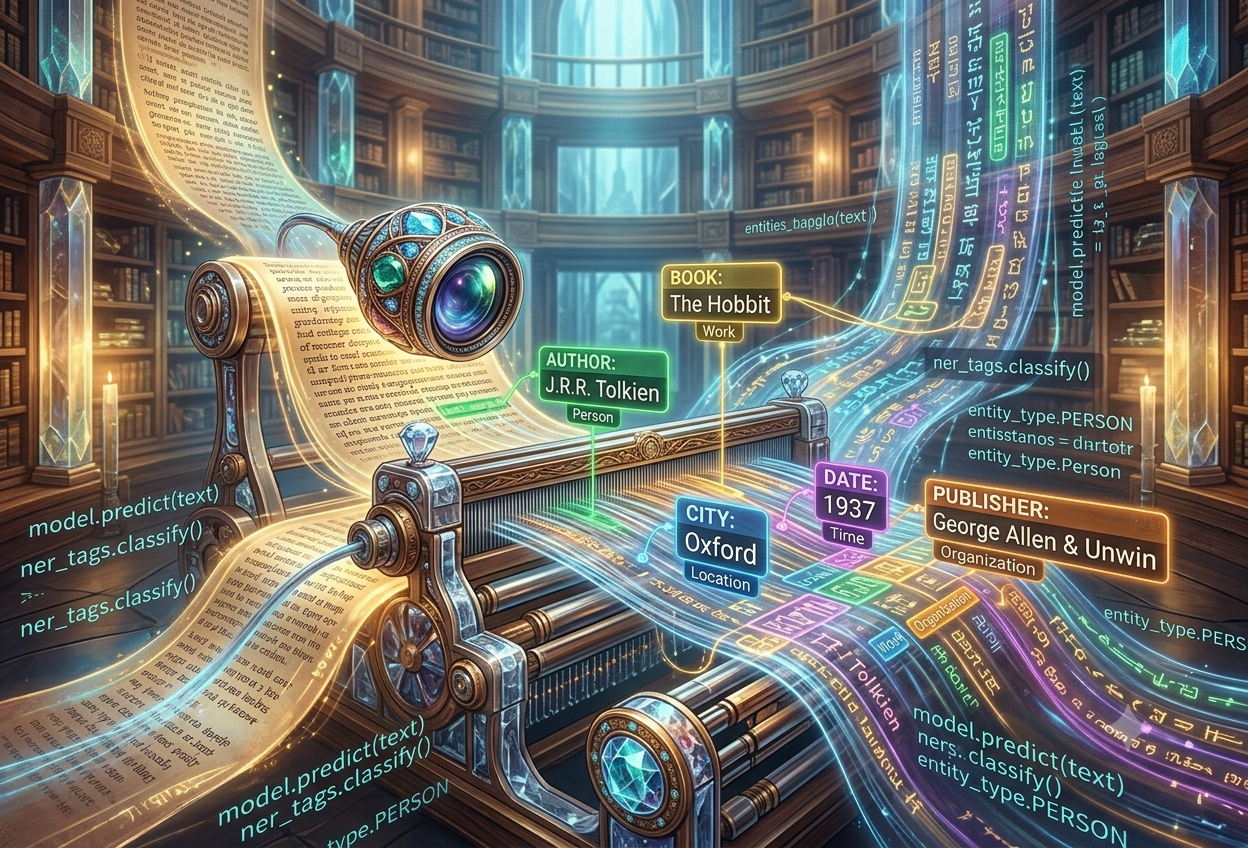
Named Entity Recognition (NER)
What Is Named Entity Recognition?
Named Entity Recognition (NER) is a foundational sub-task of Natural Language Processing (NLP) and information extraction. It scans through raw, unstructured text and identifies specific spans of words that refer to real-world entities — then labels each one with a category such as Person, Organisation, Location, Date, or Money. In doing so, NER converts messy human language into clean, structured, machine-readable data.
Imagine you just read a newspaper and your teacher asked you to go through every sentence and circle all the names of people in red, all company names in blue, and all city/country names in green. That’s exactly what NER does — except instead of one student reading one newspaper, a computer can do this to millions of articles, books, medical reports, and legal documents in seconds. It’s like a super-fast, tireless highlighter that never gets confused or distracted.
Named Entity Recognition is the task of locating and classifying named entities mentioned in unstructured text into predefined categories — such as persons, organisations, locations, and temporal expressions — enabling the transformation of free text into structured, queryable knowledge.— Core definition, NLP research community
NER in Action — A Live Example
The sentence below shows NER output as it would appear in a real system. Each highlighted span has been identified and labelled by an NER model:
Why NER Matters
Unstructured text is the majority of the world’s information — an estimated 80–85% of enterprise data exists as free-form documents, emails, reports, and messages. NER is the tool that unlocks this dark data by turning human-readable words into machine-queryable facts.
Consider what NER enables at scale. A news agency processing 500,000 articles daily can automatically build a database of every person, company, location, and event mentioned, enabling journalists to instantly search “all stories mentioning Company X since last year” with full context. A hospital system can extract drug names, dosages, diagnoses, and patient identifiers from millions of unstructured clinical notes. A law firm can automatically index every party, date, jurisdiction, and monetary figure across thousands of legal contracts.
Enabling Downstream NLP Tasks
NER is rarely the final destination — it is the foundation on which more complex NLP is built. Question-answering systems need NER to match entities in questions against entities in documents. Relation extraction needs NER to first identify the entities that might have relationships. Knowledge graph construction, event detection, and co-reference resolution all depend on NER as a prerequisite step.
Information Retrieval & Search
Search engines use NER to understand semantic queries. When you search “films starring [actor name] directed in [year]”, the search engine must recognise actor names and years as entity types. Entity-aware search dramatically outperforms keyword matching for complex queries, enabling retrieval by meaning rather than just word presence.
Data Privacy & PII Detection
Personal Identifiable Information (PII) detection is one of NER’s most commercially important applications. Before sharing documents, publishing datasets, or processing text through AI systems, organisations need to automatically locate names, addresses, phone numbers, Social Security numbers, and other personal data so they can be redacted or anonymised. GDPR compliance at scale is impossible without NER.
Business Intelligence
Financial analysts use NER to extract company names, financial figures, and market events from earnings calls, news feeds, and regulatory filings at machine speed — identifying investment opportunities, risk signals, and competitive intelligence that no human team could process fast enough. Supply chain teams extract supplier names, locations, and product categories from procurement documents automatically.
History of Named Entity Recognition
NER has a clearly traceable history from hand-crafted government intelligence systems in the 1990s to today’s transformer models that surpass human performance on standard benchmarks.
MUC Conferences — The Birth of a Task
The US government’s Message Understanding Conferences (MUC) were designed to evaluate information extraction from intelligence documents. MUC-6 (1995) formally introduced the NER task as a shared competition, defining the canonical entity categories: ENAMEX (persons, organisations, locations), TIMEX (times, dates), and NUMEX (money, percentages). This shared evaluation framework standardised the field and enabled meaningful progress comparisons.
Rule-Based Systems Dominate
Early NER systems relied entirely on manually crafted linguistic rules — pattern matching capitalised words, checking against hand-compiled gazetteers (lists of known entity names), and applying grammar rules like “any word following ‘Mr.’ or ‘Dr.’ is a person.” These systems worked well within narrow domains but required enormous manual effort for each new domain or language and broke easily on unusual constructions.
CoNLL-2003 — The Gold-Standard Benchmark
The Conference on Computational Natural Language Learning (CoNLL) 2003 shared task on language-independent NER released datasets for English and German newspaper text annotated with PER, ORG, LOC, and MISC categories. The CoNLL-2003 English dataset became the single most important benchmark in NER history, enabling decades of comparable progress measurement. CRF-based models dominated this era.
Machine Learning Rises — CRFs Become Standard
Conditional Random Fields (CRFs) replaced rule-based systems as the standard approach, achieving consistently superior results by learning patterns from annotated training data rather than hand-coded rules. The combination of CRF models with rich feature engineering (word shape, part-of-speech tags, word embeddings, gazetteer lookups) set the performance ceiling for non-neural approaches.
Deep Learning — BiLSTM-CRF Takes Over
Bi-directional LSTM networks with a CRF layer on top (BiLSTM-CRF) proved dramatically superior to feature-engineered CRFs on nearly every benchmark. By reading each sentence both left-to-right and right-to-left simultaneously, BiLSTMs capture richer context for each token. When combined with word embeddings and character-level representations, these models achieved state-of-the-art performance with minimal feature engineering.
BERT Era — Transformers Rewrite the Record Books
Fine-tuned BERT models shattered CoNLL-2003 records upon release, pushing English NER F1 scores from the low 90s to 93%+ — surpassing human performance on the benchmark (approximately 92%). BERT’s bidirectional self-attention allows every token to simultaneously consider every other token in the sentence, capturing long-range context that sequential models cannot access efficiently.
LLM Era — Generalisation and Zero-Shot NER
Large Language Models like GPT-4 and Llama-3 can perform NER in a zero-shot setting — extracting entities from novel domains with no task-specific fine-tuning. LLM-based NER is especially powerful for rare or custom entity types that lack labelled training data. The emerging paradigm combines fine-tuned specialist NER models for high-volume production tasks with LLMs for flexible, novel-domain extraction.
Types of Named Entities
Entity types exist on a spectrum from the simple general categories used in early NER (just persons, organisations, and locations) to the hundreds of fine-grained types used in domain-specific systems. Here is the complete taxonomy from coarse to granular.
Standard General-Purpose Entity Categories
| Entity Type | Tag | Description | Examples |
|---|---|---|---|
| Person | PER | Individual people, fictional or real, alive or historical | Marie Curie, Sherlock Holmes, the Prime Minister |
| Organisation | ORG | Companies, government bodies, NGOs, institutions, teams | Apple Inc., WHO, Real Madrid, Harvard University |
| Location | LOC | Physical places — countries, cities, landmarks, geographic features | Paris, Amazon River, Mount Everest, Silicon Valley |
| Geopolitical Entity | GPE | Countries, states, cities — places with political significance | India, California, New York City, European Union |
| Date & Time | DATE / TIME | Temporal expressions — specific or relative dates and times | Monday, March 2025, three years ago, at dawn |
| Money / Currency | MONEY | Monetary amounts with or without currency units | $500M, €2.4 billion, fifty rupees, GBP 1,000 |
| Percentage | PERCENT | Percentage values | 12.5%, a third, seventy percent |
| Miscellaneous | MISC | Named entities that don’t fit other categories (products, events, laws) | iPhone 15, the Olympics, GDPR, World War II |
Fine-Grained and Domain-Specific Entity Types
As NER is deployed in specialised domains, the entity taxonomy expands dramatically. Each domain has its own vocabulary of entity types that require domain-specific annotated training data:
Medical / Clinical NER
Disease, Symptom, Drug name, Dosage, Procedure, Anatomy, Gene, Protein, Lab test result, Medical device. Clinical NER systems like MedSpaCy and SciSpaCy add dozens of biomedical entity types beyond standard NER.
Legal NER
Party name, Case citation, Jurisdiction, Statute reference, Court name, Judge, Date of ruling, Legal concept. Legal-BERT and specialised legal NER models extract structured information from contracts, court filings, and legislation.
Financial NER
Ticker symbol, Financial instrument, Transaction value, Market index, Analyst name, Quarter/fiscal period, Rating agency, Fund name. FinBERT and financial NER models extract structured data from SEC filings, earnings calls, and news.
Research systems like Choi et al.’s UFET (Ultra-Fine Entity Typing) use over 10,000 entity type labels — “athlete”, “author”, “musician”, “politician”, “company founder” — enabling extremely precise categorisation. While impractical for most production use cases due to annotation cost and model complexity, UFET demonstrates the theoretical maximum granularity of the entity typing task.
IOB / BIO Tagging — How NER Labels Are Assigned
NER is framed as a sequence labelling task — each token in a sentence receives a tag. But a naïve tagging scheme (simply labelling each token with its entity type) cannot handle multi-word entities like “New York City” or “Barack Obama”. The IOB scheme solves this elegantly.
The IOB (Inside-Outside-Beginning) scheme — also called BIO — assigns every token one of three prefixes plus its entity type:
Marks the first token of a named entity. For example, in “New York City”, “New” is tagged B-LOC. The B- prefix signals the start of a new entity span, essential for distinguishing consecutive entities of the same type.
Marks every token that is part of an entity but is not the first token. “York” is tagged I-LOC and “City” is tagged I-LOC. I- tokens must always follow a B- or another I- token of the same entity type.
Marks every token that does not belong to any named entity. Common words like “the”, “and”, “visited” are tagged O. The O tag has no prefix — it stands alone. In a typical news sentence, the majority of tokens receive the O tag.
The basic BIO scheme has extensions: BIOES adds “E-” (End of entity span) and “S-” (Single-token entity, both beginning and end). BILOU uses “L” for Last and “U” for Unit (single). These richer schemes give models more information about entity boundary positions, sometimes improving performance by a few percentage points — particularly for detecting single-token entities and clearly marking entity endings.
Four Approaches to NER
NER has been tackled with four generations of methodology, each building on the limitations of its predecessor. Understanding them all reveals both how the field evolved and which approach is right for a given use case today.
Approach 1 — Rule-Based Systems
The first generation of NER systems relied on manually crafted linguistic rules. A human expert would write patterns like: “any proper noun preceded by ‘President’ or ‘CEO’ is a Person” or “any sequence of capitalised words following ‘in’ is likely a Location.” These rules were supplemented by gazetteers — pre-compiled lists of known entity names (world cities, Fortune 500 companies, famous historical figures).
Rule-based systems are completely interpretable — you can always trace exactly why a span was or wasn’t labelled. They require zero training data. Their fatal weakness is brittleness: they fail catastrophically on anything outside their rules, require constant manual updates, and cannot handle linguistic variability at scale. Building a rule-based NER system for a new domain is weeks of expert linguistic work.
Approach 2 — Classical Machine Learning (CRF)
The second generation used statistical models trained on labelled examples. The Conditional Random Field (CRF) became the dominant algorithm — a probabilistic sequence model that learns the conditional probability of the entire tag sequence given the entire input sequence simultaneously, rather than labelling each token independently.
CRF models rely heavily on feature engineering: handcrafted features fed to the model include word shape (capitalisation pattern), part-of-speech tag, prefix/suffix, whether the word appears in a gazetteer, and window context (preceding and following words). CRFs with well-engineered features were the state of the art from approximately 2003 to 2015, and they remain highly competitive in low-resource scenarios where training data is scarce.
Think of a CRF like a very smart guessing game. Given a sentence token by token, the CRF asks: “What tag should this token get, considering its own features AND what tags the tokens before it got?” For example, if “Cook” follows a token tagged B-PER, the CRF knows “Cook” is very likely I-PER (continuing the person’s name). It uses the whole sentence context to find the most probable sequence of tags overall — not just the most probable tag for each token in isolation.
Approach 3 — Deep Learning (BiLSTM-CRF)
The third generation replaced hand-engineered features with automatically learned representations. The landmark architecture was BiLSTM-CRF (Ma & Hovy, 2016): a bidirectional LSTM network that reads the sentence both left-to-right and right-to-left, then feeds its outputs into a CRF layer that ensures globally consistent tag sequences.
By feeding the model character-level representations (from a character-level CNN or LSTM) alongside word embeddings (from Word2Vec or GloVe), BiLSTM-CRF models learn morphological patterns (prefixes and suffixes that signal entity types) automatically. This eliminated the need for most hand-crafted features and produced state-of-the-art results across many languages and domains with significantly less linguistic expertise than CRFs.
Approach 4 — Transformer Models (BERT and Beyond)
The fourth and current generation uses pre-trained Transformer models fine-tuned for NER. A standard BERT-based NER model adds a token classification head (a linear layer) on top of BERT’s contextual representations, trained to predict BIO tags for each token. The power comes from BERT’s pre-training: the model has already learned rich representations of language from hundreds of gigabytes of text before ever seeing a single NER example.
| Approach | Training Data | CoNLL-2003 F1 | Domain Adaptation | Best Use Case |
|---|---|---|---|---|
| Rule-Based | None | ~70–80% | Manual — weeks of work | Closed, narrow domains; no data available |
| CRF + Features | ~10K–50K tokens | ~88–90% | Re-engineer features | Low-resource, interpretability critical |
| BiLSTM-CRF | ~50K–200K tokens | ~91–92% | Fine-tune on new data | Good balance speed/accuracy |
| BERT fine-tuned | ~5K–20K tokens | ~93%+ | Fine-tune easily | Maximum accuracy, sufficient compute |
| LLM zero-shot | None | ~85–91% | Prompt engineering | Novel entities, no training data available |
The Complete NER Pipeline
Building a production NER system involves far more than training a model. The full pipeline covers data collection, annotation, preprocessing, model training, post-processing, and integration — each stage affecting the quality of the final output.
- Text acquisition and preprocessing. Raw text is collected from the source (web scraping, database export, PDF extraction) and cleaned. Tokenisation splits the text into individual tokens. Sentence boundary detection ensures each sentence is processed independently. For multilingual text, language detection may be needed to route text to the correct model.
- Feature preparation. For classical models: engineer features (word shape, POS tags, context window, gazetteer matches). For deep learning / BERT: convert tokens to subword pieces using the model’s tokeniser (e.g., WordPiece for BERT), add special tokens ([CLS], [SEP]), and create attention masks.
- Model inference. The model assigns a BIO tag to each token. For neural models, this involves a forward pass through the network. The output is a sequence of tag probabilities or direct tag predictions.
- Entity span extraction. Convert the raw BIO tag sequence into entity spans: group consecutive B-/I- tags of the same type into a single entity mention, record the start and end character positions, and store the entity type label.
- Post-processing and refinement. Apply business rules to correct systematic errors: capitalisation fixes for proper nouns, gazetteer lookup to verify or extend entity types, co-reference resolution to link multiple mentions of the same entity (e.g., “Apple”, “the company”, “it” all referring to Apple Inc.), and entity disambiguation to resolve ambiguous names (is “Apple” the fruit or the company?)
- Output and integration. Export entity spans in the required format (JSON, XML, database rows) and integrate into downstream applications: knowledge graph ingestion, search index update, database population, or real-time API response.
Key Models, Libraries & Tools
A rich ecosystem of production-ready NER libraries, pre-trained models, and cloud APIs makes NER accessible at every level — from a student writing their first Python script to an enterprise processing billions of documents.
The gold standard Python library for production NLP. Its built-in NER pipeline (en_core_web models) provides PER/ORG/LOC/DATE recognition out of the box with excellent speed. Supports custom entity training through its training API. spacy.load("en_core_web_trf") loads a transformer-based model.
The token-classification pipeline loads any fine-tuned NER model with three lines of code. Hosts hundreds of pre-trained NER models for dozens of languages and domains including dslim/bert-base-NER (CoNLL), Jean-Baptiste/roberta-large-ner-english, and domain-specific models for medical, legal, and financial text.
Python’s original NLP toolkit provides a MaxEnt-based NER tagger. The Stanford NER system (Java-based, accessible via NLTK wrapper) uses CRFs and is a classic reference implementation. Both are slower and less accurate than modern alternatives but valuable for education and legacy systems.
Flair introduced contextual string embeddings — character-level language model embeddings that produce different vectors for the same word in different contexts. Flair’s NER models were state-of-the-art before BERT and remain competitive for many benchmarks. Simpler to fine-tune than BERT while capturing rich contextual information.
AWS Comprehend, Google Cloud Natural Language API, and Azure Text Analytics all provide managed NER endpoints that scale automatically. No model management required — pay per request. Google’s NLP API provides entity salience scores (how important is this entity to the document?) in addition to type and mention count.
SciSpaCy (biomedical), MedSpaCy (clinical), LegalBERT (legal), FinBERT (financial) are domain-adapted models with entity type systems tuned for their field. Using a general-domain model on biomedical text gives poor results; using a domain-specific model on the same text typically achieves 15–25% higher F1.
# spaCy — production NER in 3 lines
import spacy
nlp = spacy.load(“en_core_web_trf”)
doc = nlp(“Elon Musk launched SpaceX in Hawthorne, California in 2002.”)
for ent in doc.ents: print(ent.text, ent.label_)
# Elon Musk PERSON | SpaceX ORG | Hawthorne GPE | California GPE | 2002 DATE
# Hugging Face — BERT-based NER
from transformers import pipeline
ner = pipeline(“ner”, model=”dslim/bert-base-NER”, aggregation_strategy=”simple”)
result = ner(“Elon Musk launched SpaceX in Hawthorne, California in 2002.”)
# [{‘word’: ‘Elon Musk’, ‘entity_group’: ‘PER’, ‘score’: 0.999}, …]
Real-World Applications of NER
NER is one of the most widely deployed NLP capabilities in the world. It quietly powers critical infrastructure across every industry that processes text at scale.
Search Engines & Knowledge Graphs
Google’s Knowledge Graph, which displays rich entity cards in search results, is built on massive-scale NER applied to the web. When you search “who is [person name]” or “movies starring [actor]”, NER has already extracted and linked all entities from billions of web pages into a structured knowledge base that enables semantic search far beyond keyword matching.
Clinical Information Extraction
Electronic Health Records (EHRs) contain vast quantities of valuable but unstructured clinical text — doctor’s notes, discharge summaries, operative reports. Clinical NER extracts diagnoses (ICD codes), medications (drug names, dosages, frequencies), procedures, and lab values, enabling automated coding, population health analytics, and adverse drug event detection at scale.
News Monitoring & Media Intelligence
News agencies and media monitoring platforms use NER to automatically index every person, company, country, and topic mentioned across thousands of publications in real time. Financial news wires extract company names and financial events to trigger trading alerts. Journalists use entity-indexed news databases to trace coverage of specific subjects across years of archives instantly.
PII Detection & Data Anonymisation
Before sharing datasets, publishing research, or sending documents through AI systems, organisations must redact Personal Identifiable Information. NER automatically identifies names, addresses, phone numbers, email addresses, Social Security numbers, and medical record numbers for anonymisation. GDPR and HIPAA compliance in data pipelines depends directly on NER accuracy.
Chatbots & Virtual Assistants
Conversational AI systems use NER for slot filling — extracting specific information from user utterances to complete tasks. When you tell a travel bot “Book a flight from Mumbai to London on the 15th”, NER extracts: origin city (Mumbai), destination (London), and date (15th). Without accurate NER, the bot cannot understand what to book. NER is the backbone of intent recognition in dialogue systems.
Legal Document Analysis
Legal NER extracts party names, case citations, jurisdiction references, dates, monetary amounts, and legal concepts from contracts, court filings, and legislation. Contract intelligence platforms automatically identify all obligations, dates, and counterparties in executed agreements. Legal research tools use NER to build citation graphs across millions of court decisions.
Key Benchmark Datasets
Benchmark datasets are the standardised measurement tools that allow researchers to compare NER systems fairly. Here are the most important ones, from the foundational CoNLL datasets to modern domain-specific benchmarks.
| Dataset | Language | Entity Types | Domain | Size | Significance |
|---|---|---|---|---|---|
| CoNLL-2003 | English, German | PER, ORG, LOC, MISC | News (Reuters) | 22,137 sentences | THE standard NER benchmark; all major models report F1 here |
| OntoNotes 5.0 | English + others | 18 types | Multi-genre text | 2M+ tokens | Largest general NER corpus; used by spaCy’s models |
| MUC-6 / MUC-7 | English | ENAMEX, TIMEX, NUMEX | News | ~1,000 docs | Historical — defined the NER task; basis of all later work |
| WNUT-17 | English | 6 types (emerging) | Twitter/social media | ~5,000 tweets | Tests NER on novel/rare entities in noisy social media text |
| BC5CDR | English | Chemical, Disease | PubMed biomedical | 1,500 abstracts | Standard benchmark for biomedical NER |
| i2b2 2010 | English | Medical problem, Treatment, Test | Clinical notes | ~800 notes | De facto standard for clinical NER on EHR data |
| ACE 2005 | English + Arabic + Chinese | 7 entity types, 30+ subtypes | Multi-domain | ~600 documents | Cross-lingual and fine-grained entity typing benchmark |
On CoNLL-2003, human annotators typically achieve approximately 92% F1 — a figure reflecting genuine ambiguity and reasonable disagreement between annotators. State-of-the-art fine-tuned BERT models now score 93–94% F1, technically exceeding average human performance. However, this should be interpreted cautiously: the benchmark reflects performance on a specific news corpus with well-defined categories, not on the full complexity of real-world NER tasks where edge cases, domain shift, and new entity types are constant challenges.
How to Evaluate NER Systems
Evaluating NER is more nuanced than evaluating a simple classification task, because both the span boundaries and the entity type label must be correct for a prediction to count as a true positive.
The standard NER evaluation metric is the entity-level F1-score. A prediction is a True Positive (TP) only if both the exact character span and the entity type match the gold-standard annotation. If a model labels “Tim Cook” as a PERSON but the gold standard expects it as just “Cook”, it is a False Positive for that span and a False Negative for the correct span. This strict matching criterion makes NER F1 significantly harder to achieve than token-level accuracy.
Precision
Of all entity spans the model predicted, what fraction were correct in both boundary and type? High precision = few false alarms. A model that only predicts entities when it’s very confident will have high precision but may miss many real entities (low recall).
Recall
Of all entity spans in the gold-standard annotation, what fraction did the model correctly identify? High recall = few missed entities. A model that labels everything as an entity will have high recall but many false positives (low precision).
F1-Score
The harmonic mean of Precision and Recall. The standard single metric for reporting NER performance. Macro-F1 averages across entity types equally; micro-F1 averages weighted by type frequency. For clinical NER where DISEASE recall is more critical than precision, weighted F1 variants may be preferred.
The CoNLL evaluation script uses exact span matching — the predicted span must perfectly match the gold span boundary to count as a TP. Partial matching evaluation (which credits predictions that overlap with the gold span) is more lenient and sometimes more meaningful for downstream tasks. The SeqEval library (Python) implements exact span matching aligned with CoNLL; the SemEval evaluation scripts implement partial matching for some tasks.
Challenges in Named Entity Recognition
Despite reaching or exceeding human performance on standard benchmarks, NER systems still fail in systematic and surprising ways on real-world text. These challenges drive active research in the field.
“Apple” can be a technology company, a fruit, or a record label. “Jordan” can be a person (Michael Jordan), a country (the Kingdom of Jordan), or a river. Context usually disambiguates, but NER systems must correctly determine entity type from surrounding words — a challenge that requires genuine world knowledge and deep context understanding.
Tweets, Reddit posts, and chat messages violate nearly every convention NER models rely on: irregular capitalisation (“going to the apple store”), misspellings (“googl just announced”), acronyms, emojis, and hashtags as entity mentions (#Tesla). Models trained on clean news text degrade dramatically on social media without specific adaptation.
The vast majority of NER research focuses on English. Languages with limited annotated training data (e.g., Swahili, Bengali, Yoruba) have far fewer available models and much lower performance. Multilingual models like mBERT and XLM-RoBERTa partially address this through cross-lingual transfer, but language-specific morphology, script, and entity conventions remain challenges.
Standard BIO tagging cannot represent nested entities: in “New York University”, “New York” is a location AND the full phrase is an organisation. Medical text is full of nested entities: “left anterior descending artery” contains both an anatomy term and a specific sub-component. Special architectures (span-based models, graph-based NER) are needed for nested entity recognition.
A model trained on Reuters news articles performs poorly on biomedical literature, legal contracts, or social media — even though the entity types are the same. The vocabulary, entity density, writing style, and relevant context clues are completely different. Domain adaptation (fine-tuning on domain-specific data) is almost always required for production deployment.
Creating high-quality NER training data requires domain experts to manually annotate text with entity spans and types — a slow, expensive process, particularly for specialised domains like medicine or law. Inter-annotator agreement on boundary decisions and ambiguous cases is often 85–90%, meaning some “correct answers” in training data are themselves debatable.
Achieving 93% F1 on CoNLL-2003 is impressive — but a production NER system must also handle tweets, code-switching, ambiguous names, nested entities, and real-time volume. Benchmark accuracy and production robustness are different problems.
— The gap between research benchmarks and real-world NER deploymentStrengths & Limitations of NER
Strengths
- Extracts structured facts from unstructured text at massive scale
- Enables downstream NLP tasks (QA, relation extraction, KG)
- Pre-trained models reach near-human benchmark performance
- Rich ecosystem of production-ready libraries (spaCy, Hugging Face)
- Fast fine-tuning to new domains with small labelled datasets
- Critical for GDPR/HIPAA compliance via PII detection
- Multilingual models cover 50+ languages from one model
- Cloud APIs enable immediate deployment without ML expertise
Limitations
- Domain shift degrades performance without retraining
- Entity ambiguity (Apple fruit vs Apple company) causes errors
- Standard BIO tagging cannot handle nested entities
- Annotation of training data is expensive and time-consuming
- Poor performance on low-resource languages
- Social media, noisy text causes substantial performance drops
- False positives in PII detection can over-redact documents
- BERT-scale inference costly for very high-throughput applications
NER vs Related Tasks — The Broader Picture
| Task | What It Does | Relationship to NER |
|---|---|---|
| NER (Named Entity Recognition) | Identifies and classifies entity spans in text | The foundational step |
| Entity Linking / NEL | Links entity mentions to entries in a knowledge base (e.g., Wikipedia) | Downstream of NER — needs entity spans first |
| Relation Extraction | Identifies relationships between entity pairs (“CEO of”, “located in”) | Downstream — requires entity pairs from NER |
| Co-reference Resolution | Clusters different mentions of the same entity (“Apple”, “the company”, “it”) | Downstream — operates on NER output |
| Event Extraction | Identifies events (acquisition, election) and their participants | Uses NER to find event participants |
| Information Retrieval | Finds relevant documents given a query | NER enables entity-aware semantic search |
Comprehensive technical overview covering NER definitions, types, BIO tagging, approaches from rule-based to transformers, with Python code examples using NLTK and spaCy.
Enterprise-level explainer on NER covering definitions, importance, entity types, pipeline steps, and business applications with a focus on practical deployment considerations.
Detailed guide to NER methods, use cases, and challenges. Covers tokenisation, entity identification, classification, contextual analysis, and post-processing with worked examples.
Comprehensive survey of NER entity type taxonomies, approaches, annotated dataset creation, and real-world deployment patterns across healthcare, finance, and legal domains.
In-depth technical and business overview of NER covering architecture evolution from CRFs to transformers, practical deployment, and enterprise applications. Akash Takyar, 2024.
Practical guide to NER for AI practitioners, covering model selection, annotation strategies for training data creation, and evaluation best practices for production NER systems.
Accessible overview of NER for learners entering the NLP field, explaining core concepts, entity categories, real-world applications, and how NER connects to career paths in data science.
Explainer comparing NER (token-level sequence labelling) with text classification (document-level), clarifying when each task is appropriate and how they complement each other.
Comparative evaluation of the leading commercial NER APIs (AWS Comprehend, Google NL, Azure, IBM Watson, spaCy, Hugging Face) with accuracy benchmarks and pricing analysis.
Model-focused guide comparing NER architectures from rule-based through transformer models, with practical advice on model selection for PII detection and data privacy use cases.
Practitioner’s guide to NER annotation workflows, active learning for NER data collection, and integrating custom entity types into production annotation pipelines.
Encyclopaedic reference covering the history of NER from MUC conferences, formal task definitions, IOB annotation schemes, evaluation metrics, benchmark datasets, and key algorithm families.