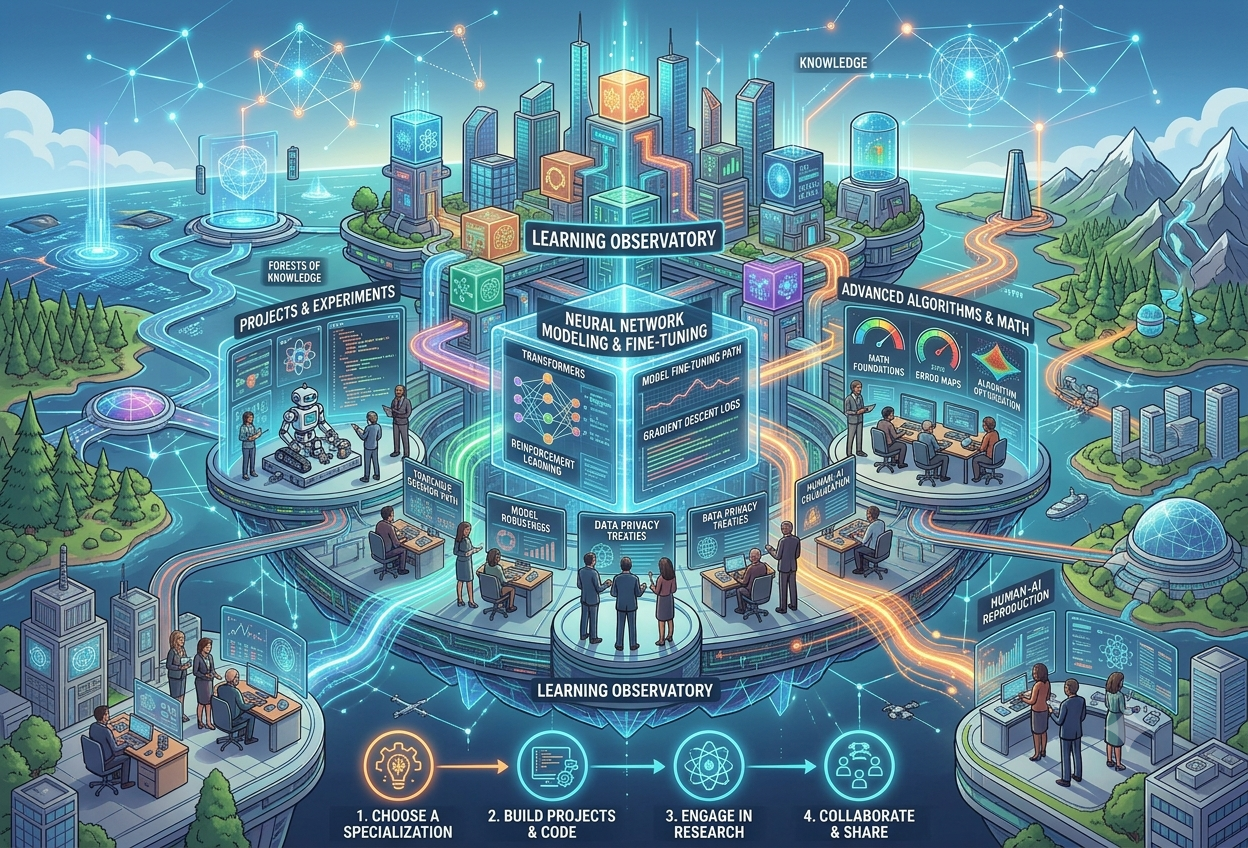
Your Next Steps as an AI Learner
Two Paths, One Decision
Imagine standing at a fork in the road. One path is a quick, well-lit trail that gets you somewhere genuinely useful within days. The other is a longer, steeper climb that takes months, but ends at a much higher viewpoint. Neither path is “better” — they just lead different places, and the right one for you depends entirely on where you actually want to end up.
“Knowing how to learn AI is quickly becoming a basic professional skill. What matters most isn’t your job title or years of experience — it’s whether you know how to use AI effectively.”— Adapted from AI education research summaries, 2026
Before opening a single course or signing up for anything, it helps to pause and honestly answer one question: do you want to use AI tools skillfully, or do you want to build AI systems yourself? Both are entirely legitimate goals, and both can meaningfully change how you work — but they call for very different learning plans, timelines, and levels of technical depth.
Think about the difference between learning to drive a car really well versus learning to be a car mechanic who can build an engine from scratch. Both are useful skills about the same machine, but a great driver doesn’t need to know how to rebuild a transmission, and a great mechanic doesn’t necessarily need to be the fastest driver. Learning AI works the same way — you can become excellent at using it without ever learning to build it, or you can go further and learn to build the engine itself.
Path A: The Power User
This path is for anyone who wants to multiply their output, automate repetitive work, and stay sharp in their current job or studies — without writing a single line of code. It relies on clear communication with existing AI tools rather than programming, and the results can show up within days of focused practice.
Path B: The Builder
This path is for anyone aiming to actually develop AI systems — training models, building applications powered by AI, or working as a specialist in the field. It requires learning programming, some mathematics, and a fair amount of patience, with realistic timelines measured in months rather than days. The reward is a much higher ceiling: genuine technical expertise that opens doors a purely tool-based skillset cannot.
No code required. Learn to direct existing AI tools skillfully. Useful results within days.
Requires code and math. Learn to build and train AI systems yourself. Useful results within months.
Plenty of learners start on Path A for quick wins, then move toward Path B once curiosity (or career goals) pull them deeper.
Why Learning AI Matters So Much Right Now
AI literacy has shifted, in just a few short years, from an interesting bonus skill to something much closer to a basic expectation — showing up in hiring decisions, performance reviews, and the everyday rhythm of countless jobs.
This shift is sometimes described as AI becoming “the great equalizer.” Unlike many skills, your ability to use AI effectively does not depend heavily on your job title, your degree, or how many years of experience you have. What matters far more is whether you understand how to communicate with these tools clearly and apply them thoughtfully — a skill genuinely available to a complete beginner willing to practice.
Three Reasons the Timing Matters
- The Skills Gap Is Widening: As AI tools improve rapidly, the gap between confident users and hesitant ones is becoming a genuine professional differentiator.
- The Technical Barrier Keeps Dropping: Many tools now respond to clear, structured everyday language, meaning meaningful results no longer require programming knowledge to get started.
- Career Paths Are Still Forming: Dedicated AI roles are new enough that motivated newcomers can still establish themselves as genuine experts, rather than competing against decades of entrenched specialists.
Hesitation has a real cost. Every month spent waiting for the “right time” to start learning is a month a curious peer might spend actually building skills and a portfolio. The good news is that the starting cost for beginning has never been lower — most of what follows in this guide costs nothing but time and consistency.
Becoming an AI Power User
Becoming genuinely fluent with AI tools does not require writing a single line of code. What it requires is real fluency: knowing which tools fit which tasks, how to direct them clearly, and how to weave them naturally into your daily work.
Start With the Major General-Purpose Tools
Most Power Users benefit from becoming comfortable with a small set of general-purpose AI assistants before branching into anything specialised. Different tools tend to have different relative strengths — some excel at structured, multi-step reasoning tasks, others at long-form writing and careful editing, and others at deep integration with everyday productivity software like documents and spreadsheets. Trying the same task across a few different tools is a quick way to discover which one’s particular strengths match your own typical work.
Beyond general-purpose assistants, a layer of specialist tools exists for more specific needs: tools focused on research with real-time, sourced information; tools designed to work directly with your own uploaded documents without inventing facts; and, for anyone with genuine privacy concerns, tools that can run an open-source AI model entirely on your own device rather than sending data anywhere else.
Imagine three excellent tutors at school, each especially good at something slightly different — one is brilliant at math problems, one is amazing at helping you write essays, and one is fantastic at organising your notes. You wouldn’t necessarily pick just one tutor forever; you’d learn which tutor to ask for which kind of help. AI tools work the same way.
Building AI-Native Habits
Tools alone do not create good results — habits do. A handful of simple practices separate people who use AI occasionally from people who have genuinely woven it into how they think and work:
- Save Your Reasoning, Not Just the Output: Keeping a record of an AI conversation alongside a finished piece of work preserves the thinking behind a decision, useful when revisiting a project later.
- Build a Personal Style Library: Collecting your own best AI-assisted outputs — emails, summaries, drafts that really landed — gives you ready-made examples to guide future requests toward a consistent tone.
- Ask “Could AI Draft This First?”: For almost any task that takes more than a few minutes, the honest answer is usually yes — and starting from an AI-generated first draft is almost always faster than starting from a blank page.
- Reduce Friction: The easier it is to open an AI tool the moment you think of a task, the more consistently you will actually use it.
A genuinely useful mental model for working with AI is the 80/20 rule: AI can reasonably handle roughly 80 percent of a first draft, while the remaining 20 percent — judgment, context, nuance, final polish — still depends on you. Expecting AI to do 100 percent of the work sets you up for disappointment; expecting it to meaningfully speed up 80 percent of the work sets you up for a genuinely useful partnership.
Mastering Prompt Design
“Prompt design” sounds technical, but the underlying skill is one you likely already have: the ability to give clear, specific instructions to someone who is capable but cannot read your mind.
A genuinely reliable framework that works across nearly every AI tool combines five simple ingredients: Role, Context, Task, Constraints, and Format. Telling an AI tool who to act as, what situation it’s operating in, exactly what to do, what limits to respect, and how to present the result transforms a vague request into something the AI can actually execute well.
“You are a senior marketing strategist [Role]. You’re launching a B2B product for HR teams [Context]. Write three subject line options for a cold outreach email [Task]. Keep each under 10 words [Constraint]. Return as a numbered list [Format].”— An illustrative example of the Role + Context + Task + Constraints + Format framework
Three Techniques That Noticeably Improve Results
- Separate Instructions From Data: When giving an AI tool both directions and raw material to work on — like a document to summarise — clearly marking which part is the instruction and which part is the content to process helps prevent the two from getting confused.
- Break Big Tasks Into a Chain: Rather than one enormous request, splitting complex work into a sequence — summarise, then analyse, then draft — generally produces cleaner results, since each step builds cleanly on a smaller, well-finished previous step.
- Show, Don’t Just Tell (Few-Shot Examples): Giving the AI two or three examples of the kind of output you want, before asking it to produce its own, is one of the fastest ways to noticeably improve quality — especially for anything where tone matters.
Imagine asking a friend to draw you a picture. “Draw something” gets a random result. “Draw a blue dog wearing a red hat, sitting in a garden, using only crayons” gets you something much closer to what you actually pictured in your head. Prompt design is simply learning to describe what you want clearly enough that the AI can actually deliver it — the same skill as giving any good instruction to anyone.
The encouraging news is that prompt design genuinely improves with deliberate practice, much like any other communication skill. Reviewing what worked and what didn’t after each attempt, rather than moving on immediately, builds intuition far faster than reading about prompting in the abstract.
Becoming an AI Builder — The Foundation Stack
If your goal is to actually build AI systems rather than simply use them, the path is more demanding — but it is also more learnable than most newcomers expect, and it does not require an advanced degree to begin.
Programming Is Non-Negotiable
Python has become the default language of the AI world, used across research, production systems, and nearly every major framework. Beginners typically need a solid two to three months of consistent, daily practice to comfortably handle variables, functions, loops, conditionals, common data structures, basic object-oriented programming, and simple error handling. This foundational stage is the one step that genuinely cannot be skipped — every later stage depends on it.
The Mathematics You Actually Need
Mathematics matters in AI, but the goal is not becoming a professional mathematician — it is understanding just enough to grasp why a model behaves the way it does. Three areas matter most:
How data gets represented and manipulated as vectors and matrices — the basic language AI models use to store and process information.
How models actually learn, through a process called gradient descent that gradually nudges a model toward better answers.
How to interpret a model’s outputs, evaluate its real performance, and understand the uncertainty behind any single prediction.
You don’t need to be a professional chef to understand that baking bread involves yeast reacting with sugar and warmth. A basic grasp of why something works is enough to use it well, troubleshoot it when it goes wrong, and have an informed conversation about it. The math behind AI works the same way — you need just enough to understand the “why,” not necessarily enough to invent a brand-new recipe from scratch.
Understanding the Modern AI Stack
Before writing any AI-specific code, it helps to understand how the field’s major concepts relate to each other, since they are often used loosely and interchangeably in casual conversation: Artificial Intelligence is the broadest umbrella term; Machine Learning is a major subset focused on learning patterns from data rather than being explicitly programmed; Deep Learning is a further subset using layered neural networks, responsible for many of today’s most impressive AI breakthroughs; and Generative AI — the large language models behind today’s most famous chatbots — sits at the most specific end of that chain, built using deep learning techniques.
A Month-by-Month Roadmap
Knowing what to learn is only half the challenge — knowing roughly when to learn it, and in what order, makes the difference between steady progress and overwhelmed paralysis. Here is one realistic, widely-referenced sequence for the Builder path.
Foundations: Python, Data, and AI Basics
Build core programming skills, learn to clean and manipulate data with common libraries, and practice structured prompt engineering alongside modern AI coding assistants from day one.
Applied AI: APIs and Retrieval Systems
Move beyond chat interfaces by connecting AI models directly into your own applications, and learn how systems can fetch and use external documents to ground their answers in real, current information.
Autonomous Agents and Orchestration
Build systems that can reason through multi-step tasks, use tools, and even coordinate multiple specialised AI agents working together on a larger goal.
Specialisation, Deployment, and Ethics
Learn to deploy and monitor AI systems reliably at scale, study how to evaluate AI safety before production use, and optionally specialise further in traditional machine learning, computer vision, or natural language processing.
Think about learning to cook. First you learn to safely use a knife and stove (the basics). Then you learn to follow recipes well (applying what you know). Then you learn to adapt a recipe and cook several dishes at once for a dinner party (more advanced coordination). Finally, you might specialise — becoming great at baking, or grilling, or a particular cuisine. Learning AI follows a remarkably similar progression.
This Plan Is a Compass, Not a Cage
Every published roadmap, including this one, is a generalised starting template rather than a fixed schedule. Your actual pace will depend heavily on your prior background, the number of hours you can realistically dedicate each week, and which parts of AI genuinely interest you most. The timeline matters less than the underlying sequence: foundations before applications, applications before advanced autonomy, and advanced autonomy before deep specialisation.
Tools & Frameworks Worth Knowing
The AI tooling landscape can look overwhelming from the outside, with new names appearing constantly. A smaller set of foundational tools, however, covers the large majority of what a learner actually needs to get genuinely productive.
| Tool / Library | What It’s For | Best For |
|---|---|---|
| pandas | Cleaning, transforming, and analysing tabular data | Almost any data-related task |
| NumPy | Fast numerical computation with arrays and matrices | Underlying math operations |
| Scikit-Learn | Classic machine learning algorithms made simple | Beginners’ first ML models |
| PyTorch | Building and training neural networks | Deep learning, research, production |
| Hugging Face | A hub of pre-trained, open-source AI models | Skipping training from scratch |
| LangChain | Chaining prompts, tools, and data sources together | Building LLM-powered applications |
Retrieval-Augmented Generation (RAG) — A Skill Worth Prioritising
One specific technique deserves special attention because of how widely useful it has become: connecting an AI model to an external knowledge source — your own documents, a company wiki, a specific dataset — so it answers questions grounded in that real information rather than relying purely on what it learned during training. This approach, often shortened to RAG, has become one of the most in-demand practical AI skills, precisely because it lets an AI system stay accurate and current about information it was never originally trained on.
Agents & Tool Use
Beyond simply answering questions, modern AI systems increasingly act as agents — capable of planning multi-step tasks, using external tools, and pursuing a broader goal rather than just responding to a single prompt. Learning to build even a simple agent, one that can search for information and summarise what it finds, teaches far more about how these systems actually work than reading about the concept ever could.
Think about the difference between a librarian who only knows what’s already in their own memory, and a librarian who can walk over to the shelves, pull out the exact right book, and read you the answer from it. RAG is what turns an AI from the first kind of librarian into the second kind — giving it permission to “go check the shelves” instead of just guessing from memory.
Don’t Try to Learn Everything at Once
New tools and frameworks emerge constantly, and trying to track every single one is a losing battle. A far more effective strategy is building strong, transferable foundations — solid Python, a clear understanding of how models actually work, comfort with APIs — so that picking up any specific new tool later becomes a quick, manageable task rather than starting over from scratch each time.
Self-Study vs. Formal Education
One of the first practical decisions any aspiring AI learner faces is whether to teach themselves using free or low-cost resources, or to pursue a structured, formal program. Both routes have produced genuinely successful AI professionals.
Benefits of Self-Study
- Costs little to nothing for many high-quality foundational resources
- Lets you move at your own pace, faster through familiar material
- Allows immediate, flexible pivoting toward whatever interests you most
- Builds genuine self-direction, a valuable trait employers actively value
- Can begin literally today, with no application or enrolment process
Benefits of Formal Education
- Provides structured sequencing, reducing the risk of skipping foundational gaps
- Offers mentorship and direct feedback from experienced instructors
- Comes with built-in accountability and a fixed schedule
- Often includes career services, networking, and recognised credentials
- Can be especially valuable for research-focused or highly technical specialisations
For most learners pursuing applied AI roles, demonstrated skill — a portfolio of real, working projects — tends to carry more practical weight with employers than credentials alone. That said, some research-oriented or highly specialised positions, particularly at large research labs, may still favour candidates with advanced formal degrees. The realistic answer for most people is a hybrid: free or low-cost structured courses for foundational sequencing, paired with genuinely self-directed projects to prove real, applied skill.
Neither path guarantees success on its own. A formal degree without any real projects to show for it can leave a graduate surprisingly underprepared for practical work. Pure self-study without any structure can leave a learner with scattered, incomplete knowledge. The strongest outcomes tend to combine some structure with a genuine commitment to building real things.
Common Mistakes to Avoid
A handful of predictable mistakes trip up new AI learners again and again, regardless of which path they choose. Knowing about them in advance is one of the cheapest ways to avoid wasting genuine time and effort.
Expecting AI to handle 100 percent of a task, with zero remaining judgment required from you, sets up an almost guaranteed disappointment. The realistic frame is roughly 80 percent done by AI, 20 percent finished by you.
ExpectationsWatching endless videos about AI is not the same as learning AI. Genuine skill comes from prompting, building, breaking things, and figuring out why — every hour of passive watching should be matched by an hour of active doing.
PracticePasting sensitive personal, client, or proprietary information into a public AI tool risks that data being used or exposed in ways you cannot fully control — always understand a tool’s data handling before sharing anything sensitive.
SafetyAI models reflect the data they were trained on, including its flaws and biases. Always review outputs for fairness and accuracy before acting on or sharing them — the responsibility for what gets published ultimately stays with you.
Responsibility“Skipping the uncomfortable work in favour of something that feels more productive is the single most common pattern that trips learners up — across nearly every learning community, every single time.”
— A common observation echoed across AI learning communitiesOne More Mistake: Jumping Between Unfinished Resources
A particularly sneaky trap is constantly switching between popular new tutorials and courses without ever fully finishing any single one. This creates a comforting illusion of progress — you always feel busy — without actually building the depth that comes from completing something end to end. Choosing one solid resource, finishing it completely, applying what you learned in a real project, and only then moving forward tends to produce far more durable, usable skill.
Building Your Portfolio
Knowledge that lives only in your head is genuinely hard for anyone else to verify. A portfolio of real, working projects turns invisible learning into something concrete that other people — employers, collaborators, even your future self — can actually see and evaluate.
Start a Public Record From Day One
Every project, however small, benefits from being stored in a properly documented public repository, complete with a clear written explanation of what the project does and why. This habit, formed early, compounds significantly over time: a learner who has consistently documented six months of small projects has a far more compelling story to tell than one who has simply completed several isolated courses with nothing to show for them.
Imagine two students who both spent a whole year learning to paint. One has a stack of finished paintings they can show you, each with a little note about what they were trying to do. The other has notes from art classes but no actual paintings to look at. Even if both students learned a similar amount, the first one has something far more convincing to show for it.
What Makes a Project Genuinely Convincing
- It Solves a Real Problem: A project addressing something genuinely useful — even something small and personal — is more compelling than a generic tutorial copy.
- It’s Properly Documented: A clear explanation of the goal, the approach, and any challenges encountered shows real understanding, not just code that happens to run.
- It’s Actually Finished: A handful of complete, working projects demonstrates more reliability than a long list of abandoned half-attempts.
- It Shows Genuine Iteration: Evidence of fixing mistakes, refining an approach, or responding to feedback often impresses more than a project that looks perfect from the very first attempt.
Where to Find Real Practice Material
Beyond self-directed projects, structured data science competitions provide genuine practice with real datasets, the chance to study how more experienced practitioners approach the same problem, and a natural way to benchmark your own progress against a community of fellow learners. Treating even modest, beginner-level competitions as genuine practice — rather than something to win outright — builds exactly the kind of practical experience that a portfolio needs.
Career Paths in AI
Once foundational skills are in place, AI opens into several genuinely distinct career paths, each with its own focus, day-to-day work, and required skill emphasis.
AI Engineer
Builds practical applications using existing AI models — chatbots, retrieval pipelines, and autonomous agents that solve real, immediate business problems. Sits at the intersection of software engineering and applied AI.
Data Scientist
Explores data and builds models that uncover insights or predict outcomes, often working closely with business stakeholders to translate findings into real decisions.
Machine Learning Engineer
Designs and deploys machine learning systems at scale, handling the technical architecture required to move a model from an experiment into a reliable, production-ready product.
Research Scientist
Conducts cutting-edge research to advance the underlying state of the art, often inventing or substantially improving the algorithms that everyone else eventually builds on.
Each of these paths rewards a slightly different skill emphasis — an AI Engineer leans heavily toward software engineering and integration, a Research Scientist leans heavily toward deep mathematical and theoretical understanding, while a Data Scientist and Machine Learning Engineer sit somewhere in between, depending on the specific organisation and role. None of these roles requires choosing a single fixed identity forever; many practitioners move between them as their interests and the field itself continue to evolve.
Because dedicated AI roles are relatively new, even hiring managers are still figuring out exactly what to expect from them. What remains stable, regardless of title, is the underlying foundation: solid programming, a genuine understanding of how models actually behave, and comfort working with the broader systems that surround any individual model.
Your Next Steps — The Road Ahead
Across this entire series of guides, you have already built a genuinely strong conceptual foundation — what AI is, how it should be judged for fairness and explainability, how it should be kept safe and aligned, how privacy and environmental costs factor in, and how the world is trying to govern it. This final guide closes the loop: turning that conceptual understanding into a practical learning plan you can actually act on.
Reasons for Optimism
AI tools increasingly respond to plain, well-structured language, meaning meaningful results no longer require a programming background to begin.
AccessibilityHigh-quality, free, university-grade material is genuinely available for both the Power User and Builder paths, removing cost as a real barrier for most learners.
ResourcesDedicated AI career paths remain new enough that a motivated newcomer can still establish real expertise, rather than competing against decades of entrenched specialists.
OpportunityHaving worked through the ethics, safety, privacy, environmental, and policy dimensions of AI already, you are starting your technical learning with a depth of responsible-AI context many learners lack.
Head StartRemaining Challenges
- The Field Moves Quickly: New tools and techniques emerge constantly, requiring genuine ongoing learning rather than a single finite curriculum.
- Motivation Without External Structure: Self-directed learners must build their own accountability, a genuine challenge without the natural deadlines of formal education.
- Avoiding Tutorial Hell: The temptation to consume content passively rather than build actively remains a constant, ongoing discipline, not a problem solved once and forgotten.
- Choosing Depth Over Breadth: With so much to learn, resisting the urge to chase every new tool in favour of finishing what you start matters more than covering everything.
The best time to start learning AI was years ago. The second-best time is today. Pick one small, real project — not another course, but something you genuinely want built — and start it before this week is out. The hesitation you might feel right now disappears almost entirely the moment you produce your very first useful result.
Comprehensive expert guide covering prerequisite skills, programming tools, and a detailed month-by-month learning roadmap.
Academic perspective introducing the Power User vs. Builder framework, prompt design techniques, and common learner mistakes.
Accelerated learning perspective focused on rapid foundational AI literacy for time-constrained learners.
Structured course-provider guide outlining foundational AI topics and recommended learning sequences.
Practical self-study guide covering free resources, study strategies, and avoiding common self-learning pitfalls.
Beginner-oriented overview of foundational AI concepts and accessible entry points for new learners.
Step-by-step structured guide to building AI competency, including certification and credentialing considerations.