Transformer Architecture
in AI
A super-smart reading assistant that can look at every word in an entire book all at the same time, instantly understand how each word relates to every other word, and write a perfect summary in any language — all in under a second. That is what a Transformer does with data, and it is the architectural idea that changed artificial intelligence forever.
Picture a super-smart reading assistant that can look at every word in an entire book all at the same time, instantly understand how each word relates to every other word, and then write you a perfect summary in any language you choose — all in under a second. That is essentially what a Transformer does with data. It is the architectural idea that changed artificial intelligence forever.
A Transformer is a deep learning architecture that processes sequences of data — words, pixels, sound samples, or protein sequences — by learning how every element in that sequence relates to every other element simultaneously, using a mechanism called self-attention.— Core Concept · Deep Learning Architecture
The Transformer was introduced in a 2017 paper titled “Attention Is All You Need” by researchers at Google Brain. The name was bold and the claim was true: an architecture built entirely around “attention” — with no recurrence, no convolution — could outperform all previous approaches to language translation. Within a few years, this architecture would become the foundation of nearly every major AI system in the world.
Before Transformers, dominant AI models for language were recurrent neural networks (RNNs) that processed text word-by-word, one at a time — like reading a book while covering everything except the current sentence. Transformers threw this constraint away entirely. They look at every token in a sequence all at once, enabling massively parallel computation and far richer understanding of long-range relationships in data.
Imagine you have a jigsaw puzzle of 500 pieces. An old-fashioned AI would look at piece #1, then piece #2, then piece #3 — one at a time, forever. A Transformer AI looks at ALL 500 pieces simultaneously and instantly figures out which pieces connect with which others. That is why it is so much faster and smarter at understanding things!
Why Transformers Changed Everything
The Transformer’s impact is difficult to overstate. In the eight years since its introduction it has become the single most important structural idea in all of artificial intelligence. Every major language model — GPT-4, Claude, Gemini, LLaMA, Mistral — is built on a Transformer foundation. So are leading image models, protein structure predictors, music generators, and code assistants.
- Parallelism. Unlike RNNs which must process tokens sequentially, Transformers compute all positions simultaneously, enabling orders-of-magnitude faster training on GPU/TPU hardware.
- Long-range understanding. Self-attention can connect a word in sentence 1 to a relevant word in sentence 100 without degradation — something RNNs fundamentally struggled with.
- Scale. Transformer performance improves predictably as you add more parameters, more data, and more compute — the “scaling law” that has driven the LLM revolution.
- Transferability. A Transformer pre-trained on vast unlabelled data can be fine-tuned on small specialised datasets to perform dozens of different tasks excellently.
- Universality. The same architecture works for text, images, audio, video, code, molecules — making it the first truly universal deep learning backbone.
To truly appreciate what Transformers achieved, we need to understand the painful limitations of what came before them. The story is one of brilliant but fundamentally constrained ideas that hit a wall — until someone found a completely different road.
Recurrent Neural Networks (RNNs)
An RNN processes a sequence like someone reading a novel page by page, holding a running “memory” of what they have read so far. At each step it reads the next word and updates its internal state before passing it to the next step. For short sentences this worked reasonably well. For long paragraphs the memory would degrade — important information from 50 words ago would gradually fade, like trying to remember the beginning of this paragraph while reading its end.
Long Short-Term Memory (LSTMs)
LSTMs were designed to address the memory problem of RNNs. They added special “gates” — mathematical controls — that allowed the network to selectively remember or forget information over long sequences. LSTMs powered early voice assistants, translation tools, and text predictors. But they still processed tokens one at a time (no parallelism), were notoriously difficult to train, and still degraded on very long sequences.
RNN Problem: Sequential Processing
Every word must wait for the previous word to be processed. Training on 10,000 words takes 10,000 sequential steps — painfully slow. Modern GPUs, which excel at parallel work, are mostly idle during RNN training.
RNN Problem: Vanishing Memory
By the time the network reaches word 50, its “memory” of word 1 has been overwritten dozens of times. Early context is effectively forgotten. Understanding long documents or conversations was almost impossible.
LSTM Improvement: Gated Memory
LSTM gates (input, forget, output) let the network explicitly decide what to keep in memory and what to discard. This improved long-range recall significantly — but the sequential bottleneck remained.
Transformer Solution: Attention
By making every position directly accessible to every other position simultaneously, self-attention eliminated both the sequential bottleneck and memory degradation in a single elegant stroke.
The authors of “Attention Is All You Need” realised that previous models were using attention as a supplement to recurrence — a small add-on. They asked: what if we threw away recurrence entirely and made attention the entire mechanism? The answer turned out to be transformative, in every sense of the word.
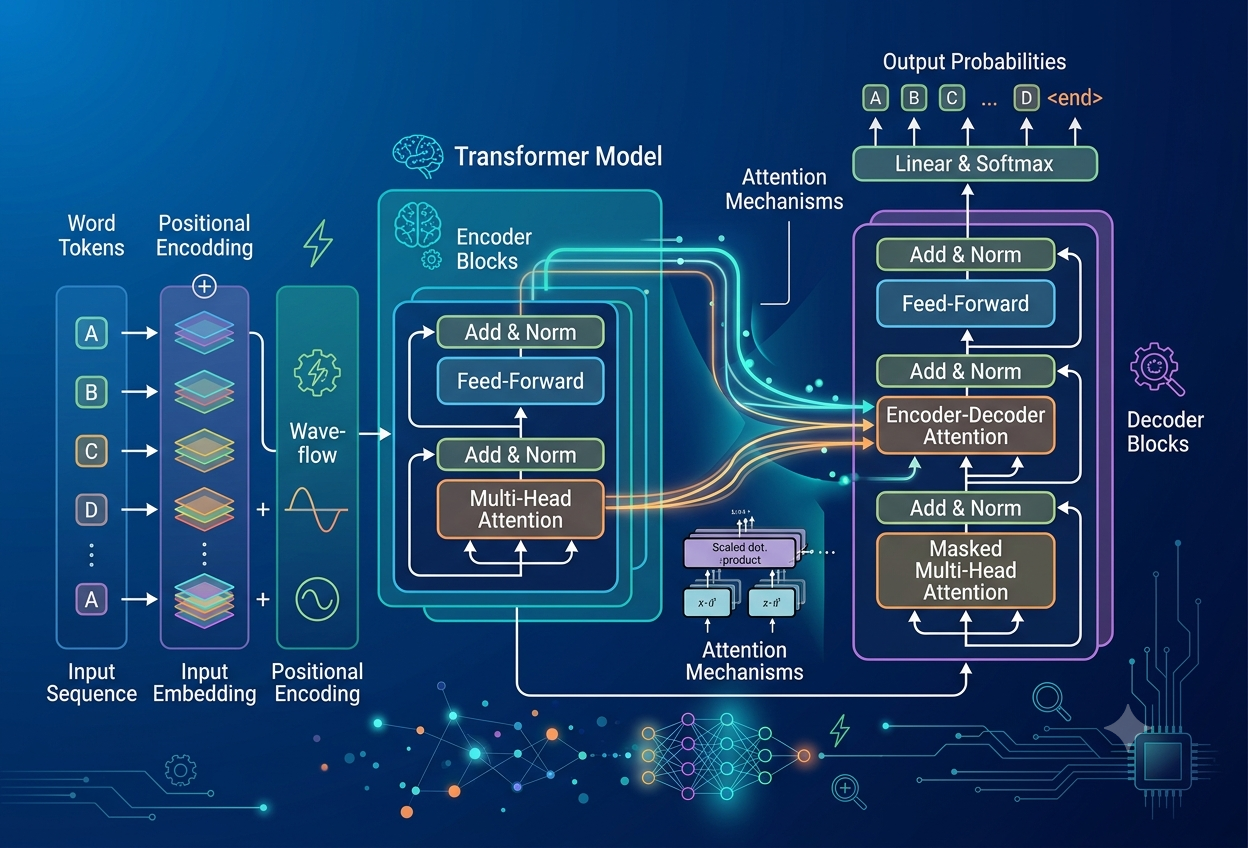
The original Transformer has an elegant structure: an Encoder stack that reads and understands the input, and a Decoder stack that generates the output. Think of the Encoder as a brilliant reader and the Decoder as a gifted writer who has just been handed the reader’s detailed notes.
FIG 01 — The original Transformer encoder-decoder architecture. The encoder (red) reads all input tokens simultaneously. The decoder (blue) generates output tokens autoregressively, consulting the encoder’s output at every step via cross-attention.
Neural networks cannot understand words — they only understand numbers. So the first thing a Transformer does is convert every piece of text into a structured sequence of numbers. This two-step process of tokenisation followed by embedding is the front door through which all language enters the AI.
Step 1 — Tokenisation
A token is the basic unit of text the Transformer works with. Tokens are often parts of words — chosen to balance vocabulary size against coverage of rare words. The most common approach is Byte Pair Encoding (BPE), which learns which character sequences appear most frequently and merges them into single tokens. For example, the sentence “The transformer is amazing!” might become: ["The", " transform", "er", " is", " amaz", "ing", "!"]. Each token maps to an integer ID from the vocabulary. GPT-4 uses about 100,000 tokens; original BERT used 30,000.
Imagine a special stamp album with 50,000 stamps. Each stamp represents a word-piece like “play” or “ing” or “un”. When you want to write a message, you pick stamps and arrange them in order. The AI only ever works with the stamp numbers (IDs), not the words themselves — numbers are what computers love!
Step 2 — Embeddings
Once tokenised, each integer ID is converted into a vector — a list of floating-point numbers — using a learned embedding matrix. If the embedding dimension is 768 (as in BERT-Base), each token becomes a list of 768 numbers. These numbers are learned during training. After training, similar words end up with similar vectors. The word “king” minus “man” plus “woman” produces a vector very close to “queen” — a famous demonstration of the geometry of learned embeddings.
FIG 02 — Tokenisation converts text to integer IDs; embedding looks up each ID in a learned table to produce a dense vector. Positional encoding is added element-wise before the first Transformer layer.
Self-attention is brilliant at connecting tokens — but it has a blind spot. Because it processes all tokens simultaneously, it has no built-in sense of order. “Dog bites man” and “Man bites dog” would look identical to a pure attention mechanism. Positional encoding solves this by injecting each token’s position directly into its vector.
The original Transformer used a fixed formula based on sine and cosine waves to generate a unique “position fingerprint” for each slot in the sequence:
pos = position index (0,1,2,…) · i = dimension index · d_model = 512
Original approach. Fixed mathematical formula — no learning required. Can generalise to sequences longer than seen during training. Used in original BERT and T5.
Each position gets a trainable vector embedding, learned from data just like token embeddings. GPT-2 and many later models use this. Simpler but limited to the max sequence length seen during training.
Rotary Position Embeddings (RoPE, used in LLaMA/Mistral) and ALiBi inject relative positions into attention scores rather than embeddings — enabling far better generalisation to very long contexts.
Self-attention is the single most important idea in the Transformer. It allows every word in a sentence to simultaneously look at every other word, figure out how relevant each one is, and update its own representation accordingly. It is both mathematically elegant and intuitively powerful.
The Query, Key, Value Framework
Imagine you are in a library. You walk in with a query — a question: “I want books about space travel.” Each book has a key (its catalogue entry). You compare your query against every key to find relevant books, then retrieve the actual content — the values — weighted by relevance. Self-attention works exactly this way for tokens: every token simultaneously acts as a query, a key, and a value.
K = X · W_K (What do I have to offer?)
V = X · W_V (What information do I contain?)
SCALED DOT-PRODUCT ATTENTION Attention(Q,K,V) = softmax( Q·Kᵀ / √d_k ) · V
Q·Kᵀ = how well each query matches each key (n×n attention scores)
/√d_k = scale to avoid vanishing softmax gradients
softmax = convert raw scores to probabilities summing to 1.0
· V = weighted sum of value vectors by those attention probabilities
FIG 03 — Self-attention in action. When processing “bank,” the model assigns the highest score to itself (0.57) and a significant score to “deposits” (0.19), correctly learning this is a financial context.
Multi-Head Attention — Many Perspectives at Once
Running self-attention once gives one perspective on relationships between tokens. But language has simultaneous dimensions: syntax, semantics, co-reference, and more. Multi-head attention runs self-attention in parallel multiple times, each with different learned weight matrices, allowing each “head” to specialise in a different type of relationship.
head_i = Attention(XW_Qi, XW_Ki, XW_Vi)
h = number of heads (8 in base models, 96 in GPT-3)
Each head uses independent W_Qi, W_Ki, W_Vi projection matrices
All heads run in PARALLEL, then concatenated and projected by W_O
Imagine eight judges watching the same dance. Judge 1 focuses on footwork. Judge 2 on arm movements. Judge 3 on timing. Judge 4 on facial expression. All scores are combined at the end. Multi-head attention does the same — each “head” focuses on a different type of relationship between words, and all perspectives are merged for a richer overall understanding.
After self-attention mixes information between positions, each token’s representation passes through its own private two-layer neural network — a feed-forward transformation applied independently to every position in the sequence. While attention is about connecting tokens to each other, the FFN is about processing each token’s combined context within itself.
W₁: d_model(512) → d_ff(2048) ← 4× expansion
ReLU (max(0,·)) introduces non-linearity
W₂: d_ff(2048) → d_model(512) ← back to residual stream
Modern LLMs use GELU or SwiGLU instead of ReLU
Research in mechanistic interpretability has found that FFN layers behave like key-value memory stores. Different neurons activate for different conceptual patterns: one might fire for “things made of metal,” another for “words that follow ‘the President of,'” another for “code that defines a function.” This is thought to be how Transformers store factual knowledge learned during pre-training.
Deep networks are notoriously unstable during training — values can explode or vanish as they propagate through dozens of layers. Two mechanisms work together to keep Transformers stable even when scaled to hundreds of layers: residual connections and layer normalisation.
Instead of passing a sublayer’s output directly forward, the input is added back: output = sublayer(x) + x. This creates a gradient “highway” for backpropagation, eliminating vanishing gradients in deep stacks. Inspired by ResNets in computer vision.
After each sublayer (and residual), activations at every position are normalised to mean 0 and variance 1, then rescaled by learned parameters γ and β. This keeps values in a stable range throughout the network’s depth, dramatically improving training speed and convergence.
The original paper applied LayerNorm after the residual (Post-LN). Most modern large models (GPT-2 onward) apply it before the sublayer (Pre-LN). Pre-LN is more stable during training and has become the standard practice.
Each sub-layer (attention or FFN) in a modern Transformer uses: output = x + sublayer(LayerNorm(x)). The input flows through unchanged (the residual stream), while a transformed version is added on top. This combination is what makes it possible to stack 96, 120, or even 200+ identical layers without training instability.
The encoder is the “reading and understanding” half of the original Transformer. It takes position-encoded token embeddings and produces a rich contextual representation of each — capturing not just what each token is, but how it relates to everything else in the sequence.
FIG 04 — One complete encoder layer. Multi-head self-attention is followed by Add & Norm, then the FFN, then another Add & Norm. This structure repeats N times (6 in the original, 12 in BERT-Base, 24 in BERT-Large, 96 in GPT-3).
Encoder-only models like BERT use full bidirectional attention — each token can attend to tokens both before and after it, seeing the full sequence context simultaneously. This makes them ideal for tasks requiring deep understanding of existing text: classification, question answering, named entity recognition, and semantic search.
The decoder is the “writing” half of the Transformer. It generates output tokens one at a time, each time consulting both what it has already generated and the encoder’s understanding of the input. It has three sub-layers per layer instead of two — adding a cross-attention bridge that connects encoder and decoder.
Like the encoder’s self-attention, but tokens can only attend to previous tokens, not future ones. A triangular mask prevents “cheating” by looking at the answer while generating it. This autoregressive property ensures only already-generated tokens influence what comes next.
The bridge between encoder and decoder. The decoder generates Queries from its own current state, but uses the encoder’s full output as both Keys and Values. This lets each decoder position dynamically focus on whichever parts of the input are most relevant for generating the current output token.
Identical in structure to the encoder’s FFN — a two-layer expand-then-contract network applied position-wise after cross-attention has combined the encoder context with the decoder’s current state. Each of these three sub-layers is wrapped with Add & Norm.
Imagine writing a translation with your eyes closed. You start with a blank page and write one word. Then you look at your notes (the encoder’s output) to decide the next word. You write that, consult again, and so on. But you can never look ahead at what you have not yet written — that would be cheating! One word at a time, consulting notes each time — that is exactly how the decoder works.
Decoder-Only Models — GPT, LLaMA, Claude
Modern language models use a decoder-only architecture — they remove the encoder entirely and use only masked self-attention layers. During pre-training they learn to predict the next token given all previous tokens. The encoder-decoder structure is retained mainly for sequence-to-sequence tasks like translation, where input and output are clearly separate sequences. For open-ended generation, the decoder-only approach is simpler, scales better, and has become the dominant paradigm for all frontier LLMs.
For those who want to see how all the pieces fit together mathematically, here is a complete summary of the core Transformer equations — from input embedding to output token probability.
2 — SCALED DOT-PRODUCT ATTENTION (SINGLE HEAD) Q = XW_Q, K = XW_K, V = XW_V
Attention(Q,K,V) = softmax(QKᵀ/√d_k) · V
3 — MULTI-HEAD ATTENTION head_i = Attention(XW_Qi, XW_Ki, XW_Vi)
MultiHead = Concat(head₁,…,head_h) · W_O
4 — ENCODER LAYER (REPEATED ×N) A = LayerNorm(X + MultiHeadAttn(X))
H = LayerNorm(A + FFN(A))
5 — FEED-FORWARD NETWORK FFN(x) = max(0, xW₁ + b₁) · W₂ + b₂
6 — OUTPUT (DECODER FINAL PROJECTION) P(next_token) = softmax(H_final · W_vocab) ← probability over full vocabulary
| Symbol | What It Is | Typical Value (BERT-Base) |
|---|---|---|
| d_model | Embedding / hidden dimension throughout the network | 768 |
| d_ff | Inner dimension of the feed-forward network | 3,072 (4× d_model) |
| h | Number of attention heads | 12 |
| d_k = d_v | Dimension per attention head (d_model / h) | 64 |
| N | Number of stacked encoder (or decoder) layers | 12 (Base), 24 (Large) |
| V | Vocabulary size (number of possible tokens) | 30,000 (BERT), ~100,000 (GPT-4) |
| √d_k | Scaling factor preventing vanishing softmax gradients | 8 (= √64) |
The original Transformer spawned an entire family of architectural variants, each optimised for different tasks, modalities, and efficiency requirements. Understanding this family tree explains why different AI tools exist for different purposes.
Examples: BERT, RoBERTa, DeBERTa, ELECTRA. Best for: Classification, NER, semantic search. Full bidirectional attention — each token sees all others. Cannot generate text natively.
Examples: GPT-4, Claude, LLaMA, Gemini, Mistral. Best for: Text generation, code, chat, reasoning. Causal (masked) self-attention. Dominant paradigm for frontier LLMs today.
Examples: T5, BART, mT5, Flan-T5. Best for: Translation, summarisation, document Q&A. Full encoder understanding + autoregressive decoder generation.
| Model | Year | Type | Params | Key Innovation |
|---|---|---|---|---|
| Original Transformer | 2017 | Encoder-Decoder | 65M | Self-attention replaces recurrence entirely |
| BERT | 2018 | Encoder-only | 110M–340M | Bidirectional masked language modelling (MLM) |
| GPT-2 | 2019 | Decoder-only | 1.5B | Large-scale causal language modelling at scale |
| T5 | 2019 | Encoder-Decoder | 11B | “Text-to-text” framework unifying all NLP tasks |
| GPT-3 | 2020 | Decoder-only | 175B | Dramatic few-shot learning from sheer scale |
| ViT | 2020 | Encoder-only | 86M–632M | Transformers applied to image patches |
| ChatGPT / GPT-4 | 2022–23 | Decoder-only | ~1T (est.) | RLHF alignment for conversational AI |
| LLaMA 3 / Mistral | 2024 | Decoder-only | 8B–405B | Open-source efficiency with RoPE + GQA |
| Gemini Ultra | 2024 | Multimodal | ~1T+ (est.) | Native multimodal: text + image + video + audio |
Transformers Beyond Language
Vision Transformers (ViT)
Images are split into fixed-size patches (e.g. 16×16 pixels), each treated like a token. ViT applies standard self-attention across patches, achieving state-of-the-art image classification by learning which patches relate contextually to which others — exactly like words in a sentence.
Audio & Music
Audio spectrograms or raw waveform segments are treated as tokens. Whisper (speech recognition) and MusicLM both use Transformer architectures, leveraging the same self-attention logic across time steps of sound to convert audio to text or generate music from text prompts.
Protein & Biology
Amino acid sequences are treated like sentences. AlphaFold 2 uses Transformer-based architectures to predict 3D protein structures — a 50-year scientific grand challenge solved in 2021. ESMFold (Meta) uses a language-model Transformer trained purely on protein sequences.
Code Generation
Programming languages are token sequences just like natural language. GitHub Copilot, CodeLlama, and DeepSeek Coder are Transformer-based models trained on trillions of code tokens, able to complete, explain, translate, and debug code across dozens of programming languages.
The Transformer architecture has spread so rapidly and completely that listing its applications is essentially the same as listing what modern AI can do. It has become the universal computational substrate of the AI revolution.
Conversational AI & Assistants
ChatGPT, Claude, Gemini, Copilot — every major AI assistant is built on a decoder-only Transformer. The billions of parameters encode conversational knowledge, reasoning ability, and instruction-following behaviour learned from vast text corpora and refined through human feedback. Transformers enable the nuanced, context-aware multi-turn conversations these systems are known for.
Language Translation
The original use case. Google Translate’s Neural Machine Translation, DeepL, and Microsoft Translator all use Transformer-based models. Modern neural translation handles idiomatic expressions, cultural nuance, and grammatical variation far more accurately than any previous approach, serving over one billion translation requests per day globally.
Medical & Scientific AI
Clinical AI systems built on Transformers can read and summarise electronic health records, suggest differential diagnoses from symptoms, predict drug-drug interactions, and assist radiologists with image analysis. In genomics, Transformers model DNA sequences to predict gene expression and the effects of mutations.
Search & Information Retrieval
Google’s search ranking has used BERT since 2019 — the largest change to its algorithm in years. Bing, Google, and Amazon Alexa all use Transformer-based models to understand the semantic meaning of queries rather than just keyword matching. RAG (Retrieval-Augmented Generation) combines Transformers for both embedding and generation.
Creative & Generative AI
DALL-E 3, Stable Diffusion, Midjourney, Sora — image, video, and audio generation models all incorporate Transformer components. Sora (OpenAI) uses a “Diffusion Transformer” (DiT) that processes patches of video frames with self-attention to generate coherent long-form video from text descriptions.
Legal, Finance & Enterprise AI
Law firms use Transformer-based models to review contracts, identify relevant case law, and draft legal summaries. Investment banks use them for earnings call analysis, regulatory document parsing, and automated report generation. Every major enterprise AI product launched since 2020 has a Transformer at its core.
✓ STRENGTHS
- Parallelism. Unlike RNNs, all tokens are processed simultaneously during training, enabling efficient use of modern multi-GPU hardware and dramatically faster training at scale.
- Long-range dependencies. Self-attention directly connects any two positions in a sequence regardless of distance — a fundamental capability that recurrent models fundamentally struggled with.
- Scalability. Transformer performance scales predictably with model size, data volume, and compute — the “scaling law” that has driven a decade of AI progress.
- Transfer learning. A pre-trained Transformer can be fine-tuned for dozens of downstream tasks with remarkably small amounts of task-specific data.
- Universality. The same architecture works for text, images, audio, video, proteins, molecules — the most versatile deep learning backbone ever created.
- Interpretability tools. Attention weights provide a partial window into what the model is “looking at,” and activation analysis techniques are advancing rapidly.
✗ LIMITATIONS
- Quadratic attention complexity. Standard attention requires O(n²) memory and compute with respect to sequence length n. Doubling the context length quadruples the cost.
- Enormous resource requirements. Training frontier Transformer models costs tens to hundreds of millions of dollars in GPU compute and enormous amounts of energy.
- Context window limits. Despite improvements, there is still a practical upper limit to how much text a Transformer can process at once. Very long documents require chunking.
- Hallucinations. Decoder-only Transformers generate text with no built-in fact-checking — they confidently produce fluent text that can be factually wrong.
- Black box nature. Despite attention visualisation, understanding exactly why a Transformer produces a specific output remains a major research challenge.
- No inherent reasoning structure. Transformers learn statistical patterns but lack an explicit reasoning engine — a limitation techniques like chain-of-thought prompting attempt to address.
The Transformer’s rise from a 2017 machine translation paper to the foundation of all modern AI happened with breathtaking speed. Understanding the key milestones helps situate just how rapidly this technology has evolved.
Attention Mechanism Introduced (Bahdanau et al.)
Dzmitry Bahdanau and colleagues introduced the attention mechanism as an add-on to RNN-based encoder-decoder translation models. Instead of compressing the entire input into a single vector, the decoder could dynamically focus on different parts of the input at each step. Performance improved dramatically — and the seed of Transformer attention was planted.
“Attention Is All You Need” — The Transformer Is Born
Vaswani, Shazeer, Parmar, Uszkoreit, Jones, Gomez, Kaiser, and Polosukhin at Google Brain published the landmark paper. On the WMT English-to-German translation benchmark it achieved a BLEU score of 28.4 — a new record — while training far faster than all previous RNN-based models. A new era in AI began with eight authors and eight pages.
BERT — Bidirectional Transformers for NLP
Google’s BERT showed that pre-training a large Transformer on unlabelled text using masked language modelling, then fine-tuning on small labelled datasets, could achieve state-of-the-art results on 11 NLP benchmarks simultaneously. The era of transfer learning in NLP had arrived. BERT was integrated into Google Search in 2019 — the largest algorithmic change in years.
GPT-2 and T5 — Scale and Generality
OpenAI’s GPT-2 (1.5 billion parameters) produced shockingly coherent long-form text, prompting OpenAI to delay its release for fear of misuse — the first AI system to generate significant public concern about language generation. Google’s T5 simultaneously unified all NLP tasks into a single “text-to-text” framework, demonstrating the Transformer’s universality.
GPT-3 and ViT — Scale and Modality Expansion
GPT-3’s 175 billion parameters demonstrated dramatic few-shot learning — performing tasks from just a few examples with no fine-tuning. In the same year, Google’s Vision Transformer (ViT) proved the Transformer architecture could match or exceed CNNs for image recognition, beginning the architecture’s expansion far beyond language.
ChatGPT — Transformers Reach Mainstream Society
OpenAI’s ChatGPT (GPT-3.5 fine-tuned with Reinforcement Learning from Human Feedback) reached one million users in five days and 100 million in two months — the fastest consumer technology adoption in history. Transformers moved from a specialist research topic to a household concept almost overnight, fundamentally changing public understanding of AI.
Multimodal, Reasoning & Trillion-Parameter Era
GPT-4, Claude 3, and Gemini Ultra demonstrated genuine multimodal reasoning across text, images, audio, and video. Open-source Transformers (LLaMA 3, Mistral, Qwen) reached near-frontier capability. Efficiency innovations — Flash Attention, Grouped Query Attention, Mixture-of-Experts — made trillion-parameter models practically deployable at scale.
The Transformer’s dominance is extraordinary — but the architecture has real limitations, and a rapidly growing body of research is working to overcome them, extend them, or in some cases replace them with something even more powerful.
Flash Attention & Linear Attention
Flash Attention reorders computations to minimise memory movement between GPU SRAM and HBM, achieving 2–4× speedups with the same output. Linear attention variants aim to reduce the O(n²) attention cost to O(n), enabling extremely long contexts at practical cost.
Mixture of Experts (MoE)
Instead of activating all parameters for every token, MoE models route each token to a small subset of “expert” sub-networks. GPT-4 and Mixtral use this approach to achieve very large effective parameter counts while activating only a fraction per forward pass — dramatically improving efficiency.
State Space Models (Mamba)
Mamba and other SSM architectures combine the long-range modelling of Transformers with the linear time complexity of RNNs, offering a potentially more efficient alternative for very long sequences. Hybrid Mamba-Transformer models are actively being explored at every major lab.
Reasoning & World Models
Chain-of-thought prompting, scratchpad reasoning, and process supervision are extending Transformers to multi-step reasoning. OpenAI o3, DeepSeek-R1, and Anthropic’s extended thinking modes push Transformers toward deliberative reasoning beyond simple next-token prediction.
Embodied & Agentic AI
Transformer-based models are being deployed as the “brains” of robots (RT-2, PaLM-E), autonomous web agents, and multi-agent systems. Tool use, API integration, and persistent memory are extending Transformers far beyond their original role as sequence processors.
Multimodal Native
Future models are being designed to natively process and generate any combination of text, images, video, audio, and structured data within a single unified Transformer — not as bolted-together systems but as jointly-trained multimodal reasoners from the ground up.
The Transformer is the single most consequential architectural idea in the history of artificial intelligence. By replacing recurrent processing with self-attention — allowing every element of a sequence to simultaneously relate to every other — it unlocked parallelism, long-range understanding, and remarkable scalability all at once. The encoder reads; the decoder writes; self-attention connects everything to everything. Stacked in dozens or hundreds of layers with billions of learned parameters, this repeating structure has learned to translate languages, write code, predict protein structures, generate art, and hold expert-level conversations. Understanding the Transformer is understanding the engine of the current AI age.
Transformers use self-attention to process all tokens simultaneously, connecting every token to every other. They consist of an encoder (contextual representations) and/or decoder (autoregressive generation). Core building blocks: tokenisation & embeddings (text to vectors), positional encoding (sequence order), multi-head self-attention (parallel relationship learning), feed-forward networks (per-position transformation), and residual connections + layer norm (training stability). First published in 2017, Transformers now power every major language model, most image generation systems, leading protein structure prediction, and virtually every frontier AI system in existence.
Detailed technical breakdown of encoder-decoder structure, multi-head self-attention, positional encoding, and mathematical formulations of each component.
Step-by-step exploration including self-attention mechanics, model variants (BERT, GPT), and practical implementation insights for data scientists.
Encyclopaedic reference covering the complete history, mathematical formulation, architectural variants, and academic reception of the Transformer from 2017 to present.
Enterprise-focused explainer on Transformer architecture, its business applications, and how it fits into the broader landscape of deep learning and enterprise AI.
Production-engineering perspective on Transformer architecture in LLMs, covering deployment considerations, efficiency improvements, and enterprise ML platform use.
Hardware-informed explainer covering how Transformer computations map to GPU parallelism and why the architecture revolutionised AI training efficiency.
Business analytics perspective explaining how Transformer architecture powers ChatGPT and why it matters for data-driven organisations and enterprise AI adoption.
Plain-language explainer on Transformer architecture fundamentals and its paradigm-shifting effect on artificial intelligence research and development.
Practitioner-focused guide connecting Transformer architecture to the rise of generative AI, covering how different model families use the architecture differently.
Academic-rigour textbook treatment with mathematical proofs, PyTorch code implementations, and illustrated explanations of every Transformer component.
Comprehensive educational walkthrough of Transformer components with visual diagrams and worked examples, targeting students and practitioners new to deep learning.
Cloud-infrastructure perspective on Transformer models, covering what they are, how they are trained, and how organisations deploy them in production AI workloads.